Box Dimensions Explained: How to Measure Length, Width, and Height

Quick Answer: What Do Box Dimensions Mean?
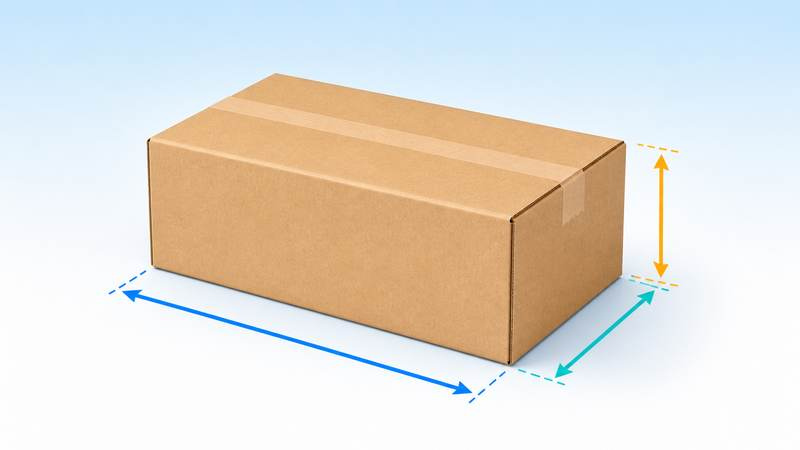
Box dimensions are usually written as Length × Width × Height, or L × W × H. Length and width describe the two sides of the base or opening. Height is the perpendicular distance from the base to the top; in some packaging specifications, it may also be called depth.
Correct measurements affect product fit, cushioning, storage, packaging quotations, pallet planning, and shipping charges. Before ordering a custom box, confirm the unit, orientation, and whether the supplier needs internal or external dimensions.
Key takeaways:
- Use L × W × H as the starting convention, but follow the supplier’s labeled diagram.
- Use internal dimensions for product fit and custom packaging development.
- Use external dimensions for carriers, warehouses, and pallet planning.
- Measure the assembled, closed package unless the instructions say otherwise.
- Include clearance, cushioning, inserts, board thickness, and closure space in the final specification.
Box Dimensions: What Length × Width × Height Means
What Is the Standard Box Dimension Order?
The common order is length first, width second, and height third. A box listed as 12 × 8 × 6 inches is therefore normally understood as 12 inches long, 8 inches wide, and 6 inches high.
This is a common convention, not a universal rule. Retail listings, packaging suppliers, furniture specifications, and carriers may label the same sides differently. When fit, printing orientation, or freight cost matters, use the supplier’s diagram rather than guessing from the number order.

Which Side Is Length, Width, or Height?
For a regular rectangular box, length is generally the longer edge of the base or opening, and width is the shorter adjacent edge. Height runs from the base to the top. A tall box may have height as its largest number, while a square box may have identical length and width.
| Term | Practical definition | Common use |
|---|---|---|
| Length | Longer base edge or labeled primary dimension | Fit and carton specifications |
| Width | Shorter adjacent base edge | Fit, stacking, and pallet planning |
| Height | Base-to-top measurement | Product clearance and storage |
| Depth | Often another name for height | Confirm with the supplier’s diagram |
What Do L × W × H, LxWxH, and L × W Mean?
L × W × H and LxWxH normally express the same three-dimensional measurement. The multiplication sign and the letter “x” are formatting variations. For example:
12 × 8 × 6 = 576 cubic inches
L × W describes only two dimensions. It may be enough for a flat sheet, label, opening, or fixed-height product, but it does not fully specify a three-dimensional box. A packaging supplier may still need the product depth, closing height, board thickness, insert design, and measurement type.
Changing the number order can change the box’s orientation even when the volume stays the same. The opening, front panel, print direction, insert geometry, stacking pattern, and shipping profile may all be different. Label each measurement before sending an RFQ.
Height and depth are sometimes interchangeable in packaging, but not in every industry. Follow the labeled diagram instead of relying on terminology alone.
One box size is not always one packaging solution.
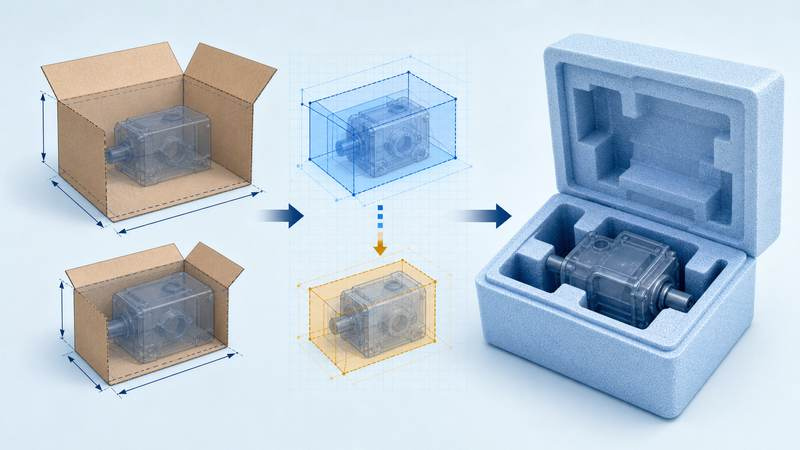
A foam-box order became a fit-and-cost decision: protect two carton sizes, compare available sizes, and check whether a custom mold was necessary.
Product cartons
Recommended foam boxes
Custom mold
Choose this route when the protection structure or required size cannot match an existing option.
Existing size
Compare stock sizes first. A small size compromise may remove tooling cost and simplify production.
Internal sales-case preview; customer names omitted. The 5.55-inch dimension follows the case screenshot and should be confirmed before publication.
How to Measure a Box Correctly
Tools and Position
Use a rigid ruler or tape measure, a flat surface, and a measurement worksheet or notes app. Place the box in its intended upright orientation and identify the base, opening, front panel, and closing direction.
Five Measurement Steps
- Measure the length. Measure the longer side of the base or opening. Keep the tool straight; do not measure diagonally.
- Measure the width. Measure the shorter adjacent side of the same base or opening.
- Measure the height. Measure perpendicular to the base, from bottom to top. Do not include open flaps unless instructed.
- Repeat the measurements. Measure every side twice and investigate differences.
- Record L × W × H with the unit. Write 16 × 12 × 10 in or 406 × 305 × 254 mm. Never mix inches, centimeters, and millimeters.
Measurement Checklist
- Confirm internal or external dimensions.
- Check whether lids, handles, padding, flaps, and protrusions count.
- Photograph the labeled measurements for supplier verification.
- Separate product size, usable internal box size, and maximum external package size.
- For a soft or damaged package, record its maximum natural dimensions without compressing it.
For a custom order, send a marked-up photograph, sketch, or reference sample if the orientation could be misunderstood. This small step can prevent a complete dieline or quotation revision.
Internal vs External Box Dimensions
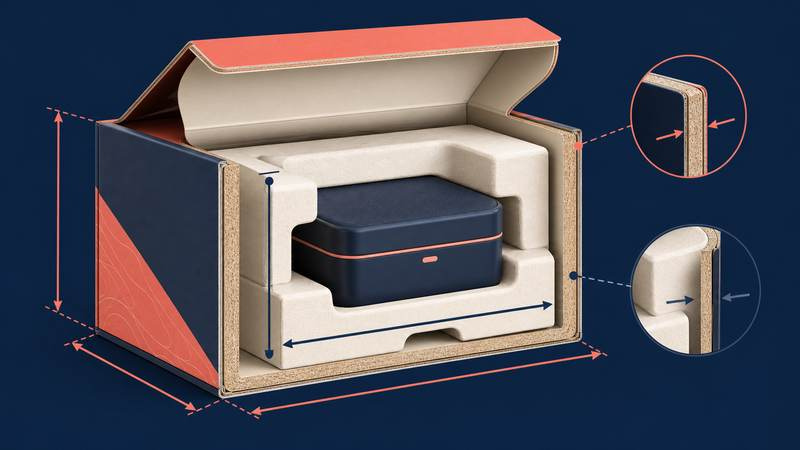
Internal dimensions describe the usable space inside the box. They are normally the most important measurements for product fit, cushioning, inserts, dividers, and custom packaging development.
External dimensions describe the total outside size of the assembled package, including material thickness and external features. They matter more for carrier entry, warehouse storage, pallet planning, carton loading, and shipping calculations.
| Requirement | Usually use | Reason |
|---|---|---|
| Product fit | Internal dimensions | Shows usable space |
| Custom packaging RFQ | Internal dimensions plus product details | Helps design around the product and protection method |
| Carrier shipment entry | External dimensions | The carrier measures the package it handles |
| Warehouse or pallet planning | External dimensions | Determines footprint and stack height |
| Insert or divider design | Internal dimensions | Defines component space |
Board thickness creates a difference between internal and external sizes. Double-wall corrugated board, folds, compression, and inserts can make the difference larger. Confirm the finished-dimension convention, board grade, structure, and tolerance before bulk production.
When 3 mm decides whether the gift box works.
A camera-accessory gift-box project showed why the insert, slots, sleeve, and outer box must be checked as one system.
Product + EVA insert + sleeve + outer box
Adhesion
The EVA insert showed bonding and deformation concerns.
Slot size
Incorrect grooves affected accessory fit and closure.
Sleeve fit
The sleeve was larger than the gift box and showed surface defects.
Internal sales-case preview; customer and brand names omitted.
Different Box Shapes and Product Fit
Tall boxes may have height as the largest number, while flat boxes may have a very small height. The agreed order remains L × W × H. Long, narrow boxes should be measured from the intended base; do not automatically relabel the longest overall side as length.
Square boxes can have equal length and width, but orientation may still matter for graphics, labels, and inserts. For irregular or bulging packages, measure the maximum outside points and follow the carrier’s rules. Boxes with lids, handles, or other protrusions should have both usable internal dimensions and maximum external dimensions recorded when they will be shipped.
Product dimensions are not box dimensions. A package may need space for clearance, cushioning, inserts, dividers, and closure. The allowance depends on product fragility, movement during transit, protection method, and manufacturing tolerance; there is no universal extra-space number.
For example, a product measuring 10 × 6 × 3 inches may need additional space for an insert and top protection. Calculate the required internal box size from the actual protection plan, then check board thickness and the resulting external size. A trial pack should confirm movement, compression, insert position, and closure before production approval.
For suitable formats, review our custom packaging products and compare box, mailer, insert, and accessory options.
A Real Quote Shows Why Quantity and Dimensions Belong Together
A Forests internal sales-close review for a custom black hat box compared four quantities: 200 pieces at $1,206; 250 at $1,292; 300 at $1,349; and 500 at $1,594. The follow-up also confirmed pictures, a cutting template, dimensions, and inner material. The practical lesson is simple: an RFQ should include dimensions, quantity, structure, lining or insert requirements, and artwork status together. These details shape the quotation and the production plan.
Box Volume and Dimensional Weight
The rectangular box volume formula is:
Volume = Length × Width × Height
A 12 × 8 × 6 inch box has a volume of 576 cubic inches. Volume is not the same as usable capacity because board thickness, inserts, cushioning, and irregular products reduce the available space.
Dimensional weight is different again: it converts package volume into a carrier pricing weight. The divisor, rounding method, service, and destination may differ. Check current carrier rules before putting a formula into a shipping SOP. Useful official references include the UPS package dimensions guide, the FedEx Service Guide, and the USPS commercial parcel rules.
A Simple Decision Framework
- Identify the task: product fit, custom packaging, shipping, or storage?
- Choose the measurement type: internal for fit; external for carriers and warehouses.
- Confirm the order: check L, W, H, or D labels and the supplier diagram.
- Apply tolerances: include clearance, cushioning, board thickness, and manufacturing tolerance.
- Test the result: verify fit, closure, movement, stacking, or shipping cost.
Before submitting a custom order, check that the units are present, the box was measured twice, the internal/external type is confirmed, and the intended orientation is clear. If any of these points is missing, the specification is not ready.
Common Measurement Mistakes
Wrong Dimension Order
Label every side before recording the numbers. A marked-up photo is safer than an unlabeled string of measurements.
Product Size Used as Box Size
Keep separate records for product dimensions, internal box dimensions, and external package dimensions.
External Size Used for Product Fit
Use usable internal space for the product, insert, and cushioning. External measurements can look correct while the product still cannot close safely inside.
Ignoring Material Thickness or Open Flaps
Ask for the supplier’s finished-dimension convention and board information. Measure the assembled, closed box unless the specification says otherwise.
Rounding Too Early
Keep precise numbers until the final calculation. Round only when the supplier or carrier requires it.
FAQs
1. What order do box dimensions go in?
They usually go in Length × Width × Height, or L × W × H. Length is generally the longer base edge, width is the shorter adjacent edge, and height runs from the base to the top. Follow the supplier’s diagram when available.
2. Is height the same as depth?
Height and depth are often used interchangeably in packaging, but not in every industry. Check the supplier’s labels or diagram before recording the measurement.
3. Should I use internal or external box dimensions?
Use internal dimensions for product fit, inserts, and custom packaging. Use external dimensions for shipping, storage, pallet planning, and carrier calculations.
4. How do I calculate box volume?
Multiply length by width by height using the same unit. A 12 × 8 × 6 inch box has a volume of 576 cubic inches, but its usable capacity is lower if board, inserts, or cushioning take up space.
5. What should I send a packaging supplier?
Send product dimensions and weight, required internal or external size, quantity, material preference, artwork status, protection needs, destination market, and deadline. A labeled sketch or photograph can prevent orientation errors.Box Dimensions Explained: How to Measure Length, Width, and Height
Conclusion
Box dimensions are normally written as Length × Width × Height, or L × W × H. Length and width describe the base or opening, while height runs perpendicular to it. L × W alone does not fully describe a three-dimensional box.
Use internal dimensions for product fit and custom packaging, and external dimensions for shipping, storage, and pallet planning. Confirm the terminology, orientation, units, measurement type, material thickness, and tolerance before ordering. Accurate measurements reduce fit problems, packaging waste, quotation errors, and unexpected shipping charges.
Need Help Choosing a Box Size?
Forests Packaging Group has supported global packaging projects since 2006, with company materials recording 10,000+ brands served across 153 countries and regions through seven wholly-owned subsidiaries. We connect your brief to structure review, material matching, sampling, production planning, inspection, and delivery coordination. Learn more about the Intelligent Factory workflow, then request a custom packaging recommendation or quote with your product size, weight, quantity, material, artwork status, destination market, and deadline.
Send Your Packaging Brief to Our Team
Share your product type, format, size, quantity, material, destination, and required date. Our team can support artwork review, sampling, production, inspection, and export coordination.
Contact us for a project-specific recommendation.


Ready to build packaging with a factory team?
Send your product size, material, artwork, quantity, destination, and deadline so our team can focus the first review on quotation and sampling.