Hot Foil vs Cold Foil for Packaging: Shine, Cost, Detail & Production Fit


Quick answer: Hot foil stamping is usually the better fit when a package needs a crisp metallic logo, a tactile impression, or a controlled premium finish on a rigid box, folding carton, or textured paper wrap. Cold foil can be a stronger option when the artwork needs broader metallic coverage, printed colour over foil, or an inline print workflow. The right process depends on the substrate, foil area, design detail, order quantity, and later finishing steps.
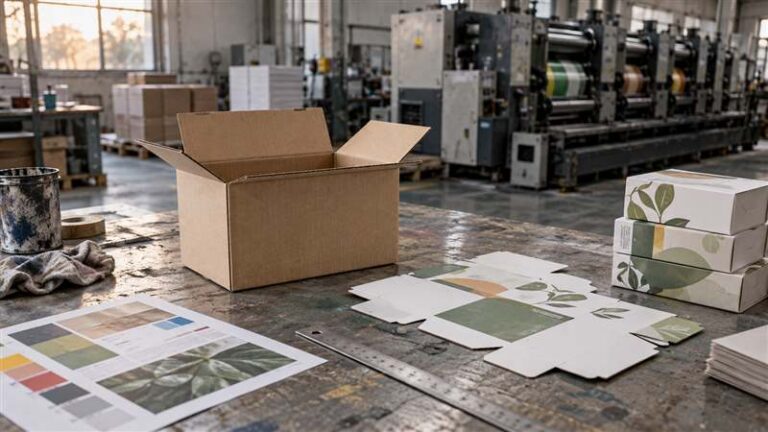
Foil is not a decoration to decide after the box structure is approved. It affects paper choice, print layers, fold lines, tooling, registration, and sampling. A screen mock-up can look right while a physical sample reveals broken fine lines, uneven foil coverage, or metallic graphics sitting too close to printed artwork.

What Is the Difference Between Hot Foil and Cold Foil?
Hot foil stamping transfers foil with a heated metal die and pressure. The die carries the artwork, presses foil against the board or paper, and leaves behind a metallic or pigment layer. It is normally a separate finishing pass.
Cold foil uses a printing plate to apply UV-curable adhesive where foil should transfer. The foil follows the adhesive, cures, and can then be overprinted as part of the printing workflow. It does not use a heated metal die pressing into the substrate.
The difference is more than temperature. Hot foil is a pressure-and-die process. Cold foil is an adhesive-and-printing process. The Foil & Specialty Effects Association’s process guide is useful for understanding the available methods, but the final decision should still come from a sample made with the actual packaging board.
| Decision point | Hot foil stamping | Cold foil transfer |
|---|---|---|
| Transfer method | Heated metal die and pressure | UV adhesive and foil transfer |
| Visual character | Crisp metallic accent with tactile definition | Metallic layer that can work with printed colour |
| Tooling | Custom metal die | Printing plate and adhesive setup |
| Suitable packaging | Rigid boxes, folding cartons, premium wraps, textured papers | Smooth folding cartons, labels, printed sheets |
| Large foil areas | Need controlled heat and pressure | Can be practical, but adhesive coverage must stay even |
| Fine lines and small text | Sharp when die and stock are matched | Needs controlled adhesive transfer and registration |
| Main production risk | Uneven transfer, pressure marks, weak fine detail | Adhesive coverage, curing, transfer, and overprint alignment |
When Does Hot Foil Make More Sense for Packaging?
Hot foil makes sense when the metallic detail is part of the physical experience. A small logo on a perfume carton, a matte-gold crest on a wine gift box, or pigment foil on textured stock can benefit from the sharp edge and pressure-created definition of hot foil.
It is also a practical route when foil sits near embossing or debossing. The finishing sequence must be planned before tooling begins. A heated die, pressure-sensitive wrap paper, and blind deboss can affect one another in ways that a flat proof cannot show.
For fragrance cartons, gift sets, and limited editions, custom perfume boxes are a good example of why foil placement has to work around bottle support, fold lines, labels, and the opening sequence—not only the front-panel artwork.
Where Hot Foil Can Create Problems
Hot foil needs more than a good-looking vector file. Common sample-stage problems include:
- Fine type or reverse-outs breaking at the edge.
- Large foil areas showing uneven transfer.
- Foil shifting too close to printed colour blocks.
- Pressure marks on soft-touch or delicate paper wraps.
- Cracking or distortion close to folds, scores, and corners.
These are not reasons to avoid hot foil. They are reasons to approve the foil artwork, paper, die, and pressure together before mass production.
When Is Cold Foil the Better Fit?
Cold foil is worth considering when metallic coverage behaves as part of the printed image rather than as a separate tactile accent. It can suit metallic graphics, colour-over-foil effects, gradients, or layouts with larger metallic sections.
The practical question is whether foil should feel like a distinct finishing detail or operate as a metallic image layer. A cosmetics carton with broad metallic graphics may point toward cold foil. A small signature logo on a magnetic gift box may still point toward hot foil.
Cold foil also needs a careful substrate review. Rough board can make the transferred foil look inconsistent. If the project includes full-coverage ink, spot UV, embossing, or matte coating, sample the actual production sequence instead of approving a foil swatch on unrelated stock.
What Cold Foil Does Not Automatically Solve
Cold foil avoids the heated metal die used in hot foil, but it introduces other controls: adhesive weight, curing, transfer quality, and registration. A metallic area that looks even on a flat press sheet can change after die-cutting, folding, rubbing, or carton erection.
Do not select cold foil only because the artwork may change often. Press setup, order volume, SKU count, foil area, and the finishing sequence still affect cost and production risk.

Which Packaging Structures Suit Each Foil Method?
The packaging format often narrows the choice faster than a generic cost comparison.
| Packaging format | Hot foil fit | Cold foil fit | Approval check |
|---|---|---|---|
| Folding carton | Strong for logos, borders, and premium accents | Strong candidate for broad metallic graphics or colour-over-foil effects | Fold cracking, registration, rub resistance |
| Rigid-box wrap | Strong for tactile logos, matte gold, pigment foil, and deboss combinations | Possible, depending on wrap stock and production route | Wrap mounting, corners, glue, pressure marks |
| Corrugated mailer | Limited because of board texture and flute profile | Limited; direct-print board often needs another visual strategy | Flute show-through and scuffing |
| Labels and sleeves | Useful for premium accents and smaller formats | Often practical for metallic print effects at scale | Adhesion, cure, and application |
| Gift-box inserts | Useful for logos and presentation details | Depends on material and flat-sheet process | Nesting, die-cutting, and abrasion |
For a rigid box or folding carton, the foil decision should follow the structural decision. Confirm the paperboard, wrap paper, fold position, glue zone, and product pack-out before approving a finishing route.
Hot Foil, Cold Foil, or Scodix: Are They the Same Thing?
No. Scodix is a digital enhancement technology, not another name for hot foil or cold foil. Digital foil can suit short runs, versioned artwork, textured effects, and projects where conventional tooling is difficult to justify. Its substrate range, cost model, and finished appearance should be evaluated as a separate option.
A buyer may receive three quotations that all say “gold foil” while describing three different methods. Each quotation should name the process, substrate, foil effect, coverage area, print layers, and any coating or embossing step. The FSEA foil comparison sheet separates hot foil, cold foil, toner-based digital foil, and varnish-based digital foil for this reason.
Use digital foil when the project needs short-run flexibility or several artwork versions. Do not assume it replaces hot foil when the brand wants pressure-defined tactile detail, or cold foil when the job needs an inline metallic print treatment.
What Drives the Cost of Foil Packaging?
Foil cost is more than foil material plus box cost. The main variables are:
- Foil area and foil-web waste.
- Foil type: metallic, matte, pigment, holographic, pearlescent, or security foil.
- Die size, line complexity, and foil colours.
- Paperboard, wrap paper, coating, and surface preparation.
- Whether foil requires a separate production pass.
- Registration requirements beside CMYK, Pantone, or other print layers.
- Order quantity and number of artwork versions.
- Sampling rounds, approval standards, and rework risk.
A small foil logo can still need meaningful setup because it requires a die and press preparation. A wide metallic field can consume more foil and need more production control. Ask for a quote based on the complete package specification instead of comparing process names alone.

How Should You Approve Colour and Foil Before Mass Production?
Approve the package as a system. A foil swatch alone cannot show how the final box will look beside its brand colour, under retail lighting, after folding, or after handling.
A useful sample review should include:
- The actual board or rigid-box wrap material.
- The final foil colour and coverage area.
- Printed colour beside the foil.
- Fine type, line endings, and reverse-outs.
- Folds, scores, corners, and glue areas.
- Embossing or debossing, where applicable.
- Rub marks and handling wear.
- The finished carton or rigid box, not only a flat sheet.
Colour approval also needs a defined proofing condition. ICC print-production colour-management resources explain why profiles and output conditions matter when artwork moves between screens, proofs, and production printing.
Why this skincare brand paid 18% more for foil
The team needed a metallic logo that could survive premium retail handling—not just look sharp on a flat sample. Cold foil was cheaper and easier to revise. It did not pass the reliability checks.
The brief
0.2 mm foil lines, CMYK overprint, 350g matte board, no laminate.
The risk
A gift box that looked sharp in approval but scratched or lost colour in retail handling.
Two routes. One retail-ready choice.
Cold foil
- Fine lines reproduced well.
- Artwork changes were simpler.
- Scratch and fold checks failed.
Hot foil
- Sharper final champagne-gold edges.
- 400+ dry-rub strokes passed.
- Better fit for retail display.
What the samples proved
reject rate ≤0.12 mm
registration error +18%
foil operation cost 2 days
per sample round
Why it won
The brand paid more to avoid scuffed shelf packs, weak overprint adhesion, and rework after delivery.
Buyer takeaway
For hairline metallic artwork, approve the finished carton—not a foil swatch or a digital proof.
Before approval, ask for
- Both foil options on the final board.
- A rub check and a fold check.
- Fine lines at real printed size.
- A stated registration tolerance.
Source note: Internal project record, France, March 2024. Customer identity withheld. Results apply to this artwork, substrate, finish stack, test approach, and handling conditions; they are not a universal performance guarantee.
A German Fragrance Box Where Foil Had to Stay Clear of the Deboss
One internal project record shows why hot foil and tactile finishing need to be developed together.
In November 2021, a German skincare and fragrance brand ordered a rigid gift box with a 2.0 mm greyboard core and a 157 g tactile matte paper wrap. The visual direction was restrained: a blind-debossed logo and decorative lines, paired with selected matte-gold foil text.
The first samples revealed two problems. The deboss did not feel deep enough, while foil edges near the deboss could blur or shift under pressure. Increasing machine pressure alone was not the answer because the tactile paper could rebound or crease.
The team made three focused adjustments:
- Increased the die engraving depth and rebalanced press pressure.
- Moved foiled elements to keep a 0.8 mm safety gap from blind-deboss artwork.
- Adjusted the wrap paper’s humidity condition before pressing to reduce rebound.
After three sample rounds, the project proceeded with an order of about 8,000–12,000 rigid boxes, valued at roughly US$13,000–17,000.
This project is evidence for hot foil combined with blind debossing, not a universal hot-versus-cold comparison. Its practical lesson is narrower: if foil and deboss sit too close together, changing one process can damage the other. Set the safe distance during artwork development, not after the die is made. For the deeper finish comparison, see embossing vs debossing for packaging.
Does Foil Affect Packaging Recyclability?
Do not label a foiled carton recyclable or non-recyclable based only on whether it uses hot foil or cold foil. The answer depends on the board, ink, coating, adhesive, foil coverage, local collection rules, and the actual recycling stream.
For a brand reducing plastic layers, foil should be evaluated with laminates, varnishes, adhesives, and the amount of metallic coverage. If recyclability is a purchase requirement, ask for the complete material build and verify it against the destination market’s relevant guidance.
FAQ
Is hot foil more expensive than cold foil?
Hot foil often has metal-die and separate-pass setup costs. Cold foil can reduce some tooling exposure but has adhesive, curing, press, and registration requirements. Compare complete packaging specifications instead of process names alone.
Can cold foil achieve the same shine as hot foil?
Cold foil can create a strong metallic effect on the right smooth stock. Hot foil is often selected when the buyer needs dense, sharp, tactile metallic detail. Approve both methods on the final substrate if appearance matters.
Does hot foil work on recycled or textured paper?
It can, but results depend on fibre texture, coating, foil type, die detail, heat, and pressure. A physical sample is essential because rough texture can affect edge definition and coverage.
Can foil be combined with embossing or debossing?
Yes, but spacing, production sequence, die pressure, and board stability must be planned together. In the German fragrance-box project, moving the foil 0.8 mm away from the blind deboss helped keep the foil edge clean.
Is Scodix better than hot foil for short runs?
Scodix can suit short runs, versioned artwork, and digital enhancement. It is not a universal replacement for hot foil because tactile effect, substrate compatibility, and pricing logic differ.
What Should Be Included in a Hot Foil or Cold Foil RFQ?
A supplier can quote and sample more accurately when the brief includes:
- Box type, assembled dimensions, and dieline.
- Requested board, wrap paper, or material appearance.
- Vector artwork.
- Foil colour and estimated coverage area.
- Whether foil sits beside CMYK, Pantone, embossing, debossing, spot UV, or lamination.
- Quantity, SKU count, and expected artwork revisions.
- Required delivery destination and deadline.
- Product details and pack-out requirements for rigid boxes or gift sets.
- Approval expectations for colour, registration, rub resistance, and folding.
Send the structure, artwork, material expectation, quantity, and destination through the packaging inquiry page rather than requesting a foil price without the board and finishing details.
For a finish that works on the actual box—not only on a mock-up—start with the board, artwork, quantity, and handling requirements. Forests Packaging Group can review those points before sampling.
Send Your Packaging Brief to Our Team
Share your product type, format, size, quantity, material, destination, and required date. Our team can support artwork review, sampling, production, inspection, and export coordination.
Contact us for a project-specific recommendation.

Ready to build packaging with a factory team?
Send your product size, material, artwork, quantity, destination, and deadline so our team can focus the first review on quotation and sampling.