Pet Food Packaging: Bags, Pouches and Material Choices

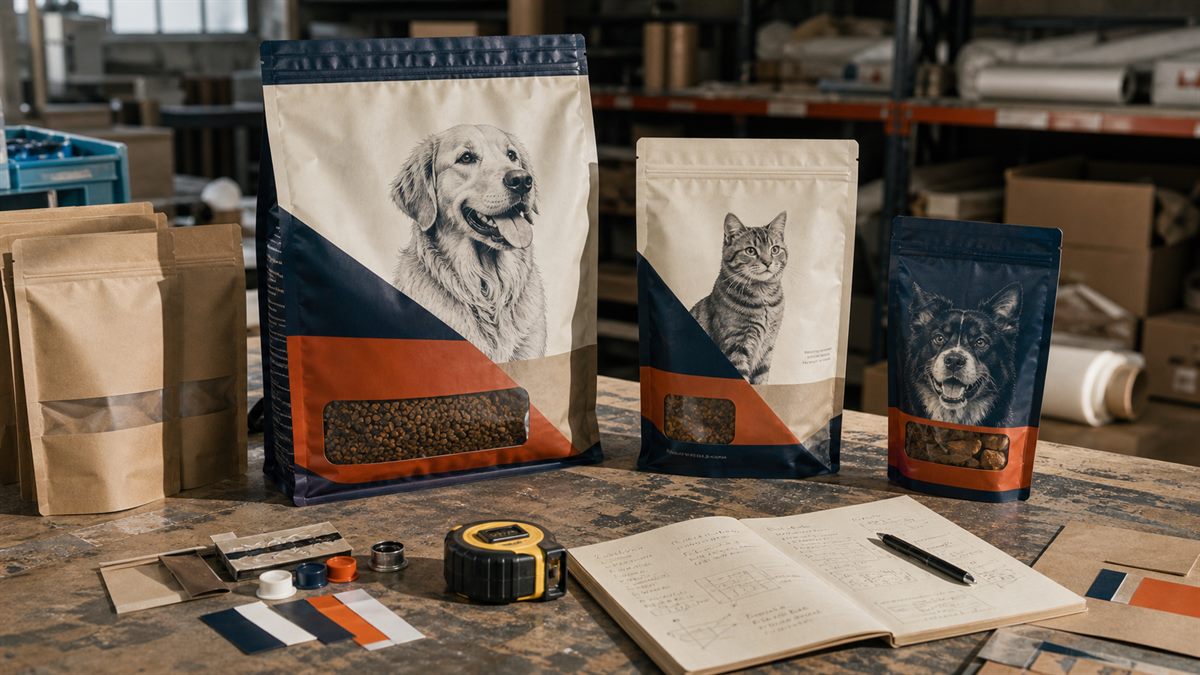
Quick answer: The right pet food packaging starts with the food, not the artwork. Dry kibble, wet food, and treats need different barriers, seals, formats, and handling strength. After that, the package has to make the range easy to shop. A useful design is both a food-protection system and a shelf-side signpost.
That balance is why pet food packaging is harder than it looks. A bag can look excellent in a presentation and still lose aroma, pick up moisture, split at the seal, or become confusing when six similar SKUs sit next to it. This guide covers the practical choices behind custom bags and pouches, then turns them into a brief a supplier can actually quote.
What good pet food packaging has to do
Pet food packaging has two jobs that happen at the same time. It protects the product through filling, storage, transport, and opening; it also helps a shopper answer a simple question in a few seconds: is this the right food for my dog or cat?
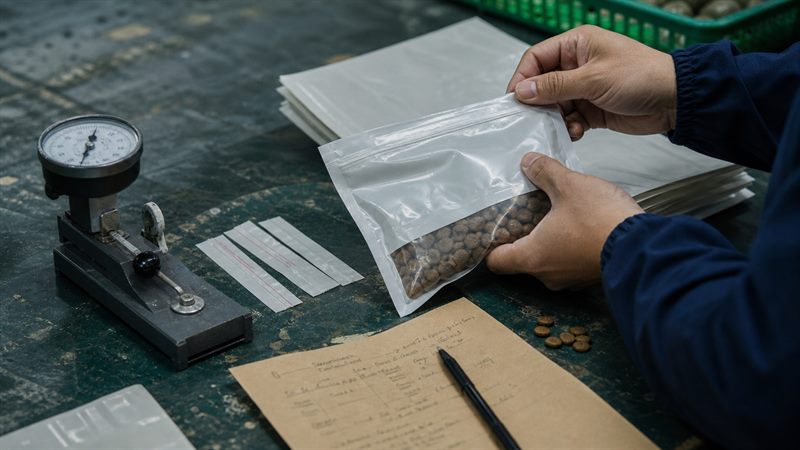
Protect freshness and product quality
Dry food is sensitive to moisture, oxygen, aroma loss, and the oils in the recipe. Treats may need stronger aroma retention because smell is part of the buying experience. Wet food usually demands a high-barrier structure and seals that suit the product and its processing route. The exact construction should follow the formulation and target shelf life, not a generic “premium bag” label.
Survive the route to the bowl
A 10 kg bag is handled differently from a small treat pouch. Larger packs need a stable base, strong seals, useful lift points, and enough puncture resistance for warehouse and parcel handling. E-commerce adds another layer: the pack may be dropped, squeezed into a carton, or shipped beside products with hard edges. A neat front panel cannot compensate for a weak side gusset.
Make the range easy to read
The front of pack should establish a fixed reading order: brand, dog or cat, life stage, food type, flavour or protein, then the main benefit. A shopper should not have to decode the colour, tiny icons, and product name separately. When a brand sells puppy, adult, senior, grain-free, and sensitive recipes, the system matters more than one attractive bag.
Choose the format by product and pack size
| Product | Common formats | Points to check |
|---|---|---|
| Dry dog or cat food | Stand-up, flat-bottom, quad-seal, side-gusset | Oil and oxygen barrier, seal strength, pack weight, resealing |
| Treats | Small pouches, zipper bags, sachets | Aroma retention, easy opening, portion size, display area |
| Wet pet food | Retort pouches or other high-barrier formats | Hermetic sealing, processing compatibility, puncture resistance |
Stand-up pouches suit treats and smaller food packs where display presence and resealing matter. Flat-bottom and quad-seal bags give larger dry-food packs a more stable footprint and several printable panels. Side-gusset bags are useful when capacity and efficient filling matter more than a small shelf footprint. Rollstock and sachets can make sense for automated filling or portion formats, but the filling line should be checked before artwork is finalised.
Barrier and material choices
Packaging suppliers often talk about layers, but buyers should ask what each layer is doing. One layer may provide stiffness, another printability, another oxygen or moisture resistance, and another reliable sealing. A paper-looking pack may still contain a functional barrier layer. A mono-material option may simplify end-of-life handling but still need validation for oil, aroma, seal, and drop performance.
For a dry food project, ask for the target moisture and oxygen performance, grease resistance, seal range, and the test method behind those figures. If the recipe contains a high level of fats or oils, a beautiful paper-forward construction that allows aroma or grease migration is not a sustainable result. It is a return problem waiting for a calendar date.
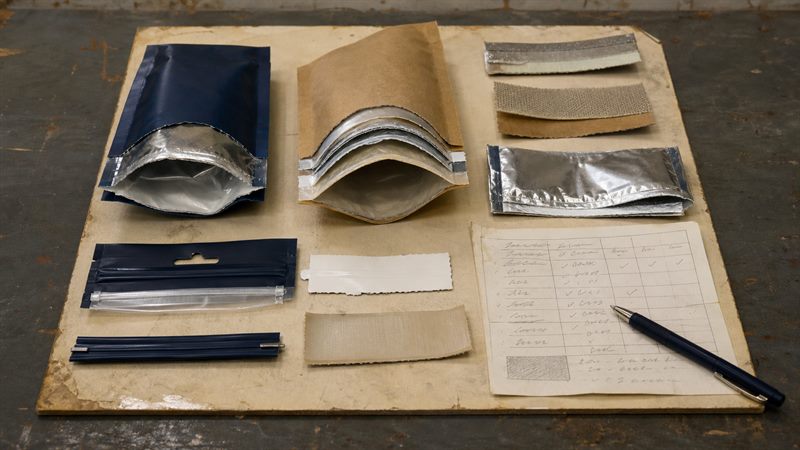
Use a simple protection-first decision route
When several materials look acceptable on paper, use a fixed order of questions. First, define what can damage the food: moisture pickup, oxidation, aroma loss, grease migration, light, or rough handling. Second, identify where the pack will be filled and sealed. A structure that performs well in a laboratory may still be a poor fit if the filling line runs outside its seal window or if the zipper does not close cleanly at production speed.
Third, decide how much of the material is actually necessary. This is where sustainability becomes useful rather than decorative. A thinner or mono-material structure may reduce material complexity, but only if it still holds the target shelf life and survives the route. If the package fails early, the wasted food and replacement shipment can outweigh the material saving. Finally, test the complete filled pack, including the closure and coding area. The bag should be checked after filling, stacking, transport simulation, and opening by a real user.
This sequence also makes supplier conversations faster. Instead of asking for a catalogue of films, you can ask for two or three structures against a known performance brief. The supplier can then explain the trade-off between barrier, stiffness, print surface, seal behaviour, cost, and end-of-life options. That is a much better starting point than choosing the shiniest sample in a showroom.
What the Asda redesign gets right
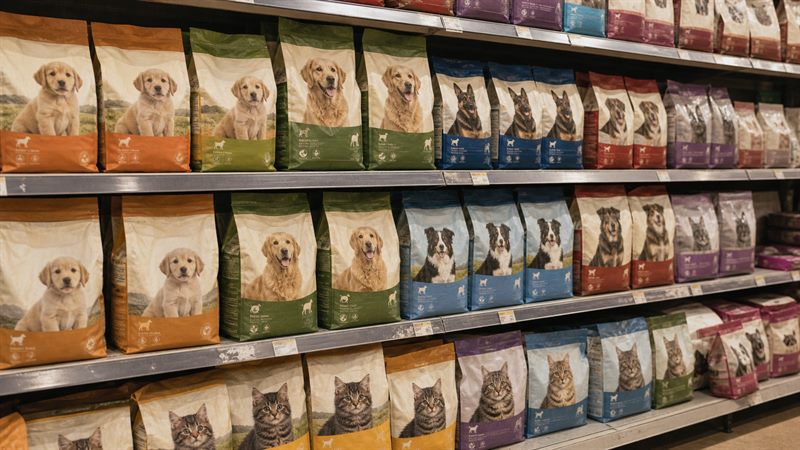
In 2023, Asda worked with STORMBRANDS on new packaging for its own-label Hero dog food and Tiger cat food ranges. Packaging Europe reported that the redesign used expressive cat and dog photography, softer colours, a friendlier type style, consistent colour coding, and clearer life-stage signposting.
The useful lesson is not to copy the visual style. It is to understand the job of the system. The pets look up from the pack, the range uses repeatable cues, and the shopper gets a stronger sense of what changes from one SKU to the next. That is especially valuable for private-label products competing beside familiar national brands. The design connects emotionally, but the hierarchy does the quiet selling work.
For a custom pet food packaging programme, keep the parts that identify the brand fixed. Give one variable, such as colour or a clearly placed life-stage band, responsibility for range navigation. Keep the product name, protein, and benefit in the same positions across dog, cat, and treat lines. When the next SKU arrives, the team should be extending a system, not starting another design argument.
Read the Packaging Europe report on the Asda redesign.
Retail and e-commerce do not ask for the same bag
Retail packs need shelf stability, a readable front face, and quick range recognition. E-commerce packs need puncture resistance, dependable seals, and a shape that can travel inside a shipping carton without wasting too much space. If the same SKU serves both channels, test against the harder route instead of designing for the showroom alone.
Convenience features should also follow the real use case. A zipper helps households that open a bag over several days. A tear notch improves first opening. A handle can matter on a large pack, but it adds a stress point that needs testing. A window may help product visibility, yet it can reduce the available barrier or print area. Each feature should earn its place.
Build a supplier-ready packaging brief
A vague request for “custom pet food bags” creates a vague quote. Send the supplier a short brief with the information below:
- Food type, formulation risks, pack weight, and target shelf life.
- Bag or pouch format, finished dimensions, fill direction, and opening method.
- Required moisture, oxygen, aroma, grease, light, and puncture performance.
- Zipper, handle, tear notch, valve, window, or other convenience features.
- Filling equipment, seal temperature range, and coding or label area.
- Number of SKUs, artwork status, colour expectations, quantity, and launch date.
- Retail, parcel, export, or warehouse conditions that the pack must survive.
- Sustainability target and the evidence needed to support any claim.
Ask for a production-representative sample, not only a flat artwork proof. Check the filled pack, seal, gusset, zipper, coding area, and how the bag sits on a shelf. If possible, run it through the actual filling and handling process. A sample that looks good on a table has only passed the easiest test.
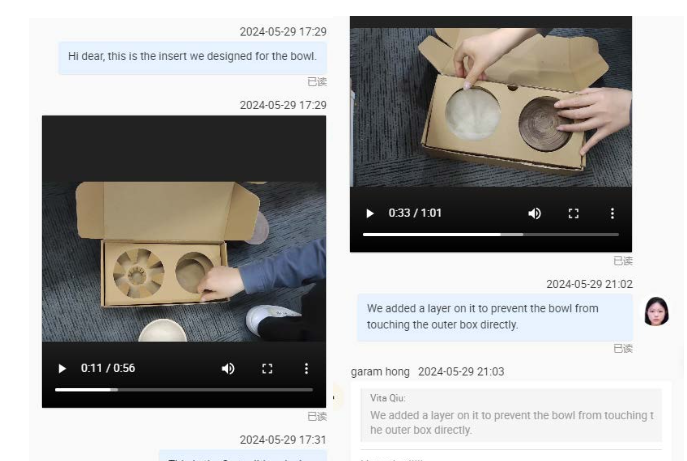
More protection
Glued paperboard insert
Lower cost
Simpler paper insert
Three weights were supplied before the insert was quoted.
The customer required a paper-based insert.
Two quotations made cost versus protection visible.
Do not quote the outer box first.
Start with product weight, insert material and protection level.
Internal sales record 58154, “Pet Packaging Series Order Sharing.” The case confirms the inquiry, three product weights, paper insert requirement and two insert quotations.
How to compare a pet food packaging supplier
Price matters, but it should be compared after the structure and performance are comparable. Ask whether the supplier has experience with food-contact packaging, multilayer or mono-material structures, flexographic or rotogravure printing, zipper and seal control, and repeat-order colour consistency. Also check what documents and test records can be supplied for the intended market.
Samples, MOQ, lead time, quality checks, and artwork control deserve their own questions. A supplier who cannot explain how a seal is checked or how a second SKU is matched to the first will create more work after the purchase order. For a growing range, repeatability is a production requirement, not a nice extra.
Five common mistakes
- Choosing the bag shape before defining shelf-life and barrier needs.
- Using colour as the only way to distinguish life stages or recipes.
- Adding a zipper or handle without testing the filled pack.
- Calling a paper-forward or mono-material structure recyclable without checking the complete construction and local recovery route.
- Approving artwork without a production sample and filling-line check.
Conclusion
Good pet food packaging keeps food stable, survives the route, and helps shoppers choose without hesitation. Start with the recipe and shelf-life target. Then choose the format, barrier, closure, print system, and sustainability path that the product can actually support.
The Asda example shows how much clearer a range becomes when emotion and information work together. A strong custom pet food packaging programme does the same thing at production level: it gives every SKU a recognisable place while keeping the material and sealing decisions grounded in real use.
Plan your custom pet food packaging
Forests Packaging Group can review your product type, pack size, barrier target, filling method, artwork, SKU range, and delivery route before recommending a bag or pouch format. Send the recipe category, dimensions, quantity, artwork status, destination market, and launch timing so the quotation starts with a usable brief.
Request samples when the seal, zipper, standing performance, or print match needs to be checked before production.
FAQs
What is the best packaging for dry pet food?
It depends on pack weight, shelf life, oil content, barrier needs, filling method, and whether the customer needs a zipper or handle. Flat-bottom, quad-seal, and side-gusset bags are common choices for larger dry-food packs.
Can pet food packaging be recyclable?
Some mono-material and recyclable structures are available, but the complete bag still has to meet barrier, seal, strength, food-contact, and local recovery requirements. The claim should be checked against the actual construction.
Should pet food bags have a zipper?
A zipper is useful when the pack will be opened and stored over time. It should be selected alongside the film, seal width, fill weight, and opening method, then checked on filled samples.
How do I prepare a pet food packaging RFQ?
Include the food type, pack size, dimensions, target shelf life, barrier requirements, bag format, closure features, filling process, number of SKUs, artwork, quantity, destination, and launch date.
What should I ask a pet food packaging supplier?
Ask about material structure, barrier testing, seal control, printing, sample methods, MOQ, lead time, food-contact documentation, quality checks, and repeat-order consistency.
Send Your Packaging Brief to Our Team
Share your product type, format, size, quantity, material, destination, and required date. Our team can support artwork review, sampling, production, inspection, and export coordination.
Contact us for a project-specific recommendation.
Ready to build packaging with a factory team?
Send your product size, material, artwork, quantity, destination, and deadline so our team can focus the first review on quotation and sampling.