Recycled Shipping Boxes: Custom & Eco-Friendly

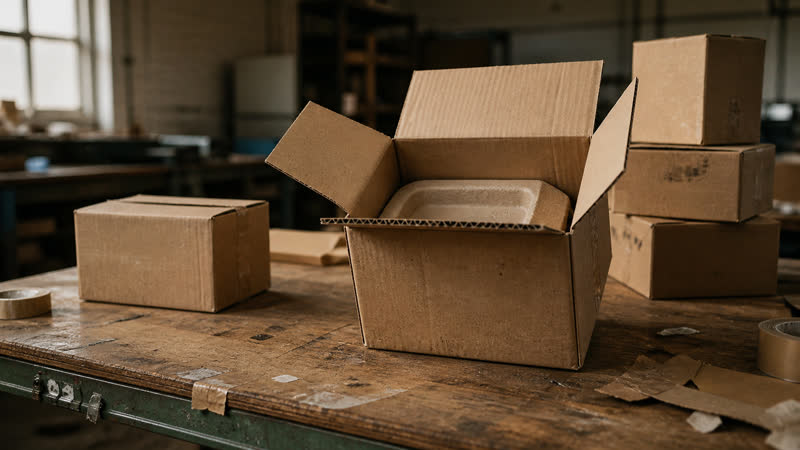
Recycled shipping boxes are not judged by the brown color alone. A buyer needs two answers before approving them: how much recovered fiber is actually in the board, and whether the finished box can survive the route from warehouse to customer.
This guide covers recycled content, PCR and PIR fiber, 32 ECT, right-sizing, printing, inserts, sampling and supplier questions. The aim is simple: turn an eco-friendly shipping box from a marketing phrase into a specification your purchasing team can check.
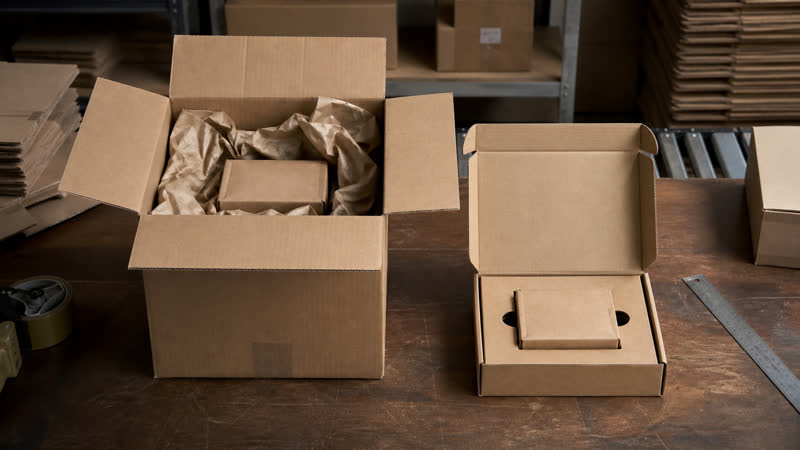
If you are comparing box formats for a live ecommerce program, our custom packaging manufacturing team can review the product and route before a board grade is chosen.
What are recycled shipping boxes?
Recycled fiber in corrugated packaging
A corrugated shipping box is built from liners and a fluted medium. Recovered paper fiber can be used in either layer, and the total recycled percentage depends on the paper grades selected for the complete board. Ask for the material declaration rather than estimating from the outside appearance.
Recycled is not the same as recyclable
“Recycled” describes what went into the box. “Recyclable” describes whether the used box can enter a suitable recovery stream. A box can have recycled content and still need a review of coatings, labels, tape and contamination before making a recycling claim.
Recycled, compostable and biodegradable are different claims
Recycled-content packaging keeps recovered fiber in the material supply. Compostable packaging is designed for a biological treatment route. Biodegradable is a much broader term and does not, by itself, state the time, conditions or facility required. Keep these claims separate in the artwork and product brief.
Why brown kraft is not proof
Virgin kraft can be brown, and recycled board can be made with a lighter or darker shade. Color is a visual choice, not a percentage. If recycled content matters to the buyer or retailer, specify total recycled fiber and ask whether a post-consumer percentage can be documented.
How much recycled content should a shipping box have?
There is no useful percentage without a clear calculation basis. A supplier should state whether the figure refers to the whole corrugated board, a liner, a medium or a production batch. It should also distinguish between post-consumer and post-industrial sources.
Post-consumer and post-industrial fiber
Post-consumer fiber comes from paper that has already been used and recovered after consumer or commercial use. Post-industrial fiber is recovered earlier in manufacturing or converting. Both can be useful, but they tell different stories about the waste stream. A phrase such as “contains recycled material” does not answer how much of either source is present.
For a serious specification, request three figures: total recycled content, post-consumer content and the method used to calculate them. If the box will carry an environmental claim, keep the declaration with the purchase order and artwork approval.
Buyers can review recycled-content certification resources through the FSC certification information, then confirm that the specific supplier, board and claim are covered.
Are recycled shipping boxes strong enough?
They can be. Fiber source is only one part of box performance. Board grade, flute profile, wall construction, dimensions, product weight, stacking pattern, humidity and parcel handling all matter. A smaller recycled box with a well-matched structure may outperform a larger box chosen by habit.
What does 32 ECT mean?
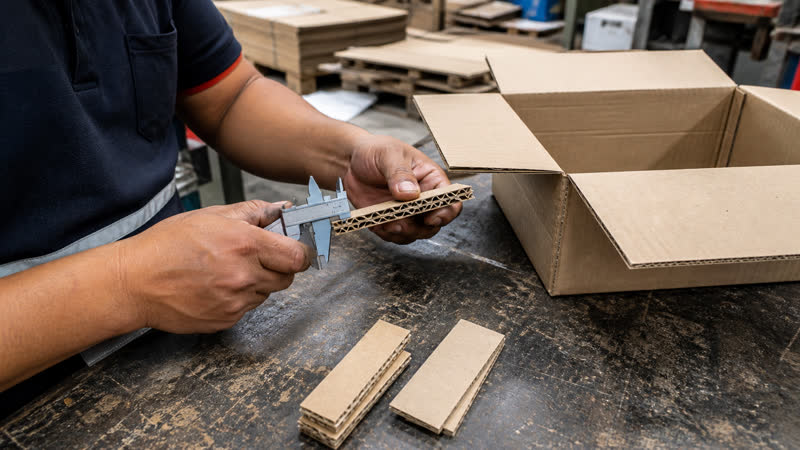
ECT means Edge Crush Test. It measures how much edgewise compression a corrugated board sample can withstand. It is a useful reference for stacking and box selection, but it is not a complete shipping guarantee. The same ECT number can behave differently when box dimensions, humidity and loading patterns change.
Consider stronger board or a double-wall construction for heavy products, broad cartons, fragile goods, high pallet stacks or long distribution routes. For lighter parcels, the better answer may be a right-sized single-wall box with a suitable insert. Test the packed product before making a final call.
Choose box strength by shipping risk
A practical review starts with the route. A small, light item moving through a controlled local parcel network has a different risk profile from a dense product in a large carton traveling across several hubs.
- Lower-risk parcels usually need a stable fit, modest stacking strength and simple paper protection.
- Moderate-risk shipments may need stronger board, corner protection or a formed insert to stop movement.
- Higher-risk shipments need a complete test of compression, drops, vibration, abrasion and moisture exposure.
The decision rule is to use the lowest-material corrugated structure that delivers the product intact through its actual distribution cycle. Removing board until the first failure is not sustainability; it is deferred waste.
Why right-sizing makes recycled boxes more sustainable
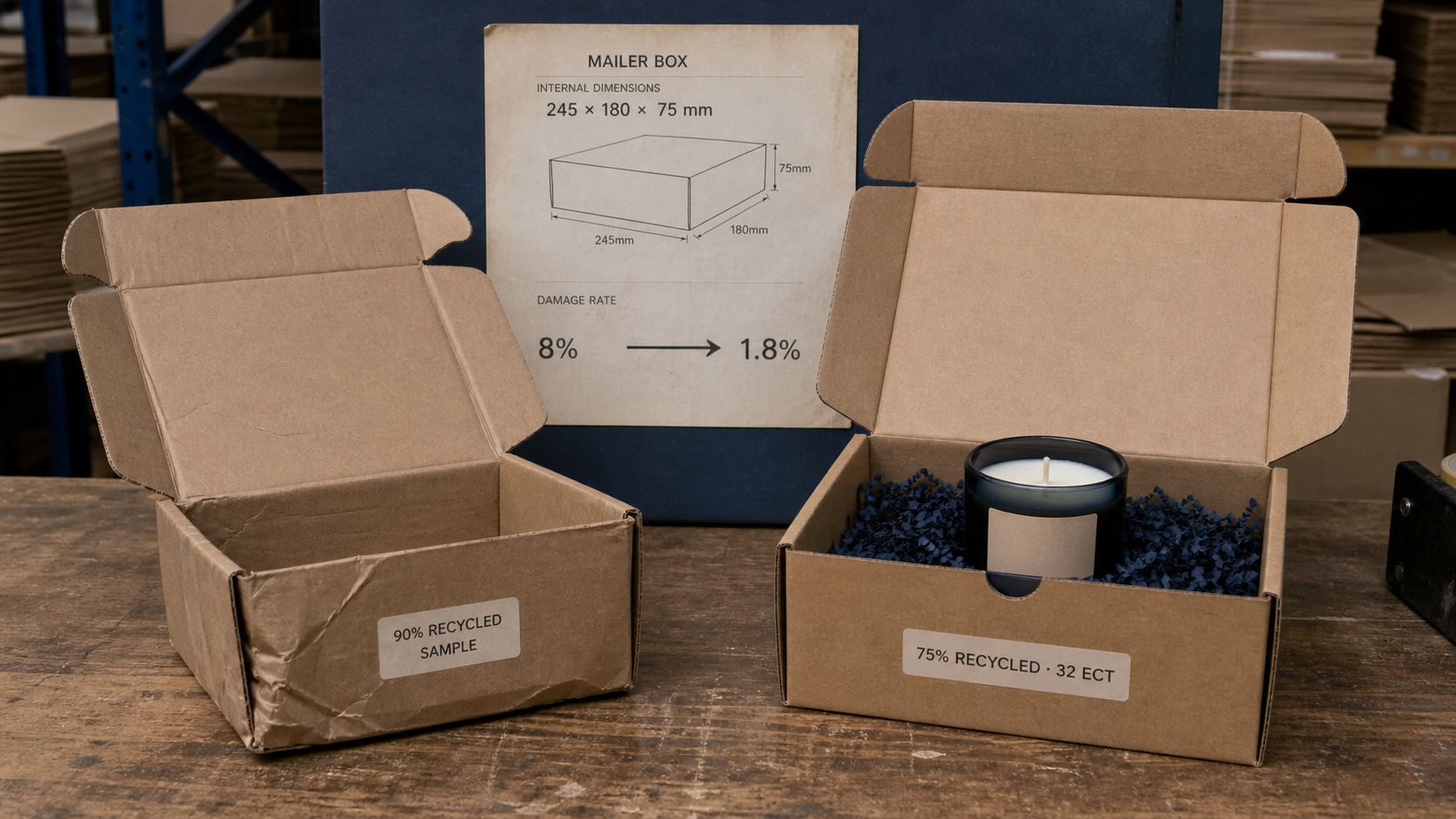
A 100% recycled box can still be wasteful if it is much larger than the product. Extra volume may require more board, more void fill and a larger shipping carton category. It also lets the product move farther before the package absorbs an impact.
Measure the packed product, then allow room for the protection it genuinely needs. The goal is not a box that squeezes the product. It is a box with controlled clearance, stable loading and enough compression room for the chosen board.
Right-sizing can improve pallet utilization and reduce the number of air-filled parcels in a truck. For custom corrugated structures, compare the material saving against tooling, changeover, storage and repeat-order requirements. Our custom mailer box options show how fit and opening structure can be reviewed together.
Stock or custom recycled shipping boxes?
Stock boxes are sensible when volumes are low, the product fits an existing size and speed matters more than branding. Custom recycled shipping boxes make more sense when the product has an awkward profile, void fill is excessive, repeat volume is stable or the brand needs a controlled unboxing experience.
Compare more than unit price. Put MOQ, sample cost, lead time, board grade, recycled percentage, print coverage, storage, freight cube and damage risk on the same sheet. A low-priced oversized carton can become expensive once void fill and dimensional freight are counted.
What can you customize?
- Dimensions: specify internal length, width and depth after the product and insert are packed.
- Board: choose the liner combination, flute, ECT or other agreed strength requirement.
- Structure: select a regular slotted container, mailer, die-cut shipper, divider or insert system.
- Printing: use one-color exterior printing for a restrained look, or add inside printing for the opening moment.
- Closure: compare tape, water-activated tape, self-locking flaps and tamper-evident options.
- Recycled content: state the total target and whether a post-consumer percentage is required.
Printing on recycled kraft shipping boxes
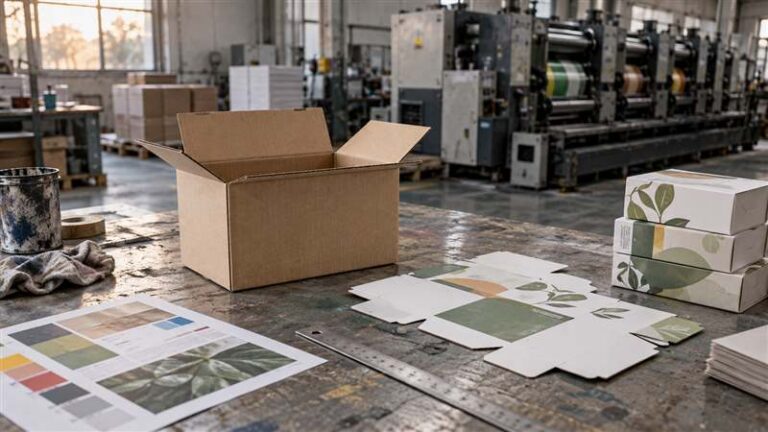
Recycled kraft board can have a warmer, less uniform surface than a coated sheet. Black and dark one-color graphics usually remain clear. Pale colors, fine lines and large solid areas need a physical proof because the board shade changes how the ink is perceived.
For many ecommerce programs, a small logo, URL, handling instruction or disposal note is enough. Full coverage printing can be done, but it should be weighed against ink coverage, registration, appearance variation and the recycling requirements of the complete box.
Do not approve a screen image as the final color reference. Ask for a print sample on the selected recycled board, then record the approved board shade and ink coverage with the artwork.
Optimize the whole protection system
The outer box is only one part of the shipment. Corrugated inserts, dividers, molded fiber, paper cushioning and void fill can change how much strength the outer box needs. A formed insert that stops a bottle from hitting the wall may be more efficient than simply moving to a much heavier carton. Our packaging logistics service is relevant when the pack-out has to be reviewed alongside handling and delivery conditions.
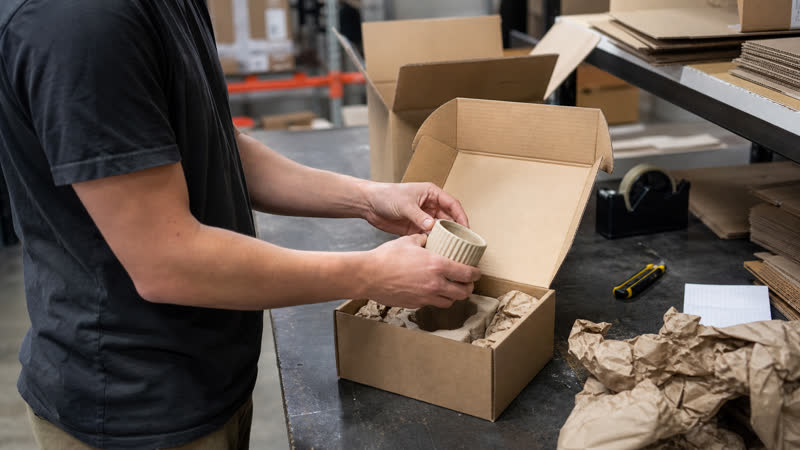
Keep the product centered, stop sharp edges from rubbing the board and prevent loose components from becoming impact points. Photograph the pack-out, record the packed weight and note where a sample deforms. Those details make the next supplier conversation much faster.
Is an eco-friendly shipping box really eco-friendly?
Use the phrase only with supporting specifications. Review recycled content, recyclability, material quantity, right-sizing, print and coating choices, supply distance and product damage. The most sustainable box is not always the one with the highest recycled percentage; it is the one that uses credible recovered material and completes the shipment without creating avoidable replacement waste.
Be careful with broad claims such as “100% eco-friendly.” The FTC Green Guides explain why environmental claims need qualification and evidence. Rules differ by market, so have the final wording reviewed for the country where the box will be sold.
Sampling before a bulk order
Pack the actual product in the proposed box. Check internal clearance, product movement, corner crush, seam strength, closure, print appearance and packed weight. Then run the handling tests that resemble the real route: pallet stacking, drops, vibration, abrasion and exposure to warehouse humidity. The ISTA testing resources are a useful reference when you need to define a repeatable distribution test.
Two or three prototypes can reveal a problem that a catalogue specification will not. If the box is too loose, reduce the dimensions or redesign the insert. If it is too weak, compare flute, board construction and load distribution before simply adding material everywhere.
Questions for a recycled shipping boxes supplier
- What is the total recycled fiber percentage in the finished board?
- What portion is post-consumer fiber, and what documentation supports it?
- Which board grade, flute and ECT or compression value are proposed?
- Are the quoted dimensions internal or external?
- Can the supplier provide a sample using the real product?
- How will inks, coatings, tape and labels affect the recovery route?
- What are the MOQ, prototype charge, production lead time and repeat-order lead time?
- Can the supplier produce the box, insert and protective components as one tested pack-out?
A capable recycled shipping boxes supplier should be able to discuss fiber content and shipping performance in the same meeting. If the conversation stops at a brown sample and the word “green,” the specification is not finished.
FAQs
Are recycled shipping boxes strong enough for shipping?
They can be. Strength depends on board construction, ECT, flute, dimensions, product weight, stacking and shipping conditions, not simply whether the fibers are recycled.
What is the difference between recycled and recyclable shipping boxes?
Recycled refers to recovered material used to make the box. Recyclable refers to whether the used box can enter an appropriate recovery stream. A box can have both attributes.
Can recycled shipping boxes be custom printed and sized?
Yes. Recycled corrugated boxes can be made in custom dimensions and printed outside or inside, with inserts and dividers added when the product needs more control.
What does 32 ECT mean?
32 ECT is an edge-crush measurement for corrugated board. It is a useful reference, but the right grade still depends on the complete box, load and distribution route.
What should a supplier document?
Request the finished board composition, total and post-consumer recycled content, strength specification, sample details, printing limits, MOQ, lead time and any recovery claim conditions.
Conclusion
Recycled shipping boxes work best when the environmental claim and the shipping job are specified together. Verify the fiber source, choose the board around the actual risk, right-size the carton, and test the complete pack-out before committing to volume.
Recycled, recyclable, compostable and biodegradable describe different things. A clear specification helps your team make a defensible choice and gives the supplier something measurable to produce.
Request a recycled shipping-box review
Send the product dimensions, packed weight, quantity, destinations, artwork and recycled-content target to our packaging consultation team. We can compare custom corrugated structures, board grades, print options, inserts and sample requirements around the way your product actually ships.
Ask for a physical sample before bulk production. A box that looks responsible on paper still has to arrive with the product inside it undamaged.
Send Your Packaging Brief to Our Team
Share your product type, format, size, quantity, material, destination, and required date. Our team can support artwork review, sampling, production, inspection, and export coordination.
Contact us for a project-specific recommendation.


Ready to build packaging with a factory team?
Send your product size, material, artwork, quantity, destination, and deadline so our team can focus the first review on quotation and sampling.