Glassine Paper: Uses, Limits & Custom Packaging Options

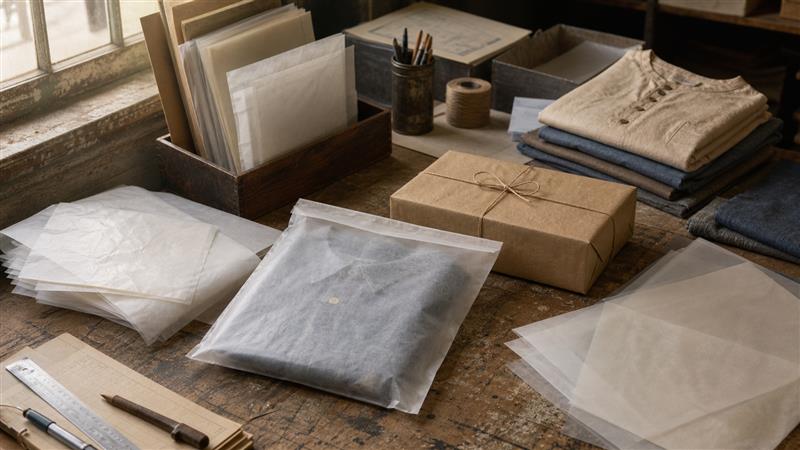
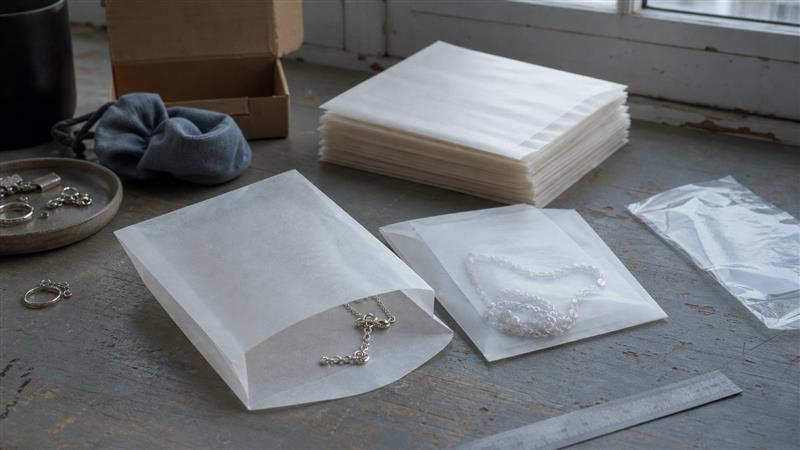
Glassine paper is a smooth, dense and translucent paper made from highly refined wood pulp. It can protect a product from dust, light scuffing and some grease without looking or behaving like a clear plastic film. That makes it useful for apparel, stationery, artwork, jewellery and selected food applications.
The catch is just as important: glassine is still paper. It is not waterproof, not a shipping box and not a universal replacement for a poly bag. This guide explains what glassine is, how it is made, where it earns its place, and what to put in a request for custom packaging manufacturing.
What is glassine paper?
Glassine starts with wood pulp, but its familiar surface comes from how the sheet is processed. The fibres are highly refined, formed into a paper web and passed through heated, polished rollers called supercalenders. Pressure and heat compress the sheet, reduce its pores and create a smooth, glossy, partly see-through surface.
Is glassine plastic or paper?
Glassine is paper-based. Its shine can make it look coated, but traditional glassine gets its main characteristics from fibre refinement and calendering rather than a plastic film laminated to the surface. That distinction matters when you are checking recycling routes, food-contact documentation or a plastic-reduction brief.
Why is glassine translucent?
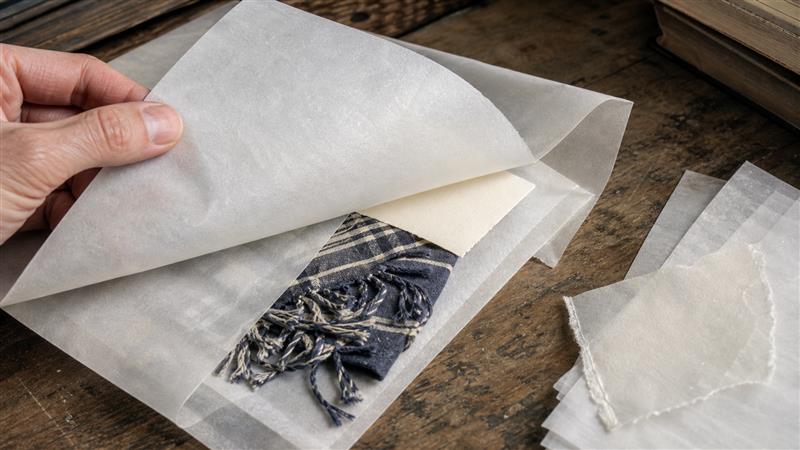
Ordinary paper contains more visible air spaces between fibres, so light is scattered and the sheet looks opaque. Glassine is denser and more compressed. Light passes through the sheet in a softer, hazier way. You can often see the outline or colour of the product, but glassine is not the same as a transparent poly bag.
How is glassine made?
- Refining the pulp: wood fibres are processed to create a fine, consistent furnish.
- Forming the sheet: the pulp is spread on a moving wire, drained, pressed and dried.
- Supercalendering: the dried paper passes through smooth, high-pressure rollers that compress and polish it.
- Converting: the finished roll is slit and converted into bags, envelopes, sheets or interleaving formats.
Glassine paper properties at a glance
- Translucency: useful when the product should be partly visible.
- Smooth surface: suitable for delicate surfaces that can be marked by rough paper.
- Grease resistance: helpful for selected products, although the exact grade and end use must be checked.
- Light moisture resistance: it can handle a few droplets or normal humidity better than porous paper.
- Limited structural protection: it does not replace a rigid mailer, corrugated box or protective insert.
Is glassine waterproof?
No. A glassine bag may resist brief contact with moisture, but it will soften or fail when exposed to heavy rain, condensation, standing water or immersion. If the product is moisture-sensitive, use glassine as an inner wrap only and specify a stronger moisture barrier or outer shipping package.
What is glassine paper used for?
Glassine works best when the package has a light protective job. It keeps dust off a product, separates surfaces, reduces rubbing and gives the customer a quiet glimpse of what is inside. It is especially useful in apparel and retail packaging applications where presentation matters but a heavy box would be unnecessary.
Apparel and accessories
Scarves, socks, small garments, belts and fashion accessories can be wrapped or bagged in glassine before going into a mailer or carton. It gives the product a cleaner handoff than loose tissue and avoids the crinkly, disposable feel of a thin plastic bag.
Jewellery, stationery and artwork
Glassine envelopes and sheets are useful for jewellery cards, prints, paper goods, pins and delicate artwork that need separation from dust or abrasion. For archival use, confirm the exact grade, pH and storage conditions rather than treating “glassine” as a complete preservation specification.
Food and bakery packaging
Glassine is used for selected bakery and grease-prone products, but food contact is not automatic. Ask for documentation for the exact paper, ink, adhesive and converting construction. A food-safe claim for one grade should not be copied onto another bag simply because both are called glassine.
Glassine as inner packaging, not transit protection
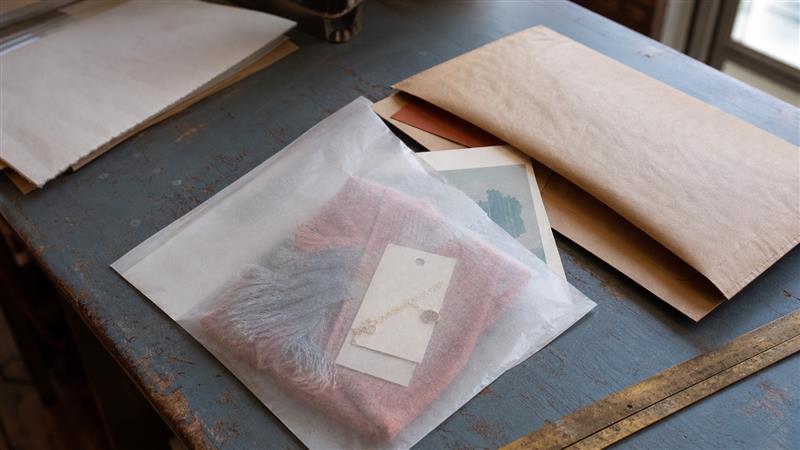
This is where many packaging briefs go off track. Glassine can protect a surface, but it does not absorb a parcel drop or stop a box from being crushed. The usual system is product → glassine bag or sheet → padded mailer or corrugated carton. Each layer has a different job.
Use the glassine layer for presentation, dust control, separation and light scuff protection. Use the outer package for compression, puncture, impact and weather exposure. If the product can break, bend or leak, test the complete pack-out rather than approving the glassine bag in isolation.
Glassine paper vs. poly bags
Poly bags normally win on transparency, moisture resistance and puncture strength. Glassine can win on paper-based presentation, surface feel and a plastic-free packaging direction. Neither material is automatically “better”; the right choice depends on what the package has to survive.
| Requirement | Glassine | Poly bag |
|---|---|---|
| Product visibility | Soft translucency | Usually clear |
| Light surface protection | Good for many flat or small products | Good, depending on film and fit |
| Moisture barrier | Limited | Generally stronger |
| Puncture resistance | Limited by paper grade and seams | Usually higher |
| Brand feel | Quiet, paper-based, tactile | Clean and highly visible |
Before replacing poly, run a real packing test. Check the product after handling, scan the barcode through the chosen format, measure packing time and see what happens when the bag is pulled across a carton edge. A material change that looks good in a sustainability presentation can create a slower or less reliable fulfilment line if these small tests are skipped.
Glassine vs. wax paper and parchment paper
Glassine, wax paper and parchment paper can look similar in a sample book, but they are not interchangeable. Wax paper relies on a wax treatment. Modern parchment paper is usually treated for non-stick and heat-resistant cooking use. Glassine is a calendered paper whose smoothness comes primarily from the paper-making process.
Choose by function, not appearance. If you need an oven-safe baking liner, glassine is the wrong starting point. If you need a translucent inner bag for a scarf, print or small accessory, parchment may bring properties you do not need and may complicate recycling or converting.
Is glassine paper sustainable?
Glassine can help reduce plastic use in applications where its performance is enough, but “paper-based” is not a complete environmental assessment. Ask whether the material uses virgin or recycled fibre, what inks and adhesives are added, and what happens in the market where the package will be discarded.
For fibre sourcing, a brand may ask for a recognised chain-of-custody system such as FSC certification information. That does not prove every part of the finished package is recyclable or compostable, but it gives the procurement team a way to check the fibre claim instead of relying on a green colour and a vague promise.
Recyclable, biodegradable or compostable?
These words describe different things. A paper package may be recyclable in one local system, biodegradable under certain conditions and not certified compostable. Printing, adhesive strips, windows and mixed-material laminates can change the answer. The safest product copy is specific: state the construction, the intended disposal route and any limitation.
Recycling acceptance is local, so check the destination market rather than assuming a universal rule. The US EPA recycling guidance is a useful reference point, but it is not a substitute for the collection rules used by the customer’s municipality or fulfilment centre.
For packaging-specific questions about fibre-based recovery, the CEPI paper-based packaging recyclability guidelines are a better starting point than a generic “paper is recyclable” claim.
Custom glassine paper packaging options
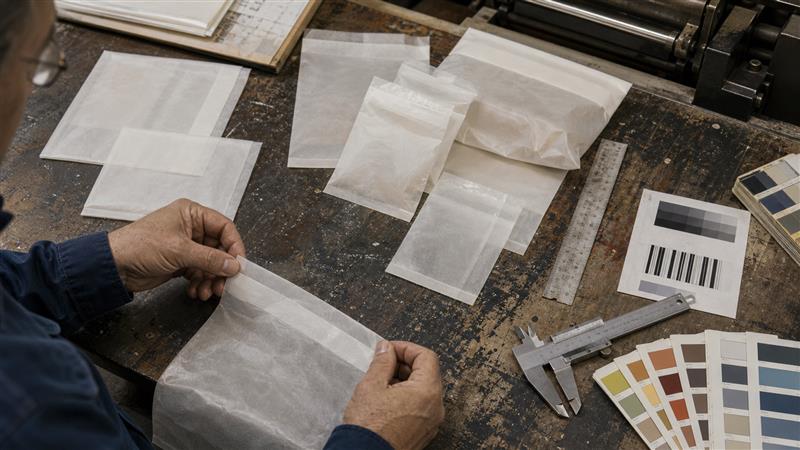
Custom glassine paper can be converted into bags, envelopes, sheets and interleaving pieces. The most useful customisation is often quite ordinary: the right width, the right opening and a closure that the packing team can use repeatedly without fighting the material.
- Custom bag or envelope dimensions
- Top opening, side opening or a wrap format
- Self-adhesive flap, tuck flap or open-top design
- Logo, one-colour print, repeat pattern or product information
- Barcode and SKU area with enough contrast for scanning
- Sheets for interleaving artwork, metal parts or delicate surfaces
Printing on a translucent substrate
Ink does not look exactly the same on glassine as it does on white, opaque paper. A light colour may become quieter; a dark colour can show through folds or overlap areas. Keep small legal or product text away from seams, request a printed sample and test the actual barcode with the scanner used in fulfilment.
Stock or custom glassine: which is sensible?
Stock bags are useful for small quantities, quick tests and products that fit a standard size without extra movement. Custom bags make more sense when the product is stable, the format will be reordered, branding matters or a standard bag leaves too much empty space.
Compare more than unit price. Put MOQ, sampling cost, lead time, size tolerance, closure performance, print registration and packing speed on the same sheet. A cheaper bag can become expensive if the team has to fold it twice, add a sticker or replace damaged product.
Sales win / glassine paper packaging
A Swedish jewellery brand replaced poly bags without hiding the product
SWEDEN · FEBRUARY 2023The problem started with a small rub markThe customer sold silver jewellery and fabric accessories online. A piece could leave the packing bench looking perfect, then pick up fine scratches inside a clear poly bag. Plastic was easy to use, but it also looked out of step with the brand as Swedish rules and customer expectations moved away from single-use packaging.
Project numbers
Before / clear poly bag
- Plastic feel conflicted with the brand position
- Metal pieces could rub against the film
- Customers saw unnecessary plastic
After / glassine inner envelope
- Smooth paper reduced direct rubbing
- Soft translucency kept the product visible
- Packing speed stayed broadly the same
The practical boundary
Glassine solved the inner-packaging problem, not the weather problem. It was smooth, presentable and suitable for product separation, but it was not waterproof. When rain reached the outer carton, the bag could wrinkle. The finished pack still needed a paper carton or water-resistant outer mailer.
Source note: Based on an internal sales-win record. Customer identity is withheld; order quantity and value are reported as ranges.
What to include in a supplier-ready glassine brief
- Product name, weight and packed dimensions.
- Required internal bag or sheet size, including clearance.
- Desired translucency, surface feel and paper weight.
- Grease, moisture, dust or scuffing requirement.
- Closure type and opening direction.
- Artwork, print colours, barcode position and readable area.
- Food-contact or archival documentation, if relevant.
- Quantity, destination market, target delivery date and repeat-order plan.
Send the supplier the actual product or a correctly weighted dummy. A bag can look perfect in a flat drawing and still be awkward once the product has corners, a label or a protective sleeve. Physical samples are not a formality here; they are the fastest way to catch a sizing or workflow problem.
Common glassine packaging mistakes
- Assuming translucent means transparent.
- Treating light moisture resistance as waterproof protection.
- Using a thin inner bag as the only shipping package.
- Assuming every glassine grade is food-contact approved.
- Switching from poly without testing tears, seams and packing speed.
- Making broad recycling or compostability claims without checking the complete construction.
How to choose a glassine paper supplier
A suitable glassine paper supplier should be able to discuss the paper grade and the converting process in the same conversation. Ask for samples, tolerances, closure details, printing limits, test reports where applicable and a clear explanation of what can change between the first order and a repeat order.
It also helps to review the supplier’s wider packaging material and sourcing guidance. The point is not to collect certificates for their own sake. It is to see whether the supplier can connect material choice with product fit, fulfilment handling, print quality and the disposal claims you plan to publish.
FAQs
1. What is glassine paper made from?
Glassine is made from highly refined wood pulp and finished through paper-making and supercalendering processes that make the sheet smooth, dense and translucent.
2. Is glassine paper waterproof?
No. It can resist light moisture, but it is still paper and should not be used as a waterproof barrier or exposed to standing water.
3. Can glassine replace a poly bag?
Sometimes. It can replace poly for products that mainly need dust, scuff and separation protection. Poly may still be the better choice when complete transparency, stronger moisture protection or higher puncture resistance is required.
4. Is glassine recyclable?
It may be accepted in paper recycling when the construction is free from incompatible coatings and components, but acceptance varies by location. Confirm the local route for the finished bag or envelope.
5. Can glassine bags be printed?
Yes. Custom printing is possible, but translucent paper changes colour appearance and can reduce contrast. Approve a physical print sample and test barcode readability before production.
Final answer: what is glassine paper?
Glassine is a smooth, dense, translucent paper with useful resistance to light grease, dust and surface rubbing. It is a strong candidate for inner packaging when the product is light, relatively flat and does not need waterproof or heavy structural protection.
For custom glassine paper packaging, start with the product and the real packing process. Confirm the internal dimensions, closure, print behaviour, documentation and end-of-life route before committing to volume. If the package has to survive a hard parcel journey, let the outer mailer or box do that job.
Request a custom glassine paper quote
Forests Packaging Group can help compare glassine bags, envelopes and sheet formats around the product, packing method, print requirement and destination market. Send the packed dimensions, quantity, artwork, closure preference and target date so the first sample answers a real production question.
For a practical next step, request a glassine paper quote with your product details and we can scope the suitable format before discussing bulk pricing.
Send Your Packaging Brief to Our Team
Share your product type, format, size, quantity, material, destination, and required date. Our team can support artwork review, sampling, production, inspection, and export coordination.
Contact us for a project-specific recommendation.


Ready to build packaging with a factory team?
Send your product size, material, artwork, quantity, destination, and deadline so our team can focus the first review on quotation and sampling.