Hexacomb Protective Packaging: A Practical Guide

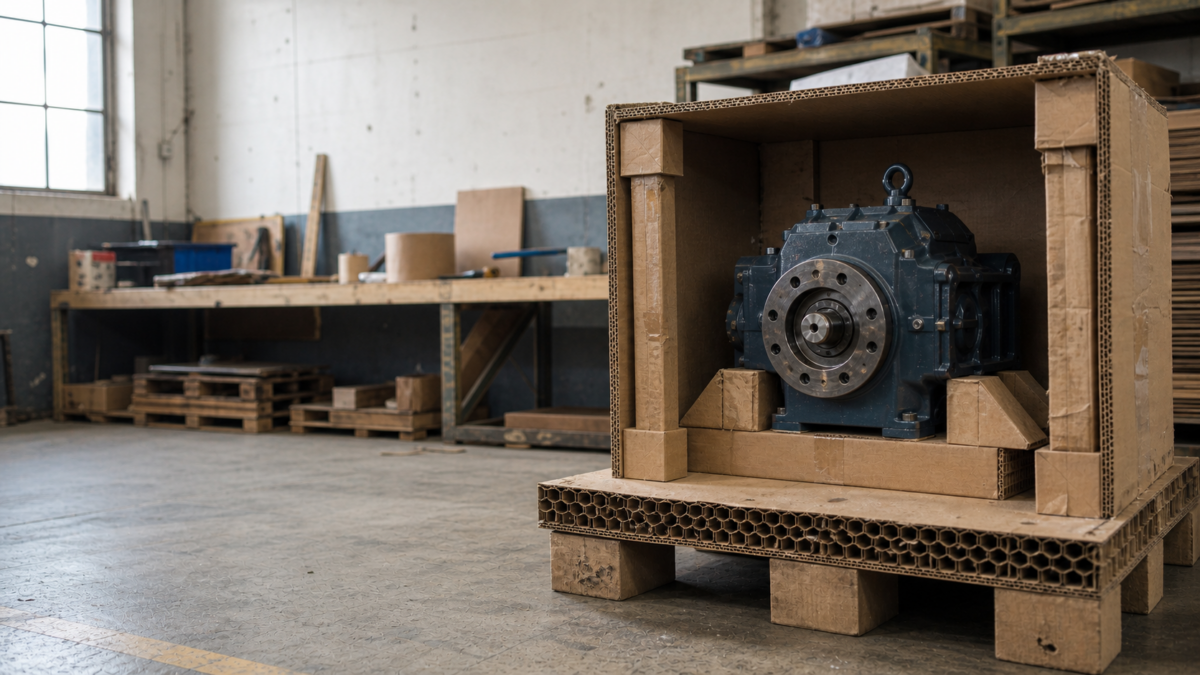
Quick answer: Hexacomb is a paper-based honeycomb protective packaging material that combines low weight with rigidity, cushioning, and configurable geometry. It can be made into pads, blocks, edge protectors, dividers, trays, pallets, and load-securement components—but the right format depends on the product, load, route, and failure risk.
If a machine arrives with a crushed corner, a furniture panel rubs against another part, or a pallet shifts inside a trailer, the problem is rarely “we needed more cardboard.” It is usually a protection system problem. This guide explains where Hexacomb packaging fits, where it does not, and what a supplier needs before quoting a custom solution.
Buyers comparing structures can start with our custom packaging product range, then narrow the brief by product weight, geometry, handling route, and protection risk.
What Is Hexacomb Packaging?
Hexacomb packaging is built around a paper honeycomb core bonded between paper facings or combined with other paperboard components. The cells create a lightweight internal structure that can resist compression, spread contact forces, and maintain a designed gap around a product. In practice, the material is less about the word “honeycomb” and more about how the geometry is placed inside the package.
A flat honeycomb pad may separate a product from the carton floor. A die-cut block may keep a motor from shifting. An edge protector may stop a furniture corner from taking a direct impact. A separator panel may prevent parts from touching each other. The same basic material can therefore support very different protective packaging jobs.
How Does Honeycomb Protective Packaging Work?
Think of the honeycomb core as a field of small columns. When a load presses down, the cells help distribute that force across a wider area instead of concentrating it at one fragile point. When a product tries to move sideways, a properly fitted pad, block, or brace turns that movement into controlled contact with the packaging structure.
That does not mean every Hexacomb board has the same performance. Core height, cell geometry, paper grade, facing material, bonding quality, component shape, and loading direction all matter. A supplier should review the actual product and the transport path rather than select a thickness from a catalogue alone.
The most useful design question is not “How strong is Hexacomb?” It is “Which load must this component handle, in which direction, for how long, and with what acceptable deformation?” That question leads to better prototypes and fewer expensive surprises during transit.
Where Is Hexacomb Protective Packaging Used?
Hexacomb protective packaging is most useful when a product needs separation, cushioning, edge control, or structural support without adding the bulk of a heavy wooden system. Common applications include:
- Appliances: top and bottom pads, corner blocks, and internal supports that control movement around large surfaces.
- Furniture: edge and corner protection for panels, legs, doors, and finished surfaces.
- Electronics: die-cut supports and separators that reduce part-to-part contact and uncontrolled movement.
- Automotive and industrial parts: blocking, bracing, partitions, and shaped components around machined or painted surfaces.
- Warehouse and pallet loads: separator panels, buffer pads, void-fill sections, and load-stabilization components.
These applications are not interchangeable. A light separator panel may be perfect for part separation but unsuitable as a load-bearing pallet deck. A corner protector may prevent edge damage but do nothing to stop a heavy product from sliding. The solution should be selected around the failure mode.
For broader project planning, buyers can compare Hexacomb with other custom packaging applications by product weight, handling route, surface sensitivity, and required protection level.

Custom Hexacomb Formats: Pad, Block, Brace, or Pallet?
“Custom Hexacomb” should mean more than a custom length and width. The shape, cut pattern, contact area, and assembly method determine whether the part actually works in the package.
Pads and top-bottom protection
Pads create a protective layer between the product and the outer carton or pallet. They are useful when the product has a broad, relatively flat contact area and the main risks are compression, abrasion, or impact from the package boundary. A pad may also distribute weight across a larger surface to reduce local pressure.
Blocks and shaped supports
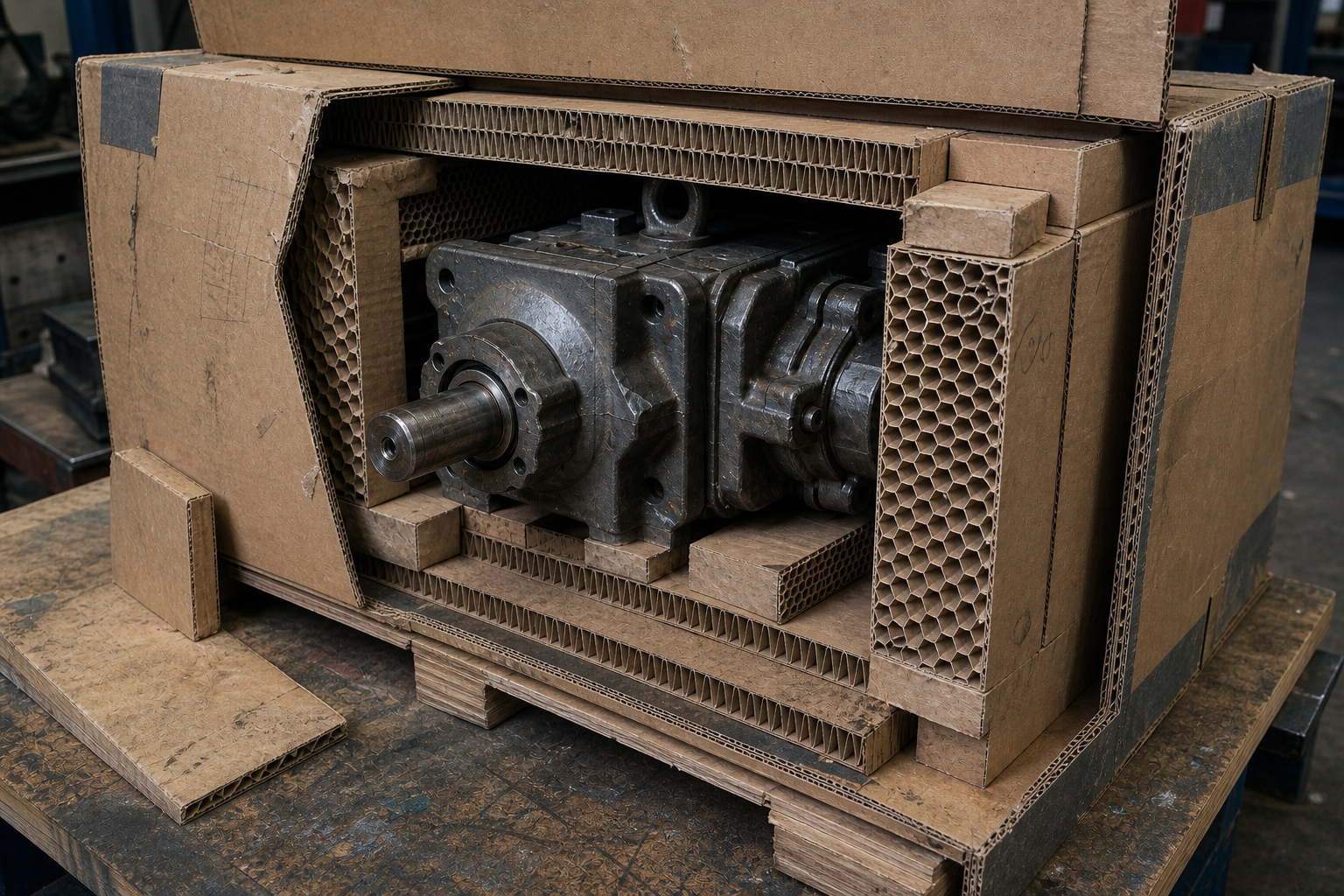
Blocks are better when the product has feet, projections, shafts, irregular geometry, or a known movement path. They can be die-cut, laminated, or assembled into a close-fitting support. The critical detail is clearance: too much space allows movement, while too little can transfer impact directly into the product.
Edge and corner protectors
Edge and corner protectors are simple in appearance but highly application-specific. The component must cover the vulnerable edge, stay in position, and work with the outer carton, straps, stretch wrap, or pallet pattern. For finished furniture or painted metal, the contact surface may also need a softer or cleaner interface.
Separators, partitions, and load-securement panels
Separators keep multiple products from contacting each other. Blocking and bracing components fill strategic gaps and prevent a load from moving during braking, turning, vibration, or stacking. These parts are often where a lightweight honeycomb structure creates the most value: it adds shape and stability without filling the entire package with material.
Paper honeycomb pallets
Paper-based pallets or pallet components can be considered when the load, handling equipment, warehouse conditions, and export requirements are suitable. They should not be treated as a universal replacement for wood or plastic pallets. Fork entry, point loads, humidity, stacking, and the exact load distribution must be reviewed before approval.
Hexacomb vs. Foam, Corrugated, and Wood
There is no single “best” protective material. The practical comparison is about the job each material must perform.
| Material | Useful when | Watch-outs |
|---|---|---|
| Hexacomb | You need lightweight rigidity, separation, blocking, bracing, pads, or shaped paper components. | Moisture, point loads, and cushioning requirements need project-specific validation. |
| Foam | You need soft cushioning, surface conformity, or strong isolation around a delicate component. | Material recovery, compression set, storage volume, and disposal may complicate the system. |
| Conventional corrugated | You need cartons, dividers, partitions, and widely available packaging structures. | Thin flat inserts may buckle or collapse when a heavier load needs structural support. |
| Wood | You need high load capacity, rigid crates, or established heavy-duty handling systems. | Weight, treatment requirements, handling cost, and disposal can be significant. |
For transport validation, the package should be tested in the configuration that will actually ship. The International Safe Transit Association provides recognized transport-testing resources, but a test protocol still needs to match the product, parcel or freight route, and distribution environment.
Where a project needs a formal distribution test plan, ASTM D4169 is a useful reference point for thinking about distribution hazards and test sequences; it does not replace application-specific engineering.
What Should You Send a Hexacomb Supplier?
A supplier can design faster when the request describes the product and the failure risk, not only the desired material. Include:
- Product length, width, height, weight, center of gravity, and fragile or finished surfaces.
- Photos, drawings, or a simple marked-up sketch showing vulnerable areas and loading direction.
- Current packaging, recurring damage, movement inside the carton, and any customer complaints.
- Shipping mode, pallet pattern, stacking height, warehouse conditions, and destination markets.
- Required quantity per shipment, annual volume, packing labor, and whether the component must be flat-packed.
- Material goals, disposal requirements, moisture exposure, and any weight or dimensional limits.
The supplier should then propose a component format, core or board construction, cut pattern, fit, and prototype plan. If the application involves heavy equipment or long-distance freight, ask how the design will be checked for compression, impact, vibration, movement, and repeatability.
For paper-based packaging claims, it is also important to separate material composition from end-of-life claims. The U.S. EPA recycling guidance is a useful reference for common paper recycling questions, but local collection rules and any coatings, laminations, or mixed materials still need to be confirmed.
11 Box Designs, One Quote That Kept the Deal Moving
The customer did not need one generic carton. They had their own design and eleven electronic-device box requirements. The winning move was to turn a complicated RFQ into a clear, item-by-item packaging plan.
📦 The RFQ Was Bigger Than It Looked
The customer already had a design, but needed eleven electronic-device boxes quoted. The challenge was not simply making a carton; it was keeping every version, quantity, and price clear.
🧩 11 versions
Each box needed its own line in the quotation.
✏️ Existing design
The supplier had to work from the customer’s brief.
💬 Clear pricing
The buyer needed an easy supplier comparison.
🔎 From Inquiry to Order
🛡️ Why This Matters for Hexacomb Protective Packaging
Electronic equipment buyers usually start with a protection problem: stop movement, separate components, protect edges, and keep loading repeatable. A Hexacomb pad, block, separator, or brace works best when it is assigned to a specific product position.
This case is not a confirmed Hexacomb order. Its value is the commercial lesson: several SKUs and different quantities must become one organized protective-packaging brief.
💡 What a Hexacomb Supplier Should Learn
List each model, size, protective component, quantity, and unit price.
State whether Hexacomb stops movement, spreads pressure, protects an edge, or separates parts.
Include drawings, open questions, and the sample plan in the same brief.
✅ What to Include in the RFQ
Send product dimensions and weight for every model, fragile zones, current box design, loading direction, shipping route, quantity, artwork status, and paper-material requirements. For Hexacomb, also confirm cell structure, board thickness, contact area, humidity, and point-loading risks.
How to Validate a Custom Hexacomb Solution
Start with a sample that represents the real product, not an empty carton. Load the component as it will be packed, close the package, and check whether the product can slide, rotate, tip, or touch the outer wall. Look for crushed cells, shifting blocks, scuffed surfaces, and deformation after handling.
Then repeat the test with production-intent materials and a realistic packing routine. If a designer needs ten minutes to position the protective parts perfectly, the pack-out may fail when a warehouse team has to repeat it hundreds of times. Ease of loading is part of protective performance.
For a larger program, compare more than the unit price. Include component count, assembly time, storage volume, freight cube, damage cost, replacement cost, and material handling. A slightly more engineered Hexacomb part may be worthwhile if it reduces movement and simplifies repeat packing—but that should be demonstrated with samples and test records.
Application engineering is especially important when one design must work across several facilities or shipping routes. A supplier with a documented factory and quality workflow can help connect the drawing, prototype, production checks, and repeat-order requirements.
Common Mistakes with Hexacomb Packaging
- Choosing a board thickness before defining the load direction and failure risk.
- Using a flat pad where a shaped block or brace is needed to control movement.
- Assuming paper honeycomb automatically replaces foam, wood, or corrugated in every application.
- Ignoring moisture, point loads, fork handling, stacking, or long dwell times in storage.
- Approving a prototype without checking the real loading speed and operator sequence.
- Writing a recyclability claim without reviewing coatings, adhesives, mixed materials, and local collection rules.
FAQs
What is Hexacomb used for?
Hexacomb is used for pads, blocks, edge and corner protectors, separators, partitions, blocking, bracing, pallet components, void control, and load securement. The correct format depends on the product and transport risk.
Can Hexacomb replace foam packaging?
Sometimes, especially when the main need is rigidity, separation, blocking, or load stabilization. Foam may remain more suitable when a product needs soft, close-fitting cushioning or strong surface conformity. A prototype and test should decide the material choice.
Can custom Hexacomb packaging protect heavy products?
It can support heavy-product applications when the core construction, component geometry, contact area, load direction, and outer package are engineered for the job. Heavy loads should be reviewed for point loading, compression, forklift handling, and stacking before production.
What information does a Hexacomb supplier need for a quote?
Prepare product dimensions, weight, drawings or photos, fragile areas, current packaging, shipping mode, pallet pattern, annual volume, packing method, destination, and deadline. Damage records are especially helpful because they show what the new design must change.
Is Hexacomb packaging recyclable?
Paper-based components may be recyclable, but the final answer depends on facings, coatings, adhesives, laminations, contamination, and local collection rules. Confirm the complete material construction and the target market’s recycling pathway before making a public claim.
Conclusion: Choose the Configuration, Not Just the Material
Hexacomb protective packaging is most valuable when its honeycomb structure is assigned a clear job: distribute pressure, create a gap, protect an edge, block movement, separate products, or support a load. It can be lighter and easier to configure than some traditional systems, but performance still depends on geometry, material construction, transport conditions, and validation.
Start with the product, route, and damage risk. Then choose the right combination of pad, block, brace, separator, edge protector, pallet component, or load-securement panel. That sequence turns “we need Hexacomb” into a packaging specification a supplier can actually engineer.
Request a Custom Hexacomb Packaging Review
Bring your product dimensions, weight, photos, current pack-out, shipping route, annual quantity, and recurring damage points. We can use those details to evaluate whether honeycomb pads, blocks, edge protection, blocking and bracing, or a paper-based pallet component is the right fit.
Send the target dimensions, material preference, artwork or drawing, quantity, destination, and deadline through our custom packaging inquiry. A clear brief makes sampling and supplier comparison much more useful.
Send Your Packaging Brief to Our Team
Share your product type, format, size, quantity, material, destination, and required date. Our team can support artwork review, sampling, production, inspection, and export coordination.
Contact us for a project-specific recommendation.



Ready to build packaging with a factory team?
Send your product size, material, artwork, quantity, destination, and deadline so our team can focus the first review on quotation and sampling.