How to Ship a Cake Safely: Packaging That Survives Transit

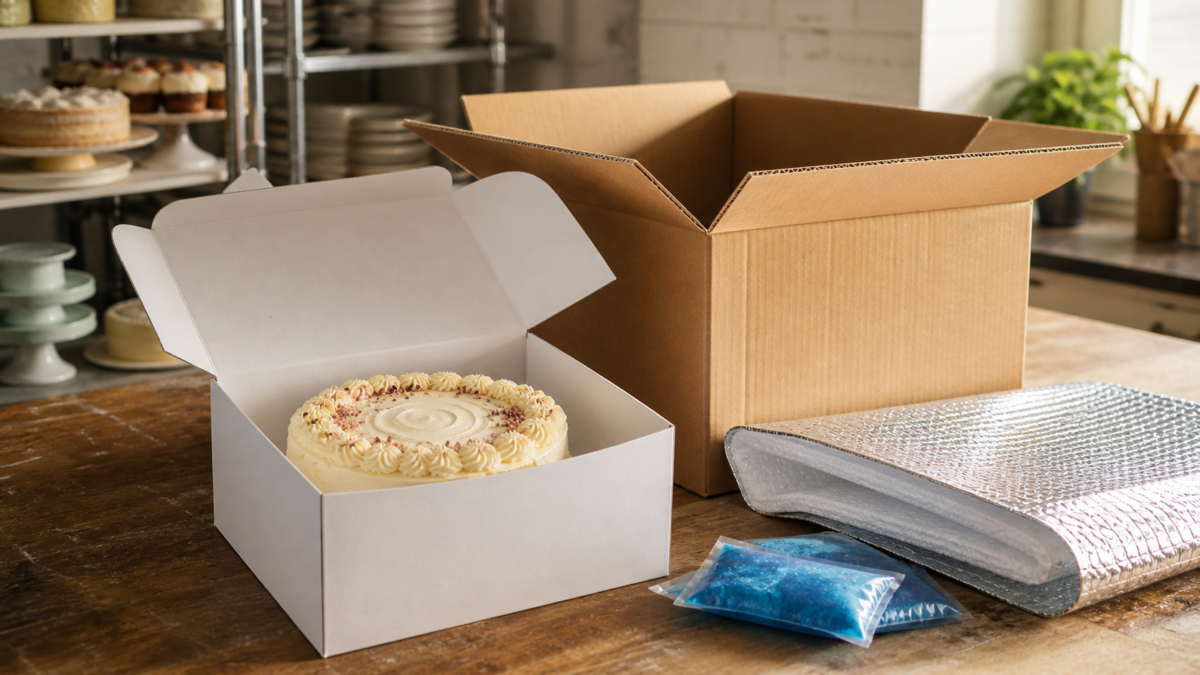
Quick answer: To ship a cake successfully, protect two different things: the cake itself and the parcel around it. Start with a stable cake board and a close-fitting inner cake box. Then add insulation or coolant when the recipe and route require it, and place that inner package inside a correctly sized corrugated shipping box with controlled cushioning.
A bakery box makes the cake presentable. A food shipping box makes the journey survivable. Treat them as separate jobs, and your odds of opening the parcel to cake instead of frosting confetti improve dramatically.

How to Ship a Cake: The Packaging System That Works
The most reliable system is layered: cake → cake board → inner cake box → insulation or temperature control → cushioning → corrugated outer box. Each layer should solve a different failure mode. The board resists flexing, the inner box limits contact, the insulation slows temperature change, and the outer carton handles drops, stacking, vibration, and rough parcel handling.
That is why a lightweight bakery box alone is rarely enough for a parcel network. It may look attractive at the kitchen counter, but it is not designed to absorb a conveyor impact or support another carton during transport. A custom food and beverage packaging system should be sized around the product, not around a generic box chart.
Can You Mail Any Cake?
Cakes that travel more easily
Dense cakes usually have a head start. Pound cake, banana bread, firm chocolate cake, carrot cake with stable frosting, and Bundt cakes can tolerate normal movement better than delicate layered desserts. A firm buttercream or ganache finish is also easier to protect than loose whipped cream.
That does not mean a dense cake can be tossed into a carton and forgotten. It still needs a rigid base, a close-fitting inner box, and a short, realistic transit plan. The recipe may be sturdy, but a soft decoration can still arrive looking like it lost an argument with the lid.
Cakes that need extra planning
Layer cakes, tall decorations, fruit toppings, mousse, custard, whipped cream, and temperature-sensitive fillings need more control. Internal dowels or supports may be necessary for tiers. A cake that depends on refrigeration, or that contains ingredients requiring strict temperature management, should be assessed against the actual transit time and route before you promise delivery.
If the cake cannot remain stable, safe, and presentable for the planned journey, local delivery may be the better packaging decision. The correct answer is not always a stronger box; sometimes it is a shorter route, a different recipe, or a different fulfilment promise.
How to Package a Cake for Shipping Step by Step
1. Cool and stabilize the cake
Let the cake set completely before packing. If the recipe allows it, chill or freeze it according to the baker’s process. Warm cake and cold packaging can create condensation, while soft frosting can mark easily when it touches the box. Secure decorations, add supports to tiered cakes, and confirm that the cake is firm enough to handle without shifting.
2. Use a rigid cake board
The cake board should support the full base and resist bending when someone lifts the box. It should not be so large that it becomes loose inside the inner carton. For commercial shipping, standardizing board sizes with common cake diameters can simplify packing and reduce last-minute substitutions.
3. Protect the surface and decorations
Use a collar, dome, or other food-appropriate protection when the cake design needs separation from the lid. Leave enough vertical clearance for piped frosting and toppers, but do not create a tall empty cavity that allows the cake to move during orientation changes.
4. Fit the cake inside an inner cake box
The inner box is the presentation and containment layer. It should be close enough to reduce horizontal movement while leaving safe clearance around the decoration. If the cake board slides, use a suitable non-slip solution or a fitted insert that does not contact the food. The inner box should close without pressing down on the cake.
5. Add temperature control only when needed
For chilled cakes, insulation can slow heat gain, but it does not create cold by itself. Gel packs, insulated liners, or other coolant systems must be selected around the recipe, expected weather, transit duration, and carrier requirements. Keep coolant separated from the food and plan for condensation so the carton does not soften.
Dry ice is a special case. It can require ventilation, handling instructions, and carrier-specific labeling. Check the current rules from the USPS guidance for dry ice and perishable shipments before building it into a shipping SOP.
6. Place the inner box inside a corrugated shipping box
The outer carton should leave room for controlled cushioning on every vulnerable side. The inner box should not touch the outer walls directly, because that transfers impact into the cake. At the same time, excessive empty space creates movement, more filler, and potentially higher dimensional-weight charges.
For repeat orders, a custom insert can control both horizontal and vertical movement. Depending on the size and route, the insert may be corrugated board, molded fibre, paperboard, or another approved material. The important point is repeatable positioning: every packer should be able to place the inner box in the same location without improvising.
7. Seal and label the parcel
Close the inner box securely and seal the corrugated carton along all required seams. “Fragile,” “perishable,” and orientation labels can communicate handling intent, but they are not a substitute for a package that can survive normal handling. The physical protection should still work when a label is missed.
8. Match the carrier to the product
Choose a service that matches the cake’s stability and temperature needs. Faster service can reduce exposure, but it does not solve a weak inner box or uncontrolled movement. Confirm pickup days, weekend handling, delivery windows, tracking, and whether the recipient will be available to refrigerate the cake.
How to Choose the Right Cake Shipping Box
| Packaging layer | Main job | What to specify |
|---|---|---|
| Inner cake box | Food presentation and containment | Internal clearance, lid height, cake-board fit, food-appropriate materials |
| Insulated liner | Slows temperature change | Thickness, liner format, condensation plan, coolant position |
| Corrugated outer box | Transit protection | Board grade, dimensions, closure, stacking and handling route |
| Insert or cushioning | Controls movement | Gap allowance, pack-out time, material recovery and repeatability |
Measure the cake, cake board, decorations, insulation, coolant, and cushioning as one system. The final outer dimensions should reflect the packed product, not only the cake diameter. If you are preparing a quote, include the product size, packed weight, target quantity, destination, transit expectation, artwork, and whether the carton must be printed or unprinted.
For projects with unusual shapes or several standard cake sizes, a supplier can help compare a family of box dimensions rather than quoting one oversized carton. That comparison may reduce filler, packing time, and dimensional-weight exposure while keeping the protection level consistent.

Cake Box Packaging vs. a Food Shipping Box
A cake box is usually designed for display, carrying, and short-distance handling. A corrugated food shipping box is designed for the secondary distribution environment: compression, vibration, stacking, drops, and contact with other parcels. One does not automatically replace the other.
Double boxing often makes sense because it separates clean presentation from rough transport. It also creates a practical space for an insulated liner, coolant, and cushioning. The outer carton can be plain and functional while the inner box carries the bakery’s visual identity.
When the same cake is shipped repeatedly, the inner and outer boxes should be developed together. A supplier’s custom packaging review can compare box style, flute, board strength, insert geometry, print coverage, and packing orientation before production.
How to Keep a Cake Stable During Shipping
Movement is usually a geometry problem before it is a material problem. If the cake can slide, rotate, tip, or touch the lid, the pack-out needs revision. Use a board that does not flex, a close-fitting inner box, and supports that restrain the package without crushing the decoration.
Test the packed cake by gently tilting and rotating the sealed parcel. Listen for movement. Check whether the inner box shifts inside the outer carton. Then inspect the cake after the test rather than assuming that a quiet carton is a safe carton.
For commercial bakeries, custom inserts become valuable when the same sizes ship frequently. They can shorten packing time, make training easier, and reduce variation between employees. The best insert is not necessarily the most elaborate one; it is the one that protects the product and can be packed correctly at production speed.
Temperature Control and Food-Safety Boundaries
Temperature decisions depend on ingredients, recipe, packaging, weather, transit time, and the receiving environment. A cold pack may help maintain a lower temperature, but the package still needs a validated plan for how cold the cake must remain and for how long. Do not treat “insulated” as a promise of a specific safe temperature.
For perishable products, build the shipping procedure around applicable food-safety guidance and the actual market. The FDA Food Code resources are a useful starting point for U.S.-focused food handling questions, but they do not replace recipe-specific or local regulatory review.
Coolant placement matters too. A gel pack should not move freely against the cake, and condensation should not soak the inner or outer carton. A liner, barrier, or secondary pouch may be needed depending on the pack-out. The practical rule is simple: protect the food from both heat and the packaging system used to control heat.
Internal food-packaging evidence · two related projects
When Food Shipping Became a System Problem
A cake may look like the product, but the delivery system decides whether it arrives stable, presentable, and within its temperature requirements. Two internal food-packaging projects show why the box should never be planned alone.
One food shipment.
Four working layers.
The strongest common lesson from the two projects: protection, temperature control, and outer shipping strength need to be specified together.
The decision behind the cases
Instead of comparing only the price of a single box, the projects treated the shipment as one sequence: product → containment → temperature protection → transport protection.
This is the same logic a bakery needs when deciding how to mail a cake. The cake box presents the product; the shipping system protects the delivery promise.
The four-supplier problem
The customer needed a foam box, ice packs, a foil bag, and an outer carton. Sourcing each layer separately created more handoffs and more coordination.
- The protective components were reviewed as one cold-chain pack.
- The outer carton became part of the thermal and logistics plan—not an afterthought.
- The practical takeaway was to compare the complete delivery system, not a single unit price.
The insulated meal-box project
This related food-packaging project adds the fulfilment view: an insulated meal box has to work in a real delivery routine, not only as a material sample.
- Temperature protection must be considered with the delivery window and route.
- The insulated format still needs practical loading, closure, and handling checks.
- For repeat food shipments, packing consistency matters as much as material selection.
Evidence note: These are two separate internal food-packaging projects. The records do not establish that they involved the same customer, market, quantity, or delivery result, so no combined customer claim is made here.

How to Test Cake Shipping Packaging Before Selling It
Pack the cake exactly as it will ship. Use the same board, inner box, liner, coolant, cushioning, outer carton, tape, labels, and shipping configuration. A test packed with extra care by the designer is not evidence that a busy fulfilment team can repeat the result.
- Check that the cake cannot slide or rotate.
- Confirm that the lid and decorations have working clearance.
- Inspect the outer carton for crushing, corner damage, or moisture.
- Review coolant movement and condensation after the expected transit window.
- Run a pilot shipment on the real route before scaling.
- Record damage, packing time, replacement cost, and customer feedback.
For formal testing programs, the ISTA test procedure resources can help frame a discussion about distribution hazards. For a bakery, the final validation still needs to use the actual cake, actual pack-out, and actual delivery conditions.
The Commercial Cost of Shipping a Cake
The lowest box price is not the same as the lowest delivery cost. A useful calculation includes packaging cost, shipping cost, packing labour, coolant or insulation, dimensional weight, replacement cake cost, refunds, reshipping, and customer-service time.
That is why a slightly stronger or better-fitting carton can be economical. If it saves several minutes of packing, reduces empty space, prevents one replacement shipment, or makes the result more repeatable, its total cost may be lower even when its unit price is higher.
For bakeries shipping several standard sizes, create a packaging matrix. List cake diameter and height, board size, inner box, outer carton, liner, coolant quantity, pack-out time, and approved carrier service. The matrix turns a fragile craft process into a repeatable fulfilment operation.
Common Cake Shipping Mistakes
- Shipping before the cake and frosting have fully stabilized.
- Using a presentation cake box as the only parcel protection.
- Leaving large gaps around the inner box and hoping filler will solve movement.
- Letting coolant touch the food or move freely during transit.
- Relying on “Fragile” labels instead of structural protection.
- Ignoring weekends, holidays, weather, or recipient availability.
- Scaling a packaging format before completing a pilot shipment.
Most of these failures are preventable during the specification stage. A good packaging brief records the cake type, packed dimensions, board, inner box, outer board grade, insulation, coolant, insert, closure, route, carrier, and acceptance criteria.
Experience Checklist: What I Check Before Shipping a Cake
Before approving a cake shipping packaging system, I look for five practical signals: the cake is fully set, the board does not flex, the inner box fits without touching the decoration, the outer box limits movement without creating unnecessary volume, and the temperature plan is matched to the recipe and route.
I also check whether another person can pack the same order from a short SOP. If the result depends on one expert “knowing how to arrange the filler,” the design is not finished. Repeatable packaging should make the correct action obvious.
FAQs
Can you ship a cake in a regular cake box?
A regular cake box is usually best treated as the inner presentation and containment layer. For parcel shipping, place it inside a stronger corrugated outer box with controlled cushioning and temperature protection when the recipe requires it.
How do you keep a cake from moving during shipping?
Use a rigid cake board, close-fitting inner box, suitable supports, and cushioning or a custom insert that prevents the inner package from sliding, rotating, or tipping inside the outer carton.
How do you keep a cake cold while shipping?
Assess the recipe and route first, then combine suitable insulation with coolant when required. Keep coolant separated from the food, manage condensation, and confirm carrier and local food-safety requirements before shipping.
What is the best outer box for cake shipping?
The best outer box is the smallest practical corrugated carton that leaves room for the inner cake box, insulation, coolant, and protective cushioning without allowing movement. Board grade and closure should match the route and handling environment.
Should a bakery test a cake shipment before selling it?
Yes. Run a pilot shipment using the actual cake and pack-out on the actual route. Inspect movement, decoration, temperature condition, moisture, carton deformation, packing time, and delivery timing before
scaling the format.
For repeat bakery programs, review the supplier’s Intelligent Factory workflow when comparing sampling, inspection, production control, and export coordination.
Conclusion: Design for a Successful Delivery
Knowing how to ship a cake is less about finding one magic box and more about matching layers to risks. Stabilize the cake, protect it inside a close-fitting cake box, control temperature where necessary, then use a right-sized corrugated outer carton with repeatable cushioning or inserts.
The best cake shipping packaging balances food protection, presentation, transit strength, packing speed, dimensional weight, and realistic delivery conditions. Test the whole system before scaling, and judge the result by the cost of a successful delivery—not by the price of an empty carton.
Request a Cake Shipping Packaging Review
Forests Packaging Group can review your cake dimensions, board size, inner box, outer corrugated carton, insert, insulation, artwork, quantity, destination, and deadline as one packaging brief. That makes it easier to compare protection, packing labour, material use, and shipping exposure before bulk production.
Send the cake type, packed size, target quantity, route, temperature requirements, and reference photos through the quote and project review page. We can then recommend the information needed for sampling and a production-ready specification.
Send Your Packaging Brief to Our Team
Share your product type, format, size, quantity, material, destination, and required date. Our team can support artwork review, sampling, production, inspection, and export coordination.
Contact us for a project-specific recommendation.
Ready to build packaging with a factory team?
Send your product size, material, artwork, quantity, destination, and deadline so our team can focus the first review on quotation and sampling.