Poly Bags With Suffocation Warning: Requirements, Sizes & Custom Options

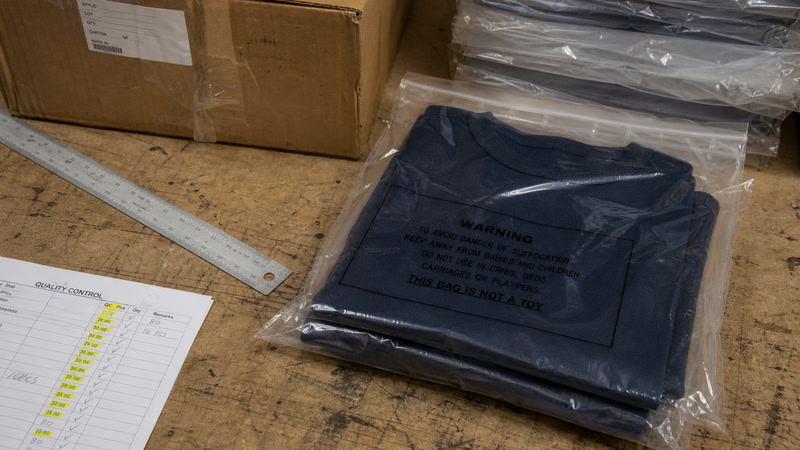
Quick answer: Poly bags with a suffocation warning are usually specified by more than the warning itself. The buyer also needs to confirm the bag’s opening, flat dimensions, film thickness, sales channel, destination market, wording, type size, barcode area, and closure. A legal rule, an Amazon FBA rule, and a retailer manual are not automatically the same thing.
Why Poly Bags With Suffocation Warnings Need Careful Specification
A warning printed on a bag looks like a small artwork task. It is not. The usable space changes with the bag size, the film stretches around the product, and the warning may share the front panel with a logo, barcode, SKU, recycling information, or retailer label. Buyers comparing custom poly bags and mailing bags should define that layout before requesting a final price.
The first question is not “Which sentence should we print?” It is “Where will this bag be used?” A thin inner bag for apparel stored and fulfilled by a marketplace may face different instructions from a thicker outer poly mailer used only for parcel transport.
Does Every Poly Bag Need a Suffocation Warning?
No single rule covers every plastic bag. Applicability can depend on the destination, intended use, bag construction, opening size, film thickness, and sales channel. California, Massachusetts, New York, Rhode Island, Virginia, several cities, Canada, Amazon, and major retailers may use different triggers or wording rules. California’s polyethylene bag statute illustrates why thickness, bag size, use, and type size should be checked together.
That is why a supplier should not label every request as “legally compliant” without knowing the market and use. The supplier can help convert the requirement into artwork and production details, but the brand or importer remains responsible for checking the rule that applies to its product.
Three requirements to keep separate
- Law: a state, city, or national requirement that may apply to certain bags.
- Marketplace policy: a fulfillment platform’s operational rule, which may be stricter or broader than local law.
- Retailer standard: a vendor manual that can add its own print, labeling, or packaging conditions.
What Amazon FBA Usually Expects
Amazon’s poly-bag preparation guidance is a common reason buyers request custom poly bags with suffocation warning print. The current guidance should be checked in Seller Central before production, but the usual specification points include a transparent bag, minimum film thickness, complete sealing, a scannable barcode, and a prominent warning when the opening reaches the stated threshold.
Amazon’s guidance has commonly specified a minimum thickness of 1.5 mil and a warning for bags with an opening of 5 inches or more when measured flat. It also limits loose excess material around the product. The official Amazon poly-bag preparation guidance should be treated as the controlling source for an FBA shipment, not an old supplier template.
For apparel and textile products, the bag may need to protect the unit from dust and moisture while keeping the barcode readable. A warning that is technically present but hidden by the product, folded into the seal, or printed too lightly can still create an operational problem at receiving.

Bag Size, Opening, and Film Thickness
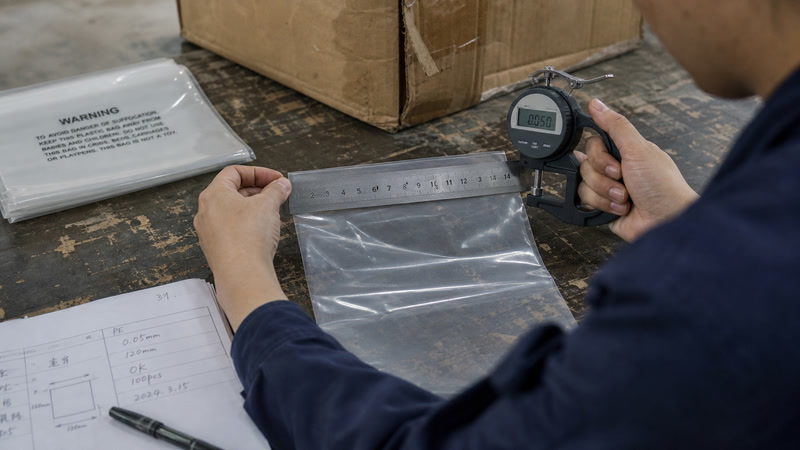
These measurements are often mixed together in a quotation, which is where avoidable mistakes begin. Ask the supplier to state how each measurement is taken.
- Width: the bag width measured flat, excluding or including gussets as agreed.
- Length: the body length from the bottom seal to the opening or flap.
- Opening: the usable mouth width, measured flat if the rule or marketplace says so.
- Film thickness: the target mil or micron value, with the permitted production tolerance.
Do not assume that a 1.5 mil bag is automatically exempt from every warning requirement. Thickness can affect the scope of a local law, while Amazon or a retailer can still require a warning as part of its own packaging program. Put both the compliance trigger and the purchasing specification on the same approval sheet.
What Should the Warning Say?
Most accepted warning copy contains four ideas: a clear signal word such as “WARNING,” the risk of suffocation, a direction to keep the bag away from babies and children, and a safe-disposal or no-toy instruction where required. The exact wording is not universal.
A commonly used US-style example is: “WARNING: To avoid danger of suffocation, keep this plastic bag away from babies and children. Do not use this bag in cribs, beds, carriages or playpens. This bag is not a toy.” Do not shorten or rewrite mandatory copy just to make room for a logo. The Massachusetts plastic bag regulation is a useful example of how wording, prominence, contrast, and type size can be specified together.
For a global program, ask whether English, French, Spanish, or another language is needed. A translation added at the end can make the warning too small, so multilingual space should be planned before the artwork is approved.
When a “Simple Bag” Became a Repeat-Order Test
A sales record titled “Drawer Gift Box & Ghost Garbage Bag Order Review” shows why poly bag projects should be treated as specification work—not just a quick printing job.
The useful part of the conversation
The customer was not simply asking, “How much is the bag?” The real concern was whether the final printed appearance would be accepted by the end customer. That changed the next step from a blind production order into a controlled proofing decision.
What packaging buyers can take from it
- Do not approve a poly bag from a screen image alone. Film surface, opacity and ink coverage can change the result.
- Separate structural approval from print approval. The bag may be physically correct while the warning text or artwork still needs revision.
- Put the warning into the artwork proof. Do not add the suffocation warning after the main design has already been approved.
- Use a targeted sample when the customer’s concern is visual. This can reduce wasted sampling while keeping the final decision clear.
Source note: Based on internal sales-win record 40935, “Drawer Gift Box & Ghost Garbage Bag Order Review.” The archive confirms the project title and proofing discussion; specific warning wording, film thickness and order quantity should be confirmed separately before being used in a technical specification.
Printed Warning or Applied Label?
Direct printing works well when the bag size, wording, and market are stable. It removes a manual labeling step and gives repeat orders a consistent appearance. It also means that a rule change may leave printed stock that cannot be used in every channel.
An applied warning label is more flexible for a trial run, a small order, or a product sold into several markets with different language needs. It adds label cost and packing labor, and the label must stay attached and readable through handling.
| Choose printed warning | Choose applied label |
|---|---|
| Repeat orders and stable artwork | Changing markets or wording |
| High packing volume | Small or pilot quantities |
| Branding and warning share a planned layout | Warning is added after product approval |
How to Design the Bag Without Hiding the Warning
Start with a simple artwork hierarchy: warning area, product identification area, barcode area, then brand area. This does not mean the warning has to dominate the front of the bag. It means the warning must remain visible when the bag is filled, folded, sealed, and viewed under warehouse lighting.
Leave quiet space around the text. Use enough contrast against the film and avoid placing small type over a busy print. If a transparent bag contains a dark garment, a thin black warning can disappear. A white ink panel or a stronger contrast treatment may be more practical than reducing the logo.
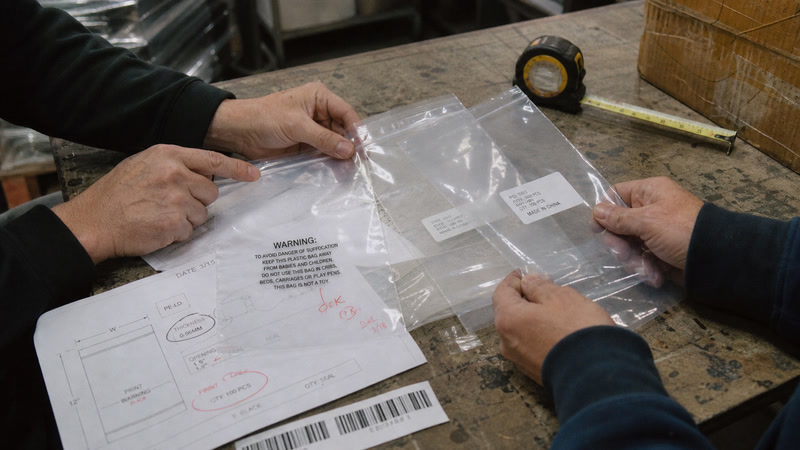
Before mass production, inspect a filled sample, not just a flat artwork proof. Check the warning after the bag is sealed, confirm the barcode scans through the film, and measure the printed type on the physical bag.
Build a Supplier-Ready Specification
A useful RFQ does not say only “custom poly bags with suffocation warning.” Send a short specification with these fields:
- Product type, packed dimensions, weight, and whether the item is apparel, retail goods, or an FBA unit.
- Bag width, length, opening, flap length, gusset if any, closure, and flat-measurement method.
- Film material, thickness in mil or micron, transparency, recycled-content requirement, and tolerance.
- Destination markets, fulfillment channels, retailer requirements, warning language, and legal copy source.
- Logo artwork, barcode type and location, print colors, warning type size, and clear-space requirement.
- Quantity, target delivery date, repeat-order forecast, sample requirement, and packaging method for shipment.
Ask for a physical sample or digital proof that shows the bag filled with the intended product. If the final bag is made for a marketplace, include a screenshot or current policy reference in the approval file and date it. That small habit prevents an old requirement from quietly becoming the production standard.
Stock or Custom Poly Bags With Suffocation Warning?
Stock bags are sensible when the size is standard, the order is small, and speed matters more than branding. Custom production earns its place when the product needs a precise fit, a printed logo, a barcode layout, multilingual warnings, a special closure, or repeat-order consistency. The relevant packaging compliance support should be discussed by product, market, and material rather than assumed from a general certificate list.
Custom does not mean “print everything.” It means fixing the details that create labor or compliance risk. A well-sized bag can reduce excess film, keep the warning in one visible area, and stop the packer from covering the barcode with a second label.
Pre-Production Checklist
- Target market and fulfillment channel confirmed.
- Current legal and marketplace guidance saved with the artwork.
- Opening, width, length, and thickness measured using an agreed method.
- Warning wording and language approved by the buyer.
- Type size, contrast, placement, and repeat interval checked.
- Barcode scans through the finished bag or is placed on the outside.
- Filled sample sealed and reviewed before bulk production.
Common Mistakes Buyers Make
The most common mistake is treating a marketplace rule as universal law. The next is copying a warning from an old bag without checking the destination. Buyers also confuse film thickness with opening size, approve artwork at screen scale, forget the barcode area, or add a second language after the print layout is already full.
A supplier can catch many of these problems during sampling, but the approval needs the buyer’s actual sales channels and destination markets. Without that information, even a neat-looking warning bag may be the wrong bag for the shipment.
Choosing a Poly Bag Supplier
Compare suppliers on more than unit price. Ask about film thickness control, custom dimensions, printing registration, small-text legibility, barcode handling, sample approval, repeat-order consistency, MOQ, and production inspection. A supplier that asks for the opening measurement and destination market is usually protecting the project from a bad assumption.
Forests Packaging Group can review the packaging specification around product dimensions, film, closure, warning layout, artwork, quantity, and destination. The team can also coordinate sampling, production checks, carton packing, and export arrangements through its packaging and logistics workflow. For a separate starting point, see the company’s ecommerce shipping packaging guidance.
For a project-specific review, send the product details, target market, warning artwork, quantity, and delivery date through the custom packaging inquiry page. The first review can then focus on the actual bag specification instead of a generic warning template.
FAQs
Do all poly bags need a suffocation warning?
No. The answer depends on the bag, destination, intended use, and sales channel. Check applicable law and marketplace or retailer rules separately.
What size opening triggers an Amazon FBA warning?
Amazon guidance has commonly used a 5-inch opening measured flat as the warning threshold. Confirm the current Seller Central requirement before production because platform rules can change.
Can the warning be printed with my logo?
Yes, when the artwork keeps the warning prominent, legible, and separated from the barcode and other graphics. Approve the finished filled bag, not only the screen proof.
Is 1.5 mil thick enough for every market?
Not automatically. Thickness may affect a local legal threshold, while a marketplace can impose its own minimum. Confirm the rule and the physical bag specification independently.
What should I send a supplier for a quote?
Send the product details, bag dimensions, opening, film thickness, material, closure, warning copy, languages, artwork, barcode, destination markets, quantity, and delivery date.
Final Takeaway
Poly bags with a suffocation warning are a compliance and production decision, not just a printed sentence. Check the market, channel, bag opening, dimensions, thickness, wording, type size, language, barcode, and closure together. Then turn those verified details into a supplier-ready specification before requesting a quote.
When the bag is part of Amazon FBA, retail, or international fulfillment, a physical filled sample is worth the extra step. It shows whether the warning remains readable when the product, seal, barcode, and branding are all competing for the same piece of film.
Send Your Packaging Brief to Our Team
Share your product type, format, size, quantity, material, destination, and required date. Our team can support artwork review, sampling, production, inspection, and export coordination.
Contact us for a project-specific recommendation.

Ready to build packaging with a factory team?
Send your product size, material, artwork, quantity, destination, and deadline so our team can focus the first review on quotation and sampling.