Regular Slotted Container (RSC): A Practical Packaging Guide


Quick answer: A regular slotted container (RSC) is the standard corrugated shipping box: four body panels, equal-length flaps, and outer flaps that meet at the center. It is efficient, easy to store, and suitable for many ecommerce, manufacturing, and distribution jobs. The right RSC still depends on product fit, board strength, stacking, handling, and the route to the customer.
This guide explains how regular slotted container packaging works, when it is the sensible default, when another box style is safer, and what to include in a quote request. The short version: start with the product and distribution risks, then let the box geometry follow.
What Is a Regular Slotted Container (RSC)?
A regular slotted container is a one-piece corrugated carton scored and slotted so it folds into a rectangular box. Its top and bottom flaps are normally the same length. The two outer flaps are usually half the box width, so they meet in the middle when the carton is closed.
That center meeting line is the feature people often recognize as “the usual shipping box.” In industry language, RSC box, regular slotted carton, slotted container, and regular slotted container packaging generally describe the same basic style. The exact board, dimensions, joint, print, and closure can still be customized.
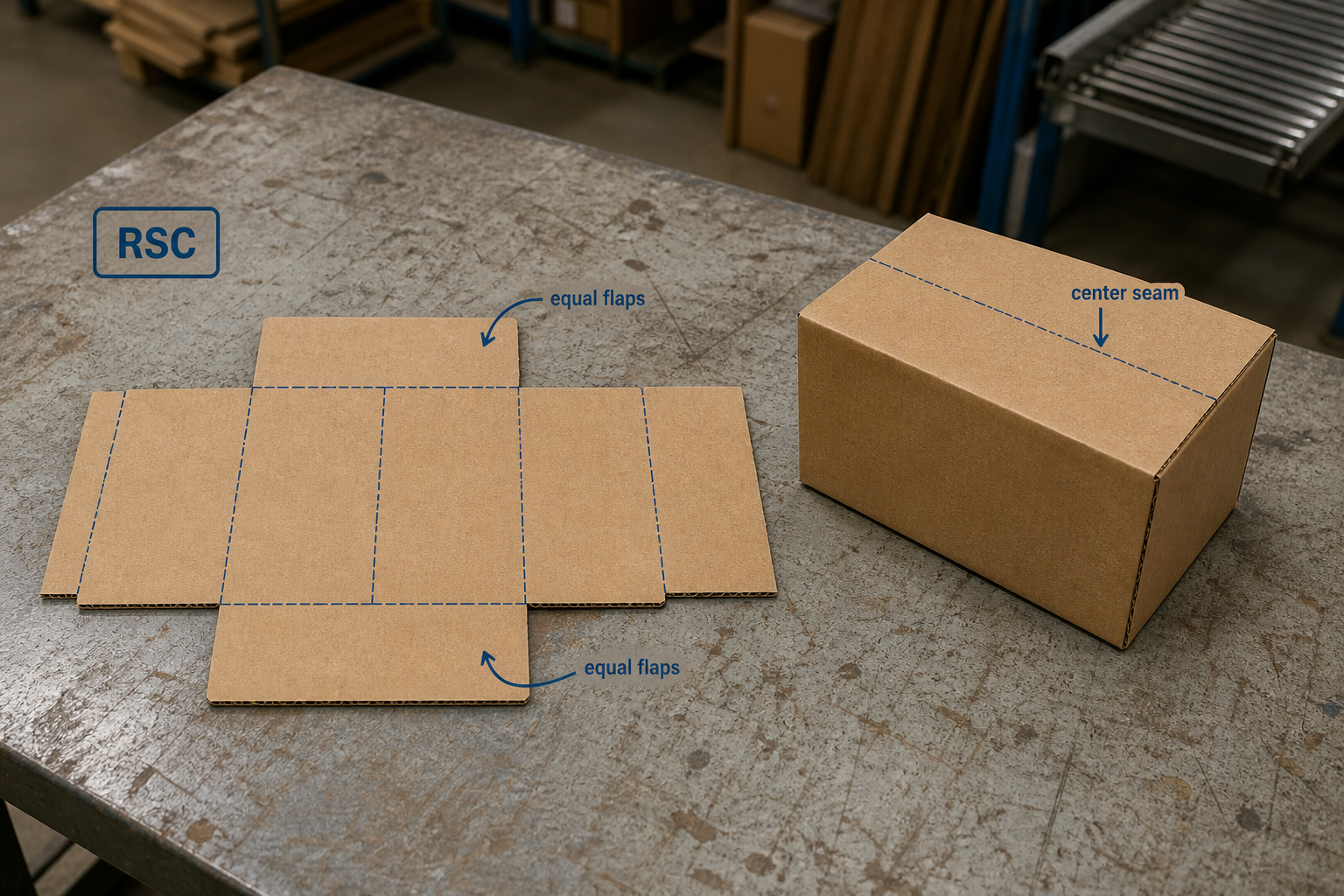
How the RSC Structure Is Built
The blank contains four main body panels, score lines between them, a manufacturer’s joint, and pairs of major and minor flaps. During converting, it is cut and creased flat. At the packing station, the blank is squared, the bottom is sealed, the product is loaded, and the top flaps are closed.
Why RSC Boxes Are So Common
RSCs use material efficiently, ship flat, stack neatly, and work with tape, staples, hot melt, or other supplier-supported closing methods. They are also widely available from corrugated manufacturers, which helps buyers compare board grades and production routes without commissioning an unusual structure.
How Does an RSC Box Work in Real Packing?
RSC performance is not created by the carton alone. The box, product, void space, closure, pallet pattern, and handling route behave as one system. A box that feels strong on a worktable can still fail if it is oversized, poorly stacked, exposed to moisture, or loaded with a concentrated point force.
- Fold: score lines guide the panels and flaps into a square shape.
- Seal: the bottom joint and flaps create a stable loading surface.
- Load: the product and any insert should sit without excessive movement.
- Close: top flaps meet at the center and are secured for the route.
For a repeat program, watch an actual packing cycle. If staff must force the flaps, turn the product repeatedly, or add unplanned void fill, the RSC may be technically correct but operationally wrong.
Where Is Regular Slotted Container Packaging Used?
RSCs are a practical fit for ecommerce shipping, case packing, warehouse movement, general merchandise, and secondary food or beverage packaging where direct food contact is not required. They are also common in manufacturing packaging for parts, hardware, packaged components, and replenishment cartons.

For ecommerce, the useful question is not simply “Can an RSC hold this item?” Ask whether it protects the product through picking, parcel sorting, van delivery, returns, and storage. An insert, divider, edge pad, or tighter size may create more value than adding a decorative finish.
For manufacturing and distribution, standard outer dimensions can simplify pallet planning and case handling. For retail, printed handling marks, barcodes, and consistent panel orientation may matter as much as the carton’s compression performance.
Advantages and Limitations of the RSC Style
The main advantage is balance. An RSC is not the most specialized structure, but it solves a large number of ordinary shipping problems with a relatively simple blank and familiar packing method.
- Efficient use of corrugated board and flat storage space.
- Broad availability and straightforward converting.
- Easy sealing and predictable case packing.
- Custom length, width, height, board, flute, print, and inserts.
- Good general-purpose protection when fit and stacking are controlled.
Its limits are equally important. Standard center-meeting flaps do not provide full overlap protection. Heavy or concentrated loads may need a stronger board, a reinforced bottom, partitions, or a different box style. Fragile products may need immobilization, not merely a thicker wall. Long, shallow, or irregular products can also expose the weaknesses of a conventional rectangle.
A useful decision rule is simple: choose an RSC when a conventional rectangular carton can protect the product without a specialized closure, full-overlap reinforcement, or complex internal structure.
RSC vs. Other Corrugated Box Styles
RSC is the baseline style, so comparisons are easiest when framed around what changes in the flaps and closure.
| Style | What changes | Typical reason to choose it |
|---|---|---|
| RSC | Equal flaps meet at center | General shipping and case packing |
| HSC | One set of flaps is removed | Open-top loading or display access |
| FOL | Outer flaps nearly overlap fully | Rough handling, stronger base or stacking |
| OSC | Outer flaps overlap partially | Long boxes where a center gap needs help |
| Telescoping box | Separate lid and base or body | Deep products, presentation, or lid fit |
The best structure is conditional, not universal. A supplier should compare the product’s weight, shape, load direction, handling route, pallet pattern, and opening requirements before recommending a custom regular slotted container or an alternative style.
How to Choose RSC Box Dimensions
Quote dimensions in a consistent order, normally length × width × height. Confirm whether they are internal or external. Internal dimensions control product fit; external dimensions affect palletization, warehouse clearance, and carrier calculations.
Measure the product at its widest and tallest practical points, then add the space required for inserts, cushioning, tolerances, and loading. Do not add empty volume simply because a larger box feels safer. Movement inside the carton can increase impact, while extra outside dimensions can increase dimensional-weight charges.

A practical fit check uses the actual product, the intended insert, and the final closure. Load it the way a packing operator will. Turn the box, check movement, inspect corners, and confirm that the same result can be repeated across several samples. A box that fits one carefully arranged unit but not normal production handling needs another revision.
For a useful background on how box geometry and board selection connect to shipping, see the custom packaging product range before narrowing the quote.
Choosing Corrugated Board, Flute, and Strength
Do not choose board grade from product weight alone. A small dense product can create a severe point load, while a larger light product can be easy to protect. Box dimensions, stacking height, warehouse time, humidity, pallet pattern, parcel handling, and drop risk all influence the specification.
Single-wall board is often enough for general distribution. Double-wall construction may be more appropriate for heavier loads, longer storage, or higher stacking demands. Flute selection balances thickness, cushioning, print surface, folding behavior, and compression performance. The supplier should state the agreed board construction and performance basis rather than using “strong cardboard” as the entire specification.
Where testing is relevant, agree on the method and acceptance criteria before production. The ISTA testing resources are a useful reference when a project needs a defined distribution test rather than an informal drop test.
Custom Regular Slotted Container Options
Custom RSC boxes can be adjusted without abandoning the efficient basic geometry. Common options include custom dimensions, single- or double-wall board, kraft or white outer liners, flexographic or offset-printed graphics, barcodes, handling marks, coatings, partitions, pads, and paper-based inserts.
Printing should follow the job. A shipping carton may need one-color handling information and a readable barcode; an ecommerce brand may want exterior graphics and a cleaner opening moment. If the board surface, moisture exposure, or abrasion risk changes, review the ink and coating together with the structure.
For a buyer comparing several formats, the packaging applications guide helps connect box selection with ecommerce, retail, food, electronics, and other handling environments.
What Should You Include in an RSC RFQ?
A clear RFQ prevents a supplier from quoting a box that is technically the right style but the wrong fit. Include the following in one brief:
- Internal or external length, width, and height, with a drawing if available.
- Product weight, shape, fragility, center of gravity, and loading direction.
- Board construction, preferred flute, strength target, and whether recycled content is required.
- Closure method, insert or divider requirements, print coverage, color references, and barcode files.
- Annual volume, order quantity, sample quantity, destination, pallet limits, and target ship date.
- Distribution route: parcel, pallet, export freight, warehouse stacking, climate exposure, and returns.
- Testing or documentation requirements, including approved sample and change-control expectations.
Attach a product sample, reference carton, dieline, or marked-up photograph when possible. A supplier can solve the right problem much faster when the brief shows how the product is loaded and what failure would look like.
When freight is priced by volume as well as weight, check the carrier’s current dimensional-weight rules. The UPS dimensional-weight explanation shows why oversizing can affect the delivered cost even when the carton itself is inexpensive.
How a Custom RSC Project Should Move From Sample to Production
A disciplined workflow is usually more valuable than a clever box name. Start with the product and distribution brief. Review the dieline and dimensions. Produce a sample. Pack the real product. Check closure, movement, stacking, print, and operator handling. Then approve the specification that will control the repeat order.
Before release, document the board, flute, dimensions, print process, colors, finish, insert, closure, packing orientation, and tolerance. If a production change is needed, record it and obtain approval before the run. That small habit prevents many “the sample was fine, but the shipment was different” conversations.
For factory-backed sampling, inspection, and export coordination, review the Intelligent Factory workflow as part of the supplier comparison.
When a “Standard” Box Reached 1,711 mm
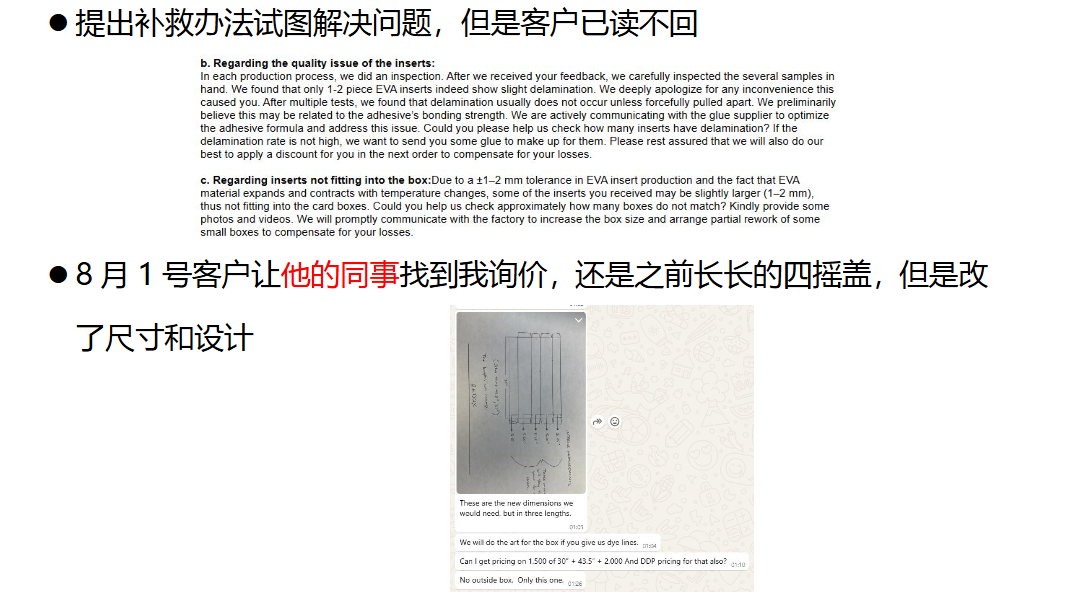
An international-trade customer first came through with a long four-flap carton inquiry recorded on July 12, 2024. The structure looked familiar—until the unfolded length, full-coverage UV requirement, and final fit review turned it into a real engineering conversation.
For a very long carton, a paper or flute splice can become visible—especially under full-coverage UV. The team found that joining the board would compromise the appearance, so the project needed a different production route.
The shipment also included EVA inserts. After delivery, the inserts expanded, some detached, and fitting became difficult. The lesson was practical: leave working clearance, and validate the insert after storage—not only on day-one samples.
- For oversized RSC-style cartons, specify “no paper splice / no flute splice” during quotation if appearance is critical.
- Test the box with the real insert, real clearance, and a realistic storage interval.
- Record dimensions, material, UV coverage, tolerance, and approved changes before releasing production.
- A difficult first project can still become repeat business when the supplier remembers the failure points. The later order used revised dimensions and three sizes totaling 5,000 cartons.
Source note: Internal case record 71187, “Longest Four-Flap Box Daily Crown Order Sharing.” The customer’s country is not stated in the record, so no location is inferred here.
Common RSC Mistakes to Avoid
- Quoting external dimensions when the product needs internal clearance.
- Choosing board from weight alone and ignoring stacking or humidity.
- Using an oversized carton and then filling the empty space with movement-prone void fill.
- Approving print on a screen without checking the actual liner and process.
- Testing an empty carton instead of the packed product.
- Changing flute, closure, or insert after approval without a recorded review.
RSC Packaging FAQs
What did the 1,711 mm four-flap case teach about RSC dimensions?
It showed that a long box needs more than a length measurement. The 1,711 mm unfolded carton required a review of board joining, full-coverage UV, loading direction, handling, and the visual effect of any paper or flute splice before production.
Should a long RSC carton allow a paper or flute splice?
Only when the appearance and performance brief allows it. In this case, the long carton and full-coverage UV made the splice visually unacceptable, so “no paper splice / no flute splice” should have been treated as an RFQ requirement from the beginning.
How should inserts be checked before bulk production?
Test the actual insert inside the actual box, then allow for storage time and material change. The case showed why EVA can expand: an insert that fits the first sample may later become difficult to load or begin to detach unless clearance is designed into the system.
What should an RFQ include for an oversized RSC box?
Include internal and external dimensions, unfolded length, board and flute, maximum finished size, print and UV coverage, splice restrictions, insert material, clearance, quantity, destination, DDP or other delivery basis, and the date needed for the first shipment.
How should production changes be approved after sampling?
Put every change in writing and approve the revised sample or specification before the run. For long RSC-style cartons, that record should cover dimensions, joining method, print coverage, insert clearance, tolerances, packing orientation, and any material substitution.
Conclusion: When an RSC Is the Right Choice
A regular slotted container remains popular for a good reason: it is simple, efficient, familiar, and adaptable. Choose it when the product is reasonably rectangular, the center-meeting flaps are sufficient, and the distribution route does not demand specialized reinforcement.
The quality of a custom RSC is decided before the carton reaches the production line. Define the fit, board, flute, closure, insert, handling route, and approval criteria first. Then the supplier can turn a standard box style into a dependable packaging system.
Request a Custom RSC Packaging Review
Forests Packaging Group can review your product dimensions, reference box, dieline, board preference, artwork, quantity, destination, and deadline as one project brief. The goal is to align structure, sampling, printing, inspection, and export handover before bulk production.
Send the product size, packed weight, target quantity, shipping route, and any existing sample through the quote and project review page.
Send Your Packaging Brief to Our Team
Share your product type, format, size, quantity, material, destination, and required date. Our team can support artwork review, sampling, production, inspection, and export coordination.
Contact us for a project-specific recommendation.



Ready to build packaging with a factory team?
Send your product size, material, artwork, quantity, destination, and deadline so our team can focus the first review on quotation and sampling.