What Is GSM Paper? Tissue Paper Weight and Thickness Explained

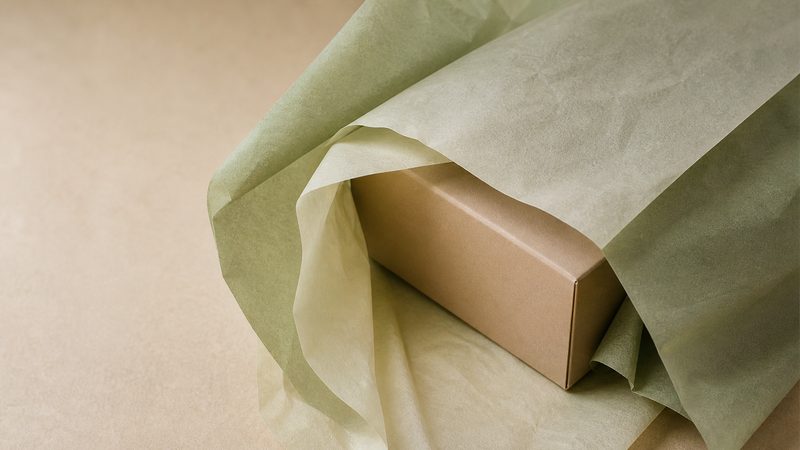
If you are choosing custom tissue, GSM is one of the first specifications you will see—and one of the easiest to misread. GSM tells you how much a sheet weighs over a defined area. It helps compare tissue options, but it does not single-handedly tell you whether a sheet will feel thicker, print better, or protect a product.
This guide explains what is GSM paper, how tissue paper GSM changes the unboxing experience, and how to brief a supplier without treating one number as a magic answer.
Quick answer: what does GSM mean in paper?
GSM means grams per square metre. In other words, it is the mass of one square metre of paper. A 17 GSM tissue sheet has 17 grams of paper per square metre; a 28 GSM sheet has 28 grams over the same area.
That makes GSM a useful common language for paper weight. The international test method for paper and board grammage is ISO 536. In a buying brief, however, GSM is only one part of the specification. You still need to define the paper grade, colour, print coverage, sheet size, fold, intended use, and acceptable appearance.
What does GSM mean in paper?
The simple definition
GSM measures mass per unit area, not a sheet’s exact thickness or strength. It lets a buyer compare like with like: two white, uncoated tissue sheets of the same size can be compared by how much fibre they contain per square metre.
The arithmetic is deliberately simple. If a 1 m² sheet weighs 20 grams, it is 20 GSM. For a smaller sample, a lab measures its mass and scales the result to one square metre. Suppliers use grammage because it makes material specifications more consistent across sheet sizes and production runs.
Why suppliers use GSM
For packaging, paper weight GSM helps communicate how light or substantial a sheet should feel, how much show-through is acceptable, and whether the sheet suits the print and folding job. It is not a promise that every paper with the same GSM will perform identically.
A skincare box needs a “first-touch” layer—not just extra paper.
In an anonymized skincare-series packaging project, the packaging needed to feel clean and considered as soon as the box opened. That is where custom tissue paper becomes useful: it creates the reveal layer, separates products visually, and gives a printed brand message room to appear.
Case note: customer identity and commercial details are omitted. The GSM recommendation is a packaging-selection lesson, not a claim that one specific GSM was used in this project.
Is GSM the same as paper thickness?
No. GSM measures weight; caliper measures physical thickness. ISO separately identifies paper and board thickness, density, and specific volume in ISO 534, while the TAPPI T 411 method addresses single-sheet thickness measurement.
A heavier tissue often feels more substantial when you compare the same paper family. But two sheets with equal GSM can still feel different because fibre type, recycled content, bulk, compression, moisture, coating, and surface finish all change the sheet’s body. A lofty tissue may feel softer and thicker than a denser sheet at the same weight.
The useful rule is: compare GSM first within the same tissue category, then ask for a physical sample. Do not treat higher GSM as an automatic quality upgrade. The best custom tissue paper thickness is the one that fits the product, print, and budget.
Paper weight GSM chart: from tissue to board
The ranges below are planning guidance, not a universal standard.
| Paper category | Typical weight range | What buyers usually notice |
|---|---|---|
| Packaging tissue | about 17–28 GSM | softness, transparency, drape, print show-through |
| Office paper | about 70–100 GSM | everyday writing and copying feel |
| Brochure paper | about 115–170 GSM | smoother print surface and more body |
| Cover stock | about 200–350 GSM | firmer cards, folders, and light packaging components |
| Paperboard | often 300 GSM and above | stiffness depends on grade, caliper, and structure |
Read this as a map, not a ranking. Tissue needs to fold and gather; paperboard needs to carry shape.
What GSM is tissue paper?
Custom packaging tissue usually sits at the lightweight end of the chart. In many packaging projects, buyers compare 17 GSM and 28 GSM options because the difference is easy to see and feel during sampling.
Lower-GSM tissue is generally more translucent and flexible. It gathers neatly around garments, soft goods, or box contents, and can create a light, layered reveal. Higher-GSM tissue generally offers more opacity and a more substantial hand feel. It can suit gift sets, accessories, cosmetics, and presentation boxes where a darker print or a less transparent wrap is wanted.
Neither option replaces protective void fill or a structural insert for fragile products. Tissue is a presentation and light-separation material; it should not be asked to do the work of corrugated board, molded pulp, or engineered cushioning.
17 GSM vs 28 GSM tissue paper
| Decision point | 17 GSM tissue paper | 28 GSM tissue paper |
|---|---|---|
| Feel | light and delicate | more substantial |
| Opacity | more translucent | generally less show-through |
| Folding | easy to gather and layer | more controlled, with more body |
| Tear resistance | lower margin for rough handling | generally more resilient within a comparable grade |
| Printing | suits light patterns and restrained coverage | often a better starting point for stronger visual coverage |
| Typical uses | apparel, soft goods, decorative wrapping | gifts, accessories, cosmetics, presentation kits |
| Relative material use | lower | higher |
This is a directional comparison, not a signed specification. A dense 17 GSM sheet can behave differently from a bulky one; test your actual logo, pattern, and intended fold.

How to choose the right custom tissue paper thickness
Start with the job the tissue needs to do. For a fashion order, the priority may be soft wrapping and a repeat pattern that still looks intentional after folding. For a skincare gift set, the priority may be a cleaner reveal and enough opacity to partially conceal the product. For a ceramic item, tissue can separate surfaces, but the protection plan must also include suitable cushioning and an outer shipping structure.
Then score each option against five questions:
- Opacity: Should the product be visible immediately, partly concealed, or fully presented after an opening note?
- Handling: Will the tissue be hand-wrapped, machine-packed, folded around a box, or used as a liner?
- Print: Is the artwork a fine one-colour repeat, or a large dark coverage area that needs more visual stability?
- Product risk: Is the sheet only decorative, or does it need to prevent surface scuffing between items?
- Order economics: Does the chosen GSM still make sense at the sheet size, quantity, packing method, and shipping destination?
For quick internal alignment, score opacity, flexibility, print compatibility, premium feel, and unit-cost fit from 1 to 5. First identify the non-negotiable requirement: drape, lower show-through, or efficient material use.

How tissue paper GSM affects custom printing
GSM influences the printing conversation, but it does not decide print quality by itself. Light, repeated motifs are usually forgiving on tissue because folds and translucency are part of the look. Large dark solids, fine reversed type, and complex multi-colour artwork need more care: the base colour, absorbency, registration tolerance, and tissue movement on press all matter.
For custom printed tissue paper, send the artwork before choosing the final paper. A useful sampling request includes the tissue colour, target GSM, print colours, repeat size, ink coverage, sheet dimensions, folding method, and a real product or representative sample. Compare the sheet flat and wrapped; a logo that looks crisp on a flat proof can land directly on a fold in a real unboxing.
When a heavier tissue is considered, ask what problem it solves. It may improve the hand feel or reduce show-through, but it may not improve a design that is too fine for the printing route. Good packaging decisions name the risk before they buy more paper.
Tissue makes the reveal. The insert keeps the kit in place.
An anonymized camera-accessory gift-box project revealed why packaging components must work as one system. The project involved a 3 mm EVA insert and several fit-and-finish checks—including slot fit, adhesion, sleeve fit, and surface quality.
Case note: customer identity is omitted. The case supports the insert-and-fit comparison; it does not claim that tissue paper replaced protective foam.

What GSM-only guides often miss
GSM is not a standalone quality score. A premium packaging experience comes from paper, print, fold, product fit, and the small details around it. For a coordinated e-commerce or retail program, tissue can be planned alongside mailer boxes, paper bags, labels, and inserts rather than sourced as an afterthought.
The hidden cost of choosing the wrong option is often not the price per sheet. It can be an unreadable logo, a tissue layer that tears during packing, unnecessary shipping weight, or thousands of sheets that do not match the approved product presentation. A small sample review is much cheaper than discovering those issues after bulk packing starts.
A practical sample check before you order
Before approving bulk production, test at least two tissue options in the actual packaging sequence. Place the real product in its box, wrap it as the packing team will wrap it, and take a photo under normal indoor light. Check whether the product shows through as intended, whether the print lands well after folding, whether corners tear, and whether the tissue opens cleanly for the recipient.
For brands selling apparel and accessories, tissue often has to work with bags, tags, labels, and mailers across both retail and delivery channels. That broader system is why fashion and apparel packaging should be reviewed as a pack-out, not as several unrelated purchases.
FAQs
What is GSM paper?
GSM means grams per square metre. It measures the mass of a sheet over a one-square-metre area and is commonly used to compare paper weight.
Does higher GSM always mean thicker paper?
No. Higher GSM often feels more substantial within the same paper type, but thickness also depends on density, fibre, bulk, coating, and manufacturing conditions. Ask for caliper and samples when thickness matters.
What GSM is best for custom tissue paper?
There is no universal best option. Around 17 GSM can suit light decorative wrapping; around 28 GSM can suit applications that need more opacity and body. Test the actual paper grade and print design.
Is 17 GSM tissue paper too thin for packaging?
Not necessarily. It can work well for apparel, soft goods, and decorative layering. It is not intended to replace cushioning or structural protection for fragile products.
Does tissue paper GSM affect custom printing?
Yes, but it is only one factor. Ink coverage, paper colour, absorbency, artwork detail, press setup, and folding all affect the final appearance. Approve a physical printed sample before production.
Conclusion: choose GSM as part of a full specification
What is GSM paper? It is a reliable measure of mass per square metre—and a useful starting point for tissue selection. It is not the same as thickness, strength, or print quality.
Use 17 GSM when lightness, drape, and a delicate layered look fit the product. Consider 28 GSM when you need more body, less show-through, or a more substantial presentation. Then verify both on samples with your actual artwork and packing method.
Plan custom tissue paper with a packaging team
Custom tissue works best when it is specified with the rest of the pack-out: product size, box or bag format, tissue colour, artwork, target GSM, quantity, destination, and launch date. Forests Packaging Group supports tissue as part of coordinated retail, fashion, gift, and e-commerce packaging sets.
Send your product dimensions, intended use, artwork, preferred tissue feel, quantity, and shipping market through our packaging quote request. We can help turn those inputs into a practical sample brief before a bulk order.
Send Your Packaging Brief to Our Team
Share your product type, format, size, quantity, material, destination, and required date. Our team can support artwork review, sampling, production, inspection, and export coordination.
Contact us for a project-specific recommendation.

Ready to build packaging with a factory team?
Send your product size, material, artwork, quantity, destination, and deadline so our team can focus the first review on quotation and sampling.