Custom Wrapping Paper: How to Design, Print & Order Branded Packaging


Quick answer: Custom wrapping paper is branded packaging material, not simply decorative gift wrap. Start with the product and packing method, then define the paper, GSM, repeat pattern, roll or sheet format, print colors, sample requirements, quantity, and delivery date before asking for a quotation.
A pattern can look perfect on a screen and still fold badly, lose contrast, or consume too much paper around the product. This guide explains how to make custom wrapping paper for ecommerce, retail, cosmetics, fashion, jewelry, gifting, and seasonal campaigns, with the production checks that matter after the design leaves the screen.
What Is Custom Wrapping Paper?
Custom wrapping paper is paper printed to a brand’s artwork, color system, pattern, or campaign requirement. It may be supplied as continuous rolls, pre-cut sheets, or another agreed format. The important difference is that the paper is specified around a real packing operation rather than chosen only for appearance.
Custom vs. standard wrapping paper
Standard paper is usually selected from an existing stock design and size. Custom wrapping paper can use a repeating logo, a small pattern, branded colors, illustrations, seasonal graphics, or a quiet texture that supports the product without competing with it. The paper, dimensions, print coverage, and repeat scale can all be reviewed as part of the packaging specification.
Where brands use it
Common applications include ecommerce orders, retail counter packing, subscription boxes, fashion and beauty presentation, gift sets, product launches, and holiday campaigns. In each case, the paper has two jobs: it protects or groups the product during handling, and it contributes to the moment when the customer opens the order.
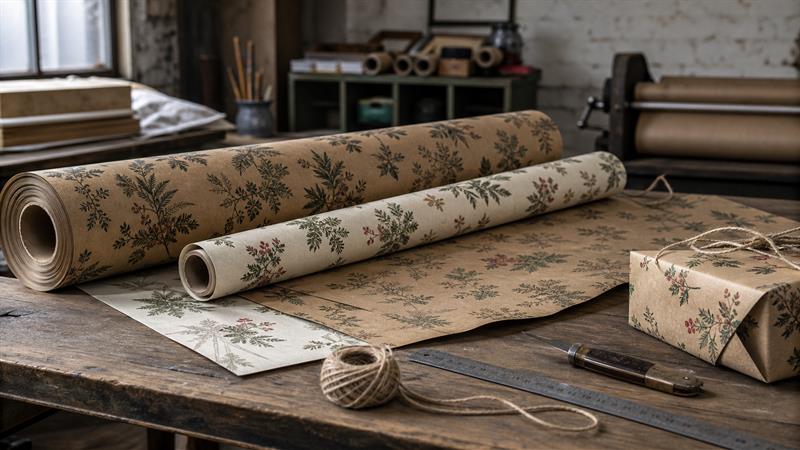
How to Make Custom Wrapping Paper for Your Brand
1. Define the packaging application
List the products that will be wrapped, their approximate dimensions, the number of orders packed per day, and whether the paper is used by hand or on a packing line. A small gift item may suit pre-cut sheets. A store or fulfillment team handling many sizes may save time with rolls that can be cut as needed.
2. Choose a design direction
A repeating logo is easy to recognize, but it is not the only route. Consider a seamless pattern, a low-contrast monogram, a seasonal illustration, or a single-color mark on kraft paper. Decide how the design should look when only part of the sheet is visible and when folds cover some of the artwork.
3. Select the paper and GSM
Paper choice affects folding, opacity, print sharpness, tear resistance, and the perceived value of the package. GSM is a useful comparison point, but it does not tell the whole story. Fiber, coating, stiffness, grain direction, and print coverage also change how the paper behaves. Our guide to paper GSM and tissue weight is a useful primer before you compare supplier samples. Ask for a physical sample when the feel is important.
4. Choose rolls, sheets, or custom dimensions
Rolls provide flexible cut lengths and can reduce repeated sheet handling. Sheets give a consistent starting size and can be easier for a standardized gift program. Measure the actual product range, storage space, cutter setup, and paper used per order before deciding.
5. Prepare print-ready artwork
Supply vector logo files where possible and confirm the required file format with the manufacturer. Show the repeat tile, pattern direction, bleed, safe area, color references, and any artwork that must not be hidden by a fold. Do not assume that a file that looks good on a design screen is ready for production.
6. Select the printing method
Single-color printing can suit a restrained logo pattern. Multi-color or full-color printing is more suitable for illustrations and detailed branded graphics, subject to the paper and quantity. The final choice depends on coverage, repeat size, paper surface, order volume, color consistency, and the supplier’s available process.
7. Review a proof or physical sample
Use a digital proof to confirm layout, repeat, dimensions, and copy. Use a physical sample to judge paper feel, ink appearance, folding, and the finished presentation. If brand color is critical, compare the sample under the lighting used by the packing or retail team.
8. Approve the production specification
Before bulk production, confirm the approved artwork version, paper, GSM, format, dimensions, print colors, quantity, packing method, carton details, delivery destination, and required date. This final record reduces the risk of a repeat order being made from an old file or a remembered specification.
How to Design Custom Wrapping Paper Artwork
Make the repeat work at three distances
Check the artwork close up, at normal packing distance, and on the wrapped product. A logo that is too large may feel loud and make the design difficult to align. A logo that is too small may disappear at a glance. Leave enough breathing room around the repeat so folds do not create accidental crowding.
Design for the wrapped product, not the flat sheet
The product will cover much of the paper. Look at where the pattern lands on the top, sides, seams, and corners. If one key graphic must remain visible, plan its position around the folding method. Otherwise, treat the pattern as a flexible surface rather than promising an exact logo position on every parcel.
Control color on the right paper
Paper color changes printed color. Kraft stock can mute pale inks and shift warm tones, while a white paper gives bright artwork a more predictable starting point. Use CMYK or Pantone references where appropriate, but approve the result on the selected substrate. Adobe’s explanation of print color management is a useful reminder that a monitor is not the same thing as a press or a finished sheet.
Choosing the Right Custom Wrapping Paper Material
Kraft paper is often chosen for a natural, understated look and can work well with a one- or two-color pattern. White or lightly colored paper is a better starting surface for detailed graphics and brighter brand colors. Lightweight paper is easier to fold and may use less material, while heavier paper can feel more substantial but may slow down hand packing or resist tight corners. If the same brand also needs a carry format, the specifications on our kraft paper bags page offer a useful comparison for GSM, print coverage, and handling.
Instead of asking for a “premium” GSM without context, describe the job: the product weight, the required opacity, how tightly the paper must fold, how much print coverage is planned, and whether the paper will be cut by hand or machine. The supplier can then recommend a workable range and confirm it through a sample.
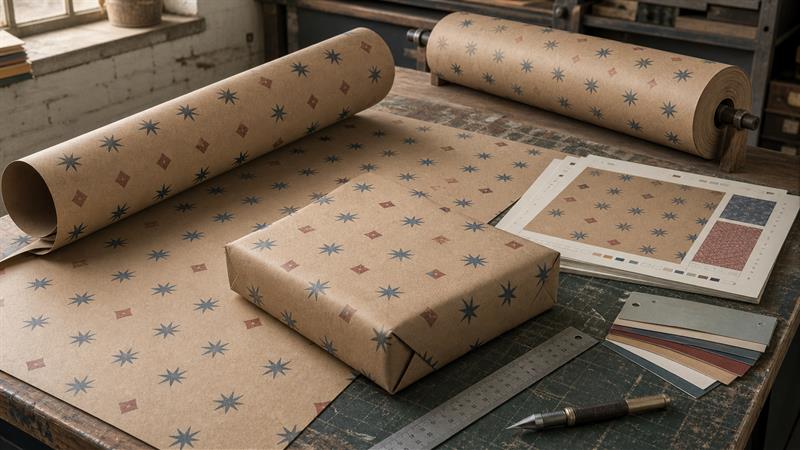
Custom Wrapping Paper Rolls vs. Sheets
| Format | Usually suits | Check before ordering |
|---|---|---|
| Rolls | Different product sizes, repeat ecommerce packing, flexible cut lengths | Roll width, core, cutter setup, storage, and paper used per order |
| Sheets | Standardized products, gift counters, pre-packed kits | Sheet size, stacking, handling speed, and leftover paper |
The better format is the one that fits the packing workflow. If packers spend time measuring and cutting every order, a pre-sized sheet may be easier. If product sizes vary, rolls may reduce waste and make the operation more adaptable. Compare total usable output rather than the price of one roll or one sheet in isolation.
Printing, Proofing, and Cost
Printing cost is shaped by paper, GSM, dimensions, print colors, coverage, printing method, quantity, roll or sheet format, finishing, packing, and shipping. Setup work may represent a larger share of a small order, while a repeatable larger run can distribute that cost across more usable paper. This is why a low unit price is not always the lowest cost per packed order.
MOQ and lead time also vary by method and specification. Allow time for artwork review, proofing, production, packing, and transport. If the paper supports a campaign or product launch, work backward from the date the packing team needs it rather than the date the artwork is finished.
What to check on a sample
- Paper feel, flexibility, opacity, and surface texture.
- Print sharpness, ink consistency, and brand-color appearance.
- Pattern scale and repeat alignment across the sheet or roll.
- Folding behavior, corner coverage, wrinkling, and cracking.
- The finished appearance around the actual product.
Then run a small packing test. Record paper consumed per order, cutting or folding time, leftover material, and packer feedback. A sample that looks attractive on a table may still be awkward when ten or fifty orders need to be packed in sequence.
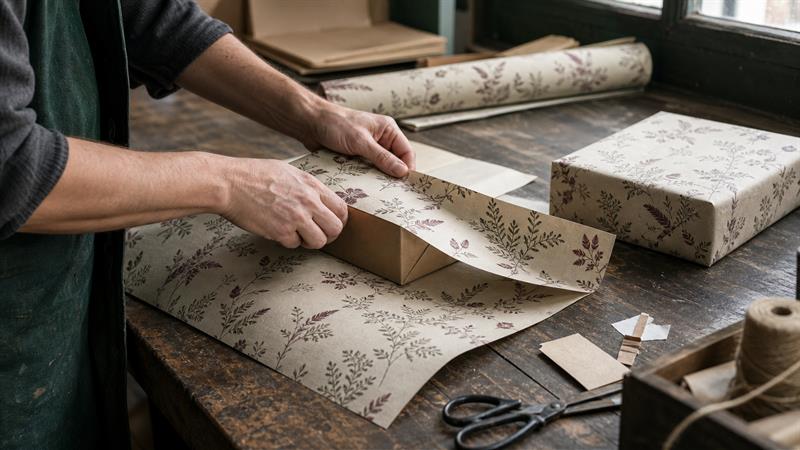
Standard Wrapping Paper or Custom Printed Wrapping Paper?
Choose standard paper when the volume is low, branding is not central to the purchase, or immediate availability matters more than a custom experience. Choose custom wrapping paper when the package is customer-facing, the order volume is repeatable, the brand presentation matters, or a seasonal pattern supports a campaign.
For a practical decision, score the two options for brand value, design complexity, paper cost, packing speed, waste, reorder frequency, and lead time. This keeps the discussion grounded in the operation instead of turning it into a purely aesthetic preference.
Sustainability Considerations
Paper is not automatically a better choice simply because it looks natural. Review fiber content, coatings, inks, right-sizing, and the way the finished paper is handled after use. Where certified sourcing matters, ask for documentation rather than relying on a green label; the FSC chain-of-custody explanation shows why material claims need to follow the supply chain.
Right-size the sheet or cut length to avoid unnecessary waste, and confirm whether the printed paper can enter the intended local recovery stream. The EPA paper recycling guidance is a useful educational reference, but local collection rules and the finished structure still need to be checked.
Common Custom Wrapping Paper Mistakes
- Making the logo pattern so large that folds destroy the visual rhythm.
- Choosing paper from a product photo without testing its flexibility.
- Approving brand colors only from a screen.
- Ignoring roll width, sheet size, storage, or cutting equipment.
- Ordering bulk production without a physical sample.
- Discussing MOQ and lead time only after the campaign date is fixed.
- Selecting a supplier on price alone and discovering that repeat orders vary.
How to Choose a Custom Wrapping Paper Supplier
A useful custom wrapping paper supplier should be able to discuss more than artwork. Ask about paper and GSM options, print coverage, rolls and sheets, custom widths, sampling, color control, production capacity, packing, delivery, documentation, and repeat-order consistency.
Ask the supplier to explain what is included in the quotation. A clear comparison should identify the paper, dimensions, print specification, quantity, sample process, estimated production schedule, packing method, and shipping assumptions. If the supplier cannot describe how the paper will be checked, the low price may simply be hiding the risk.
When a Paper Change Put a 26,000-Unit Fragrance Box Order at Risk
In September 2020, a Canadian client was preparing to order premium rigid fragrance gift boxes with flocked inner trays. The design had already been approved, but several uncoordinated changes later pushed the project close to production failure.
⚠️ What went wrong?
The main risk was not one isolated production error. It was the accumulation of changes that were not updated across the complete packaging specification.
Paper stock changed. The new paper altered printed color performance and increased the unit cost by around $0.45, making the original quotation inaccurate.
The flocked insert was revised twice. Because the box dimensions were not updated at the same time, the first prototype had fitting problems and the lid could not close correctly.
Color was judged from screen files only. The spot color looked acceptable on a PDF but shifted visibly when printed on the new paper.
Shipping changed late. Part of the original sea-freight plan was moved to express air shipment, requiring a new carton layout and revised cost calculation.
🔧 How the project was recovered
Paper, insert geometry, box dimensions and the physical color swatch were consolidated into one approval document. Any later change had to be reflected in the full document.
The real fragrance product was placed inside the box to check the tray fit, lid closure, structure and color performance together.
The quotation was refreshed according to the final approved sample, with separate pricing prepared for sea freight and air express.
Carton packing specifications were reviewed in advance so the goods could be divided between container shipping and express delivery without creating a second packaging problem.
✓ The order moved back under control
After two rounds of physical sampling, approximately 26,000 units were produced. The goods were split between sea container and air express shipment, while the fit, structure and printed color met the client’s requirements.
💡 What packaging buyers can learn
- Changing the paper stock can affect both the cost and the printed appearance.
- An approved design file is not the same as an approved physical sample.
- The insert, box dimensions and color should be checked as one connected system.
- Split logistics should be considered before the packing specification is finalized.
- The most useful supplier is not always the one with the lowest first quotation, but the one that can identify and solve problems before mass production.
For custom printed packaging, the safest workflow is simple: confirm the material, structure, artwork, physical sample and shipping plan as one complete project.
What to Include in a Quote Request
Prepare the paper type or desired appearance, GSM if known, roll or sheet format, dimensions, artwork, number of colors, print coverage, quantity, product or packing application, delivery destination, required date, and sample expectations. If the paper will be used for ecommerce, add the approximate number of orders and the range of product sizes.
Forests Packaging can review the material, artwork, format, printing assumptions, and production requirements for a custom packaging project. Once the specification is ready, use the quotation request page so the discussion starts with the real packing job rather than a generic paper description.
FAQs
How do you make custom wrapping paper for a business?
Define the product and packing method, choose the paper and format, prepare a repeatable pattern, confirm print specifications, review a proof or sample, test the paper on the product, and approve the final production record.
What paper is best for custom wrapping paper?
The best paper depends on flexibility, opacity, surface, print coverage, product weight, and packing method. Kraft and printable white papers are common starting points, but the actual application should decide the final specification.
Should I order custom wrapping paper in rolls or sheets?
Choose rolls when product sizes vary or packing volume is repeatable. Choose sheets when the product range is standardized and pre-cut handling is more convenient. Compare storage, cutting time, waste, and usable paper per order.
What should I look for in a custom wrapping paper supplier?
Compare paper options, GSM guidance, printing capability, custom widths, MOQ, sampling, color control, production capacity, lead time, sustainability documentation, packing, and consistency on repeat orders.
How can I test custom wrapping paper before ordering in bulk?
Review the physical paper and print, wrap the actual product, check folds and corners, record paper consumption and packing time, and confirm that the finished presentation works for the people who will pack the orders.
Conclusion
Custom wrapping paper combines brand presentation with a very practical packing task. The strongest projects begin with the product and workflow, then define the pattern, paper, GSM, dimensions, printing, proof, quantity, and delivery plan. Rolls and sheets should be selected according to how the team actually packs orders.
If you are learning how to make custom wrapping paper, do not stop at the artwork. Test the paper on the product, compare the printed sample with the screen direction, and evaluate the supplier’s MOQ, lead time, quality control, and repeat-order process before approving bulk production.
Send Your Packaging Brief to Our Team
Share your product type, format, size, quantity, material, destination, and required date. Our team can support artwork review, sampling, production, inspection, and export coordination.
Contact us for a project-specific recommendation.


Ready to build packaging with a factory team?
Send your product size, material, artwork, quantity, destination, and deadline so our team can focus the first review on quotation and sampling.