ECT vs Burst Strength: Which Corrugated Box Test Should You Specify?

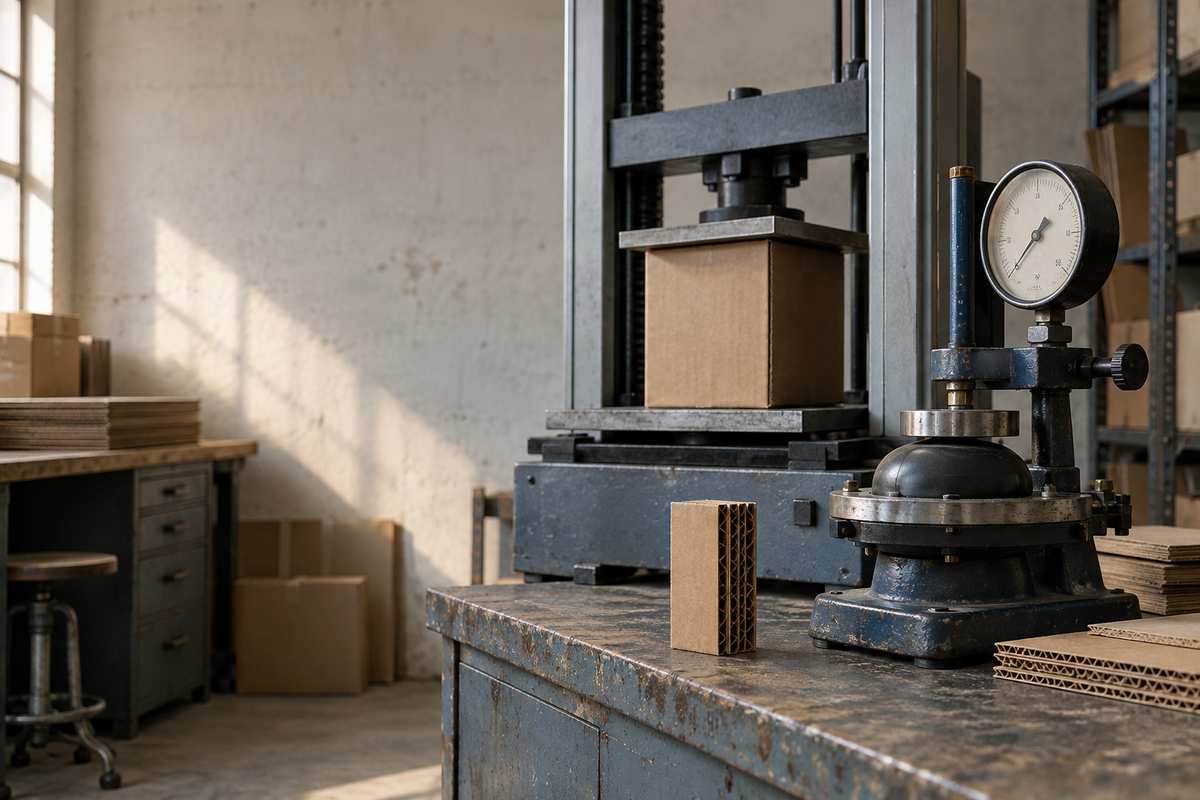
Quick answer: ECT, burst strength, and BCT measure different packaging risks. ECT focuses on stacking and edge compression. Burst strength focuses on puncture and tearing. BCT tests the finished carton under compression.
For palletized cartons, ECT is usually the right starting point. For sharp or heavy products, burst strength matters more. For large export cartons, the finished box should also be compression-tested.

ECT vs Burst Strength: What Does Each Test Measure?
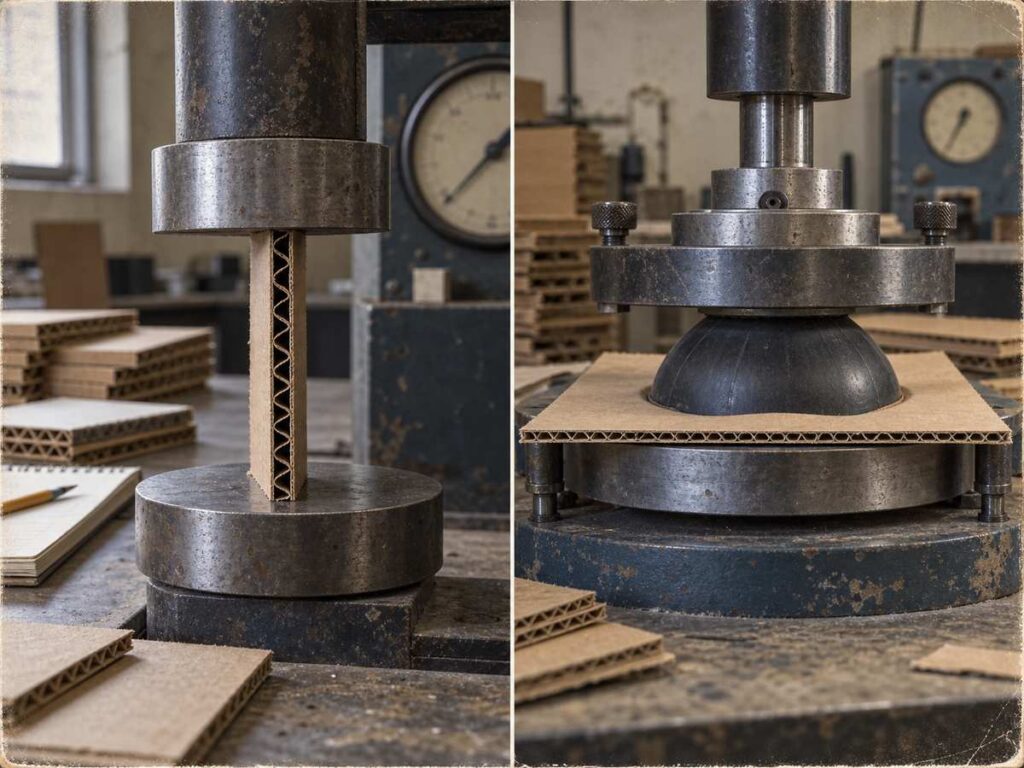
ECT stands for Edge Crush Test. It compresses the edge of a corrugated board sample until the fluting collapses. The result is normally reported in pounds per linear inch.
This matters because the vertical walls of stacked cartons carry load in a similar direction. When cartons are placed on a pallet, ECT gives a useful indication of how the board may perform under stacking pressure.
Burst strength, also called the Mullen test, measures resistance to puncture and rupture. A rubber diaphragm presses against the flat board surface until the liner or flute breaks.
The difference is straightforward:
- ECT asks how much edge compression the board can resist.
- Burst strength asks how much concentrated pressure the board can take.
- BCT asks how much compression the completed carton can handle.
For technical background, buyers can also review the relationship between edge crush performance and box compression in the TAPPI technical reference.
A practical comparison
| Test | What it measures | Best used for |
|---|---|---|
| ECT | Edge compression | Pallet stacking and warehouse storage |
| Burst strength | Puncture and tearing resistance | Sharp products and concentrated impact |
| BCT | Compression of the completed carton | Heavy cartons and export shipping |
When Should ECT Be Your Main Specification?
ECT is a practical starting point when boxes will be stacked during storage or transportation.
This includes:
- Palletized shipments
- Warehouse storage
- Parcel cartons placed under other cartons
- Long-distance road or sea freight
- Heavy products packed in corrugated cartons
- Shipments where vertical compression is the main concern
A common mistake is to select a carton only by paper weight or board thickness. A heavier-looking box is not automatically stronger. Flute type, liner quality, carton dimensions, humidity, joint position, and loading pattern all affect the result.
A large carton also places more stress on the board than a small carton. If the box is oversized or only partly filled, the panels may buckle before the paper reaches its theoretical rating.
For buyers comparing carton structures, custom corrugated shipping boxes can be specified with the product weight, internal dimensions, flute type, and expected stacking condition.
When Does Burst Strength Matter More?
Burst strength becomes more important when a carton may experience puncture or concentrated impact.
Typical examples include:
- Metal parts and hardware
- Bottles and rigid components
- Products with sharp corners
- Heavy products that can shift inside the box
- Cartons exposed to rough manual handling
- Packaging with limited internal cushioning
A corrugated board can have good ECT performance and still fail when one sharp product presses against a small area. The force is concentrated, so the liner may tear or the flute may rupture.
Internal packaging matters here as well. A stronger outer board cannot fully solve a product movement problem. If the product repeatedly hits the same panel during transport, the board may eventually fail even when the basic material rating looks sufficient.
What Does a Box Compression Test Tell You?
BCT, or Box Compression Test, evaluates the complete carton rather than a flat board sample.
The finished box is placed between two compression plates. Pressure increases until the carton buckles or loses its structural shape.
This test includes details that a board test cannot fully represent:
- Finished carton dimensions
- Flap overlap
- Joint method
- Creasing quality
- Glue or stitching
- Printing and coating
- Internal fit
- Product weight
- Moisture exposure
BCT is especially useful for large, heavy, or export cartons. It shows how the box performs after it has been folded, glued, loaded, and handled as a real shipping package.
For shipments exposed to rough parcel handling, a broader packaging test plan such as the one described by FedEx Packaging Testing can provide useful reference points.

Why the finished box matters
A carton can pass a board test but fail after conversion. A longer panel, deeper score line, weak joint, or poor flap overlap can reduce the compression strength of the completed box.
That is why the board specification and finished-box test should work together.
Why ECT 28 Beat a Heavier Double-Wall Box
A UK outdoor cookware brand needed one carton to survive sea freight, six-layer warehouse stacking, and sharp metal product edges—without increasing the outer box size.
transport damage
final board grade
measured compression
sets in first order
⚠️ The original carton
- Single-wall B-flute carton
- ECT 23 / Burst 1400 kPa
- 320 × 240 × 180 mm
- 2.8 kg packed product
- Middle-panel collapse and corner splitting
- Metal cookware edges punctured the board
✅ The final specification
- Single-wall C-flute carton
- ECT 28 / Burst 1800 kPa
- 200 g high-burst liner paper
- 120 g fluting paper
- 0201 regular slotted carton structure
- R5 rounded corners to reduce split lines
🧪 What changed during testing?
Basic C-flute board reached 2.2 m stacking height, but the box wall started to dent.
High-burst liner improved puncture resistance, but sharp die-cut corners still split.
R5 rounded corners completed the test: 2.8 m stacking for 24 hours with no permanent deformation.
💡 The practical lesson
The customer did not solve the problem by simply choosing the highest ECT grade. The better result came from combining C-flute ECT 28, high-burst liner paper, and rounded carton corners. For metal products, the face paper and die-cut design can be just as important as the compression rating.
Why a High Board Rating Does Not Guarantee a Strong Carton
A carton may fail even when the paper grade looks sufficient because:
- The box is oversized for the product.
- The product shifts during transportation.
- The carton is stacked beyond its tested height.
- Warehouse humidity weakens the paper.
- The flaps do not overlap correctly.
- The score lines are too deep.
- The joint is placed in a high-stress area.
- The box is compressed before the adhesive fully sets.
Moisture deserves special attention. Corrugated board absorbs moisture, and its compression performance may decline during humid storage or sea freight.
For recycled corrugated cartons, the balance between recycled content and physical performance also matters. Buyers comparing board options can review recycled shipping boxes together with ECT and compression requirements instead of choosing recycled content alone.
What Should You Include in a Corrugated Box RFQ?
A vague RFQ usually produces vague quotations. Suppliers need enough information to connect the material specification with the actual shipping risk.
1. Finished internal dimensions
State the usable internal length, width, and height. Do not provide only the product dimensions. Include clearance for inserts, cushioning, and loading.
2. Product weight
Give both the net product weight and the packed shipment weight. If the product contains several components, explain how the weight is distributed.
3. Board construction
Specify the flute type, number of walls, liner requirements, recycled-content target, and approximate board thickness.
4. ECT or burst requirement
State whether stacking resistance, puncture resistance, or both are important. If you already have a target value, include the testing method and unit.
5. Shipping environment
Describe pallet stacking, parcel handling, export freight, expected humidity, warehouse storage time, and possible exposure to rain or condensation.
6. Closure and joint method
Mention whether the box will use tape, hot melt, stitching, locking flaps, or water-activated tape.
7. Testing requirements
Ask whether the supplier can provide board certificates, compression testing, drop testing, or samples from the proposed production material.
8. Loading direction and pallet pattern
The same carton may perform differently when loaded upright, sideways, or in a mixed pallet pattern.
If you need help turning these details into a packaging specification, you can send the requirements through the packaging inquiry page.
Which Test Should You Specify?
Use ECT when vertical compression and pallet stacking are the main risks.
Use burst strength when the product can puncture, tear, or concentrate force on one small area.
Use BCT when you need to verify the complete carton, especially for heavy products, large cartons, export shipments, or new box structures.
In many projects, the best approach is to combine several tests:
- Minimum ECT value for the board
- Burst-strength requirement for puncture resistance
- Finished-box compression testing
- Drop testing with the real product
- Humidity or conditioning tests when required
Independent research on corrugated-board compression also shows why board structure and loading conditions should be considered together. The published research on corrugated packaging performance is useful background for technical buyers.
Frequently Asked Questions
Is ECT better than burst strength for shipping boxes?
Neither test is universally better. ECT is more useful for cartons that will be stacked or palletized. Burst strength matters more when the product may puncture the carton or create concentrated pressure on one area.
Does a higher ECT rating always mean a stronger box?
No. Carton size, flute type, moisture, flap design, joint position, and internal product movement also affect performance. A high ECT board can still fail if the finished carton is oversized or poorly designed.
When should I request a BCT test?
Request BCT when the carton is large, heavy, palletized, or used for export shipping. BCT tests the completed box, so it reflects the effect of folding, gluing, scoring, flaps, and loading.
Can burst strength replace ECT?
Usually, no. Burst strength measures puncture and tearing resistance, while ECT focuses on edge compression. A carton may perform well in one test and poorly in the other, depending on the shipping risk.
What should be included in a corrugated box RFQ?
Include the finished internal dimensions, product weight, flute type, board construction, ECT or burst requirement, closure method, pallet pattern, shipping route, humidity exposure, and required drop or compression tests.
Should recycled corrugated boxes use ECT or burst strength?
They may need both, depending on the product and route. Recycled board can perform well, but moisture, fiber quality, box size, and stacking conditions should be tested before mass production.
Final Takeaway
ECT and burst strength are not two names for the same property.
ECT is mainly connected to edge compression and stacking. Burst strength focuses on puncture and rupture. BCT shows how the completed carton performs after converting and loading.
Start with the shipping risk, then choose the test.If the carton will be stacked, begin with ECT. If the product creates concentrated impact, check burst strength. If the carton is large, heavy, or used for export, validate the finished box with compression and drop testing as well.
Send Your Packaging Brief to Our Team
Share your product type, format, size, quantity, material, destination, and required date. Our team can support artwork review, sampling, production, inspection, and export coordination.
Contact us for a project-specific recommendation.



Ready to build packaging with a factory team?
Send your product size, material, artwork, quantity, destination, and deadline so our team can focus the first review on quotation and sampling.