Types of Food Packaging: Categories, Materials, and How to Choose


There are many types of food packaging, but the right choice is rarely found by starting with a catalogue. Start with the food: what it contains, how it is filled, where it travels, how long it must last, and how people will open it. The package comes second.
This guide separates food packaging categories, formats, and materials, then turns them into a practical selection process. It is designed for the moment when “we need food-safe packaging” is true—but nowhere near specific enough.
Food packaging categories: three levels and three structures
First, separate the job a package performs from the material it is made from. That small distinction prevents a lot of confused briefs.
- Primary packaging directly contains or contacts the food: a pouch, tray, wrapper, jar, cup, or inner bag.
- Secondary packaging groups or presents the primary pack: a folding carton, sleeve, multipack, or retail display.
- Tertiary packaging protects packed goods during storage and transport: corrugated cases, dividers, pallets, and stretch wrap.
Then consider structure. Flexible packaging is light and efficient but depends heavily on film structure and seal quality. Semi-rigid trays and tubs balance visibility with stackability. Rigid cartons, jars, and cans offer shape and protection, but may add weight, space, or breakage risk. A cereal carton, for example, is not automatically the primary barrier; its inner liner may be doing that work.
Common types of food packaging by format
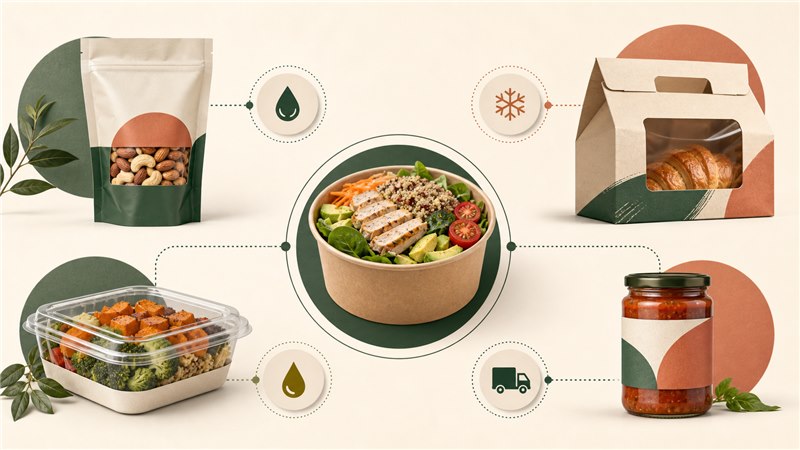
Bags and pouches suit snacks, powders, coffee, frozen food, dry ingredients, and refills. They can incorporate zippers, tear notches, windows, or valves, but the real decision is whether the seal, puncture resistance, and barrier match the food and filling process.
Boxes and folding cartons are useful for bakery, confectionery, tea, cereals, giftable foods, and products that already have an inner wrap or bag. They bring print area and shelf structure. Paperboard alone, however, is not a universal answer for oil, moisture, or extended shelf life.
Trays, clamshells, cups, tubs, and bowls work well for produce, ready meals, desserts, dairy, soups, and takeaway. Review lid fit, venting, leakage, reheating, condensation, and stacking together. A clear lid can help merchandising; it can also show every foggy drop of condensation.
Bottles, jars, and cans are common for beverages, sauces, condiments, and preserved foods. Glass gives strong barrier performance and visibility but adds weight and breakage risk. Metal can protect against light and oxygen for long shelf-life products, while demanding a different filling and closure plan.
Wrappers and films are common for bakery, confectionery, fresh produce, and single portions. Here, the questions are usually oxygen, moisture, grease, aroma, tear behaviour, and whether the chosen machinery can make a reliable seal.
Food packaging materials: what each one does well
Paper and paperboard are lightweight, printable, and excellent for cartons, sleeves, bags, and outer presentation. Their limitation is straightforward: untreated paper is not automatically a moisture, grease, or oxygen barrier. Coatings, liners, inks, and adhesives must be assessed as part of the final structure.
Plastic films and rigid plastics can provide low weight, sealing performance, clarity, and moisture resistance. Multi-layer structures may solve technical problems, but recovery can be more complex. Do not call a structure recyclable merely because one layer is.
Glass gives a strong barrier and premium shelf presence. Metal supports long shelf life and light protection. Molded fibre can provide a rigid, fibre-based form for some uses, but moisture tolerance and surface finish need checking. Compostable or cellulose-based alternatives still need a route for collection and processing; “compostable somewhere” is not a disposal plan.
Start with the food, not the package
A useful food packaging selection brief answers six questions before anyone picks a pouch finish or carton colour:
- Is the food dry, moist, oily, acidic, aromatic, fragile, or perishable?
- Will it be hot-filled, chilled, frozen, held at ambient temperature, or reheated in the pack?
- What shelf-life target and sales channel are planned?
- How will it be filled, sealed, packed into cases, and transported?
- Does the consumer need resealing, portion control, venting, tamper evidence, or easy opening?
- Which market-specific food-contact and labelling requirements must be confirmed?
Real packaging case
Fresh produce: the box was only half the solution
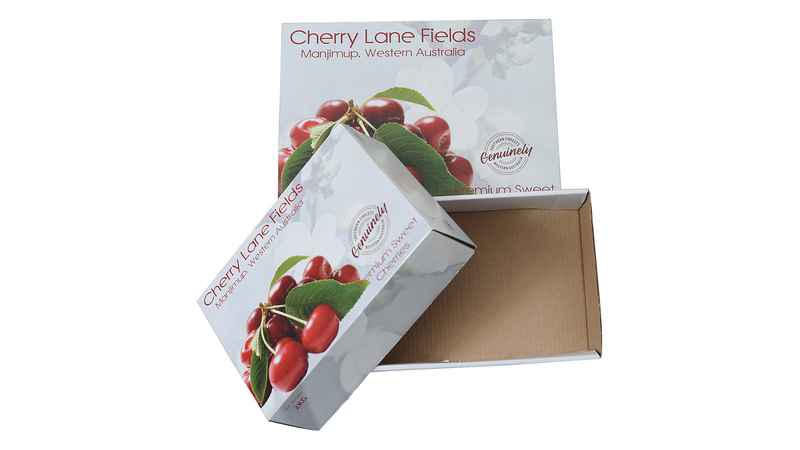
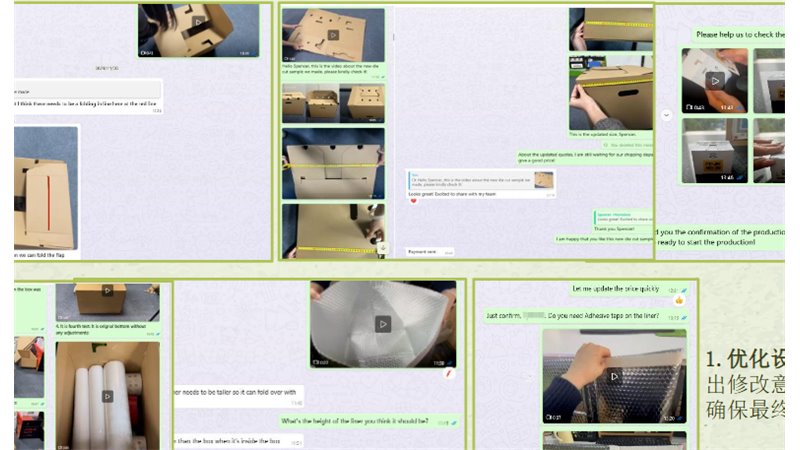
In this fresh-produce project, the brief was not simply “make a fruit box.” The customer needed a reusable fruit box that could hold around 50 lb, plus an insulated bag for temperature-sensitive delivery. Strength, reuse, and temperature management had to work together.
- For fresh food, choose the transport system—not just the primary pack.
- Define load, reuse cycle, temperature needs, and delivery route before selecting a structure.
- Use a 3D model and physical sample to check folding, fit, handling, and insulation integration early.
Project timeline: November 27, 2024–January 14, 2025. This case supports a selection workflow; it does not by itself establish a specific food-contact or temperature-performance certification.
For US-bound work, food-contact suitability should be confirmed for the exact intended use, rather than assumed from a general material name. The FDA explains that packaging components such as adhesives, colourants, and grease-resistant treatments can be food-contact substances, and that intended use matters. Its tables also distinguish food types and conditions such as hot fill, refrigeration, freezing, and reheating. See the FDA food-contact overview and its food types and conditions of use.
A quick selection matrix by application
| Food application | First priorities | Common starting formats |
|---|---|---|
| Bakery and confectionery | Grease resistance, presentation, crush protection | Cartons, window boxes, wrappers, pouches |
| Hot takeaway | Heat tolerance, venting, leakage, handling | Trays, bowls, clamshells, paper bags |
| Frozen food | Low-temperature durability, seal integrity, moisture control | Barrier bags, pouches, cartons with inner packs |
| Snacks and dry goods | Moisture barrier, resealing, shelf impact | Stand-up pouches, flat bags, cartons |
| Sauces and beverages | Closure security, compatibility, transport durability | Bottles, jars, pouches, tubs |
Use this as a starting point, not a specification. Two snack products can need very different packaging if one is salty and dry while the other contains oils, inclusions, or a long export journey.
When custom food packaging is worth it
Custom food packaging makes sense when it improves product fit, reduces leakage or damage, solves a filling-line problem, creates a better serving experience, or gives the product a genuine shelf advantage. It is less compelling when a stock format already protects the food and a label, sleeve, or stamp supplies enough branding.
Common customization choices include dimensions, gussets, windows, barrier structures, coatings, closures, tamper-evident features, print coverage, and inserts. The trick is to customize the one or two variables that change the outcome. Adding every possible feature is a good way to turn a simple pack into a complicated purchasing project.
For flexible formats, explore our custom food packaging bags. For broader format and channel planning, see our Food & Beverage Packaging application page.
Cost drivers and questions to settle early
Food packaging cost is shaped by more than the visible material. Dimensions, pack volume, barrier layers, board grade, print coverage, tooling, assembly, closure features, case packing, and freight all matter. A smaller pack can use less material, for example, but it may require a different filling set-up or create a less efficient case pack. There is no useful “cheapest” answer without the operating context.
Ask the supplier for the minimum order quantity, sample route, artwork requirements, production timing, proposed case pack, and which documents can be reviewed for the intended market. If a pack is direct food contact, include the food type, fill temperature, storage condition, and shelf-life target in the quotation request. These details are not admin clutter; they are the inputs that determine whether the proposed package can be made and used as intended.
Test the finished system, not an empty package
The most useful packaging test is rarely a glamour shot of an empty box. Fill the pack with the real product. Check seal integrity, leakage, grease migration, condensation, crushing, label adhesion, opening, and how it behaves after storage and transport. Then repeat the test after the temperature and handling conditions the pack is expected to face.
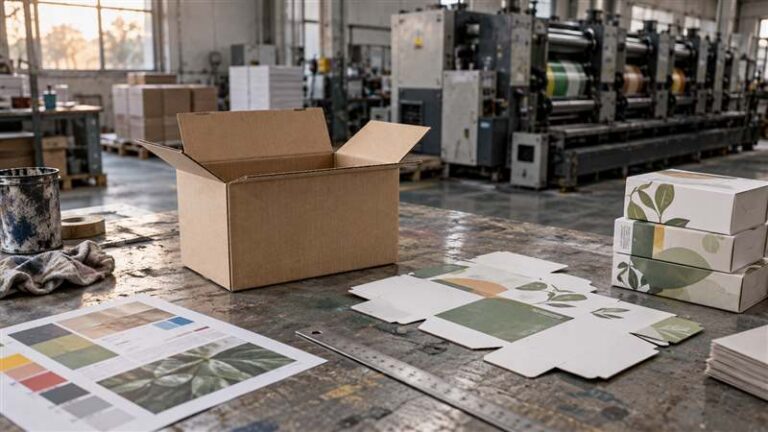
A practical factory workflow connects material and structure review to artwork, samples, production, inspection, case packing, and export handover. That is the purpose of our Intelligent Factory process: keep the approved sample and production brief connected rather than treating them as separate projects.

Sustainability: examine the complete specification
Material source matters, but it is only one part of the picture. Review total material use, pack size, recycled or certified content where applicable, mono-material versus composite construction, coatings, inks, adhesives, and local end-of-life options. A paper-based pack may still use a barrier treatment that changes recycling outcomes. A compostable pack may still lack an accessible collection route.
For paper and paperboard food packaging, also confirm the treatment used for grease and moisture resistance in the intended market. FDA information on PFAS food-contact applications notes that intended use and final manufacture affect potential migration; it is a reminder to request current, project-specific documentation rather than relying on an old material claim. Read the FDA guidance on PFAS in food-contact applications.
Food packaging supplier checklist
- Share the food type, fill weight, dimensions, filling method, shelf-life target, storage condition, and sales market.
- Request the proposed structure, technical specification, and applicable food-contact documentation for the intended use.
- Confirm the sealing method, print artwork, sample route, quantity, case pack, and delivery destination.
- Run a controlled pilot before full production—especially where temperature, grease, leakage, or machine settings are involved.
FAQ
What are the main types of food packaging?
Common formats include bags, pouches, cartons, trays, clamshells, cups, tubs, bottles, jars, cans, wrappers, and films. They can serve primary, secondary, or tertiary packaging roles.
How do I choose food packaging materials?
Start with moisture, grease, oxygen, temperature, shelf life, sealing, transport, customer use, and target-market requirements. Then compare structures against the confirmed product brief.
Is paper packaging always suitable for food?
No. Paper and paperboard can be excellent for cartons, bags, and sleeves, but moisture, grease, oxygen, and food-contact needs may require a specific treatment or an additional primary pack.
When should I use custom food packaging?
Use custom packaging when stock formats cannot provide the required fit, protection, filling performance, serving experience, or shelf presentation. Test a sample before approving the full run.
What should I send a food packaging supplier?
Send the food type, pack size, fill method, storage condition, shelf-life target, artwork, quantity, delivery market, required documents, and deadline.
Choose a format that earns its place
The best types of food packaging are the ones that protect the food, work on the line, survive the supply chain, and make sense for the customer. Format and material should follow the product brief—not the other way around. A well-tested simple pack often beats a clever package that has not met the real food, real temperature, or real transport route.
Plan your custom food packaging brief
Forests helps food and beverage buyers review format, dimensions, material structure, barrier needs, print, sampling, inspection, and export-ready packing around the actual product and market. Send your food type, fill weight, shelf-life target, filling method, artwork, quantity, destination, and required documents. We will help identify the details to confirm before quotation and sampling.
Read our guide to choosing a packaging supplier, then request a food packaging review.
Send Your Packaging Brief to Our Team
Share your product type, format, size, quantity, material, destination, and required date. Our team can support artwork review, sampling, production, inspection, and export coordination.
Contact us for a project-specific recommendation.


Ready to build packaging with a factory team?
Send your product size, material, artwork, quantity, destination, and deadline so our team can focus the first review on quotation and sampling.