What Is Gummed Tape? How Water-Activated Packing Tape Works

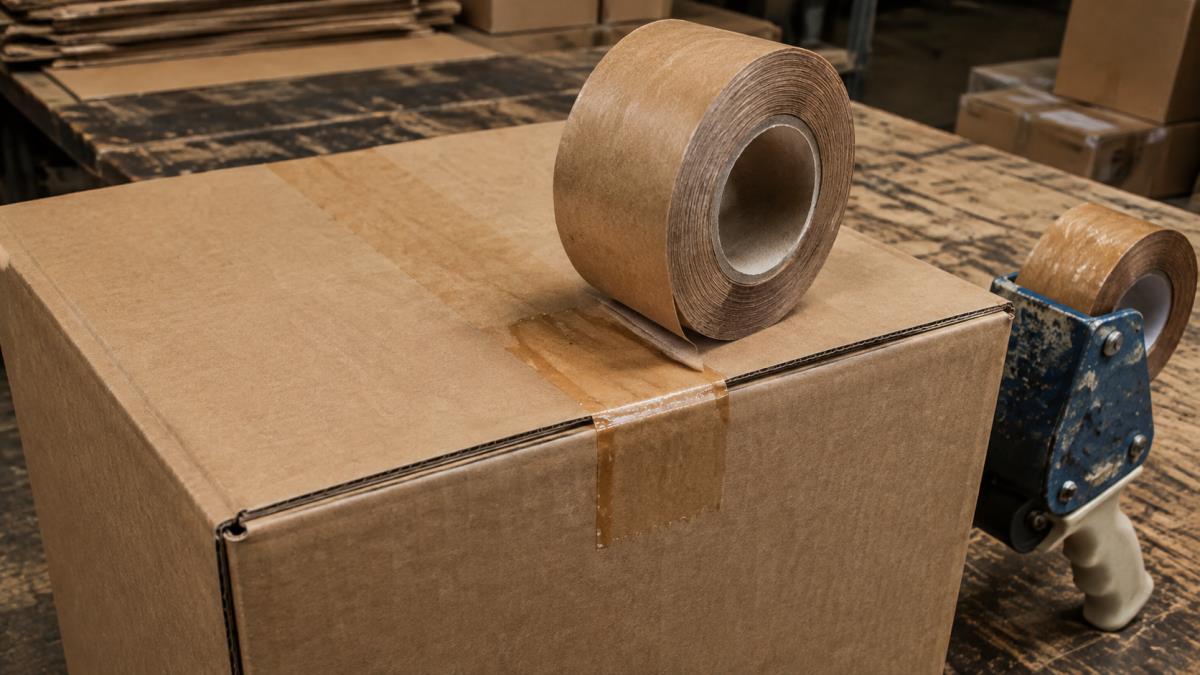
Quick answer: Gummed tape is paper packing tape with a water-activated adhesive. Wet the back, place it over a corrugated carton seam, and press it down while the bond sets. In packaging, gummed tape, gummed paper tape, and water-activated tape usually describe the same family of carton-sealing products. It is different from “bubble gum tape,” the confectionery term that often appears in search results.
The useful question is not whether water-activated tape is fashionable. It is whether the tape matches the carton, the shipment weight, the packing station, and the way the finished parcel will be handled. A small ecommerce carton may need plain paper tape. A heavier case, a long seam, or a rough recycled board may call for a reinforced construction or a different application method.
Gummed tape becomes part of the carton-sealing decision, not just a finishing detail.
What Is Gummed Tape?
Gummed tape is a paper-based carton-sealing tape coated with an adhesive that becomes tacky when moistened. The dry roll stays relatively stable on the packing bench. After activation, the adhesive bonds to the paper surface of the corrugated board and forms a continuous seal across the joint.
Is gummed tape the same as water-activated tape?
For packaging buyers, the terms are commonly interchangeable. “Water-activated tape” explains how the adhesive works; “gummed tape” describes the traditional adhesive coating. When requesting a quotation, use both terms and specify the tape construction, width, roll format, and carton surface.
What about “bubble gum tape”?
Bubble gum tape is mainly a rolled chewing-gum search term. It should not be used as the main packaging keyword or printed on a supplier brief for carton tape. If a website is targeting packaging buyers, the clearer terms are gummed tape, water-activated packing tape, gummed paper tape, and custom printed tape.
Where is it used?
Typical uses include ecommerce shipping boxes, subscription cartons, fulfillment mailers, corrugated cases, branded dispatch packaging, and parcels that need a visible seal. It can be applied by hand at a low-volume station or through a manual and electric dispenser when the packing team needs repeatable lengths and water coverage.
How Does Water-Activated Packing Tape Work?
- Dry roll: the adhesive is inactive while the tape is stored and unwound.
- Moisture: a dispenser or damp sponge adds a controlled amount of water to the adhesive side.
- Application: the wet tape is placed over the carton seam before the adhesive starts to set.
- Pressure: the packer presses the tape onto the board, especially at the ends and across the joint.
- Set: the adhesive develops its bond with the paper surface as the carton remains closed.
The key point is that water is part of the sealing system. Too little water can leave dry patches; too much can soften the board or slow the set. Waiting too long after wetting can also reduce contact because the tape begins to tack before it reaches the carton.
Gummed Tape vs. Regular Pressure-Sensitive Tape
| Decision point | Gummed tape | Pressure-sensitive tape |
|---|---|---|
| Activation | Water activates the adhesive. | Pressure activates contact with the surface. |
| Carton bond | Paper tape bonds closely to corrugated fibers. | Plastic or paper carrier holds an adhesive layer on the surface. |
| Equipment | Water-activated dispenser or controlled manual wetting. | Standard hand gun or machine applicator. |
| Removal evidence | Removal may disturb the carton surface and leave a visible break. | It may peel away with less board fiber disturbance, depending on adhesive. |
| Material review | Paper carrier, adhesive, ink, and reinforcement must be checked together. | Carrier and adhesive can create a different recovery route. |
Neither tape is correct for every parcel. Choose around throughput, carton strength, security expectations, board finish, and end-of-life requirements. The right comparison is a sealed carton handled through the expected route—not two loose rolls on a desk.
Reinforced vs. Non-Reinforced Gummed Tape
Non-reinforced gummed tape uses a paper carrier without added structural threads. It suits many standard ecommerce cartons when the box is correctly sized, the seam is stable, and the parcel weight is moderate.
Reinforced gummed tape adds reinforcement, often fiberglass or another strengthening element, to improve tear resistance and tensile performance. It can be useful for heavier cartons, long seams, or rough handling, but reinforcement changes the tape’s material profile. Do not copy the recycling description of plain paper tape onto a reinforced product without supplier documentation and a local recovery check.
A practical selection rule is simple: start with carton weight, seam length, board grade, and distribution risk. Then compare plain and reinforced samples on the actual production carton.
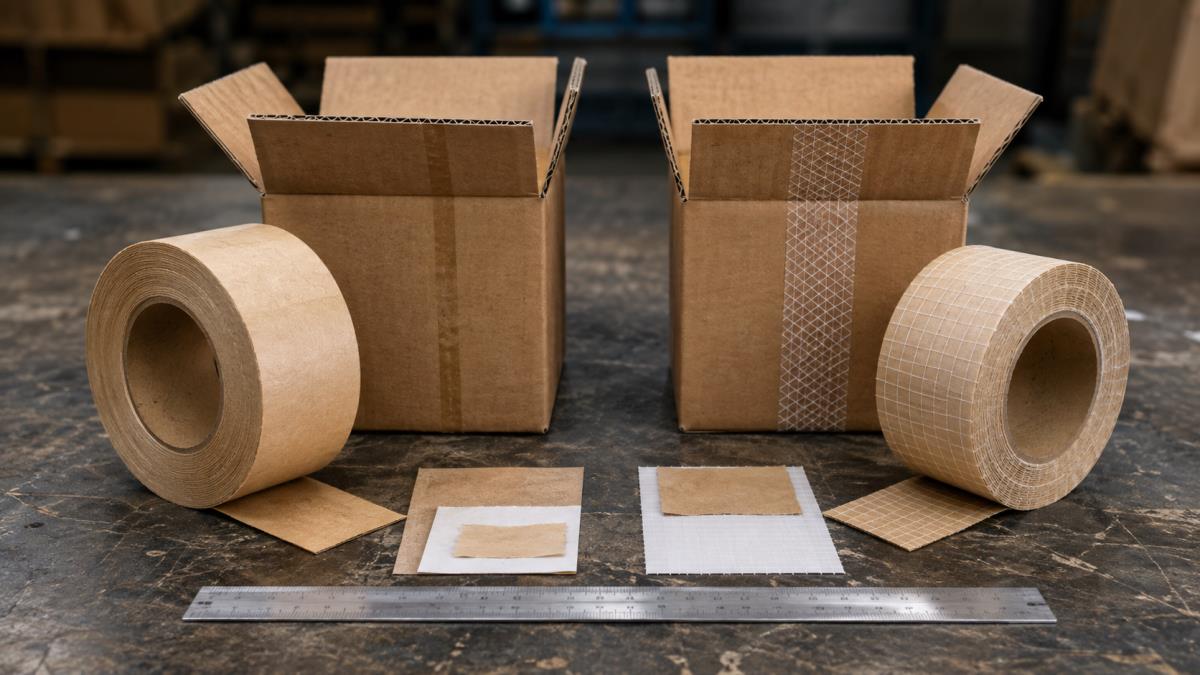 Plain and reinforced constructions solve different carton risks; one is not a universal upgrade over the other.
Choose Tape by Carton Risk, Not Only Box Size
- Standard ecommerce parcel: a non-reinforced paper tape may be enough when the carton is compact and the seam is well supported.
- Heavy case: review reinforced tape, seam coverage, carton strength, and the lifting points created during handling.
- Long or wide seam: confirm that the tape width gives continuous coverage without riding over a sharp edge.
- Rough recycled board: test adhesion on the real liner because dust, loose fibers, coating, and humidity can change the result.
- High-security shipment: ask whether visible carton-fiber disturbance after removal is useful as a tamper-evident feature. It is not a guarantee against tampering.
This is where many buying briefs become too vague. “Brown paper tape for shipping” does not tell a supplier enough. State the carton weight range, board construction, seam design, route, humidity exposure, and expected cartons per shift.
How to Use Gummed Tape Without a Dispenser
Manual application can work for samples, occasional parcels, or a very small packing station. Cut a strip slightly longer than the seam, wet the adhesive side evenly, place it at once, and press from the center toward the ends. Keep the tape flat. Do not stretch it across the joint, and do not leave wet tape waiting on the bench.
Common mistakes include soaking the tape, wetting only the center, pressing too lightly at the ends, and applying it to a dusty or crushed carton flap. If the board surface feels soft after sealing, the process may be using more water than the carton can tolerate.
Manual vs. Electric Gummed Tape Dispensers
For occasional use, a simple wetting tray or sponge may be adequate. A manual dispenser gives better control over cut length and water coverage at a small or medium fulfillment station. An electric dispenser becomes useful when several packers repeat the same seal throughout a shift and consistency matters more than the roll price.
Base the decision on cartons per shift, strips per carton, operator movement, and the cost of rework. A dispenser should match the tape width, roll diameter, core size, and required strip length. The best equipment is the one that keeps the application repeatable without slowing the person who closes the box.
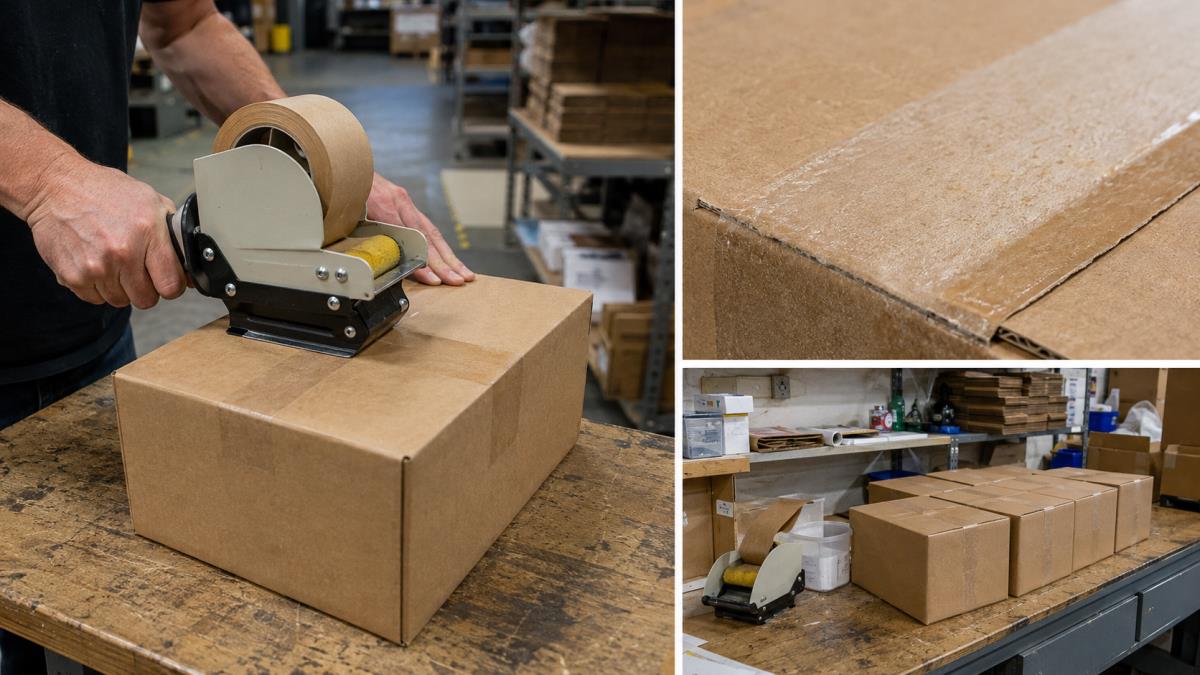 Application equipment changes water coverage, cut length, and packing rhythm.
What Width Gummed Tape Should You Use?
Two-inch and three-inch formats are common reference points, but width should follow the seam and carton risk. A narrow tape may leave the edges of a wide joint exposed. A wider tape can waste material or create awkward folds on a small carton. Test the chosen width on the real box with the real flap overlap.
Record the result as part of the packaging specification: tape width, strip length, number of strips, application direction, and whether the tape crosses a printed or coated area.
Does Gummed Tape Provide Tamper Evidence?
It can provide visible evidence of opening because a bonded paper tape may pull at the carton surface when removed. That makes it useful for ecommerce, branded fulfillment, and selected higher-value shipments. Use the term tamper-evident, not tamper-proof. No tape alone can promise that a parcel cannot be opened.
Does It Work on Recycled Cardboard?
It can, but the tape and board should be tested together. Recycled liners may vary in surface roughness, loose dust, fiber strength, moisture response, and print or coating. A tape that seals one board grade may not behave the same way on another supplier’s recycled liner.
For a reliable trial, use production cartons, the intended tape width, the planned dispenser, and the expected storage conditions. Check the seal after stacking, vibration, humidity exposure, and ordinary handling. The FEFCO packaging resources can help teams keep corrugated terminology consistent while the tape specification is being prepared.
Custom Gummed Tape for Branding
Custom water-activated tape can carry a logo, repeat pattern, care message, short slogan, or recycling instruction. Kraft stock gives a quieter natural base; white stock usually gives brighter contrast for fine artwork. Keep the design useful at the size it will appear on the box.
Design for the carton, not the roll. Check logo size, repeat interval, print direction, seam placement, and how the pattern lands on different box dimensions. A repeat that looks balanced in a flat artwork file can disappear under a flap or become crowded on a small mailer.
Ask for a physical proof on the chosen paper color and then apply the tape to the actual carton. If the brand uses recycled or certified fiber language, confirm the paper and claim documentation through the FSC information hub before printing a broad sustainability message.
Is Gummed Paper Tape More Sustainable?
Sometimes it can be a simpler paper-based system, but “eco-friendly” is not a complete specification. Review the paper carrier, recycled content, adhesive, ink, coating, reinforcement, and the recovery system available in the destination market. Plain paper tape and reinforced tape should not automatically receive identical end-of-life claims.
A better brief says what is documented: paper type, GSM, adhesive description, ink system, reinforcement, and any applicable certification. When a claim depends on local collection or sorting, state that condition instead of presenting it as universal.
Compare Cost per Sealed Carton, Not Cost per Roll
Roll price is only one line in the calculation. Record tape used per box, number of strips, application time, dispenser output, seal failures, carton rework, and the value of a branded closure. A more expensive roll can produce a lower cost per sealed carton if it reduces labor or failed seals. The opposite can also happen when the tape is over-specified for a light parcel.
 A short seal trial on the real carton can expose water, width, and board-compatibility problems early.
During a trial, measure at least one normal shift. The result should show grams or meters used per carton, average application time, failure count, and the number of operators involved.
Gummed Tape Trial Checklist
- Use the actual corrugated board and carton seam.
- Record carton weight and distribution route.
- Compare reinforced and non-reinforced samples where the risk justifies it.
- Test two-inch and three-inch widths when seam coverage is uncertain.
- Check water activation, cut length, and end pressure.
- Run the planned manual or electric dispenser.
- Inspect the seal after storage, stacking, vibration, and humidity exposure.
- Review print contrast, repeat length, and seam placement for custom tape.
- Record tape used per carton and any rework.
What to Ask a Gummed Tape Supplier
A useful quotation request should include tape type, width, roll length, core size, paper color, paper weight, adhesive type, print colors, repeat length, artwork direction, carton substrate, carton weight range, dispenser model, monthly volume, destination market, and required delivery date. Ask for technical data, proofing options, and the supplier’s recommendation for your actual board. If formal drop testing is part of the approval plan, align the method with the relevant ASTM distribution-testing standard.
For a broader review of board, adhesive, and closure choices, see our packaging adhesive guide. For the wider range of carton, mailer, and branded packaging formats, visit our custom packaging product range.
When the carton, tape, and fulfillment method need to be reviewed together, start with our custom packaging development services. For a quotation, send the substrate, carton dimensions, quantity, artwork, application method, destination, and deadline through the packaging inquiry team.
FAQs
Is gummed tape the same as water-activated tape?
In packaging, they usually refer to the same paper tape family: the adhesive becomes tacky after moisture is applied.
Is reinforced gummed tape better?
Not always. Reinforced tape suits higher-strength requirements; plain paper tape may be enough for standard cartons and may have a simpler construction.
Can gummed tape be custom printed?
Yes. Specify stock color, tape width, print colors, repeat length, roll format, and carton sizes before approving artwork.
What width should I choose?
Start with the seam coverage, carton weight, board grade, and route. Test the chosen width on the production carton instead of relying on a universal recommendation.
Is gummed tape recyclable?
That depends on the complete construction and local recovery system. Check carrier paper, adhesive, ink, reinforcement, coatings, and supporting documentation.
Final Answer
Gummed tape is water-activated paper tape for sealing corrugated packaging. It can give a strong, visible carton seal and a useful branding surface, but the result depends on the tape construction, water level, width, board surface, dispenser, and handling route. Start with the real carton, compare reinforced and non-reinforced options where needed, calculate cost per sealed box, and document the complete material construction before making a recycling claim.
Send Your Packaging Brief to Our Team
Share your product type, format, size, quantity, material, destination, and required date. Our team can support artwork review, sampling, production, inspection, and export coordination.
Contact us for a project-specific recommendation.

Ready to build packaging with a factory team?
Send your product size, material, artwork, quantity, destination, and deadline so our team can focus the first review on quotation and sampling.