SBS vs CCNB Paperboard: How to Choose the Right Board for Folding Cartons


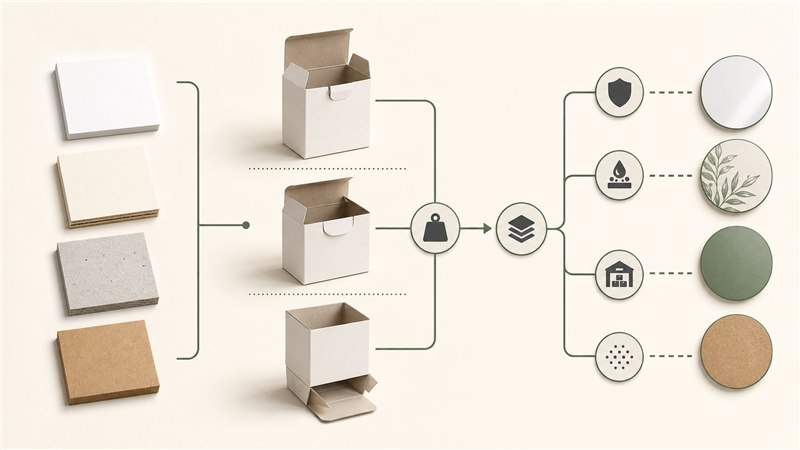
Quick answer: SBS and CCNB can both be used for printed folding cartons, but they solve different packaging problems. SBS is often the stronger starting point when both sides of the carton will be seen, the artwork relies on pale colors or fine detail, or the product needs a clean white interior. CCNB can be a sensible option when the grey reverse is hidden, recycled-fibre content is part of the brief, and the carton does not need a presentation-led interior.

The wrong choice usually shows up after printing: a grey interior behind a premium product, a light brand color that looks dull, a fold that cracks after finishing, or an expensive board specified for a box that never needed it. The useful question is not “Which board is better?” It is “Which board fits this product, artwork, sales channel, and approval process?”

At CustomPackMart, a carton project starts with the packed product, artwork, board requirement, filling method, sales channel, and destination market. That gives the supplier something more useful than a request for “white paperboard” or “recycled board.”

SBS vs CCNB in one minute

SBS means Solid Bleached Sulfate. It is commonly specified as a bright white paperboard made with bleached virgin fibre. The board is white through the sheet, so the inside, reverse side, and cut edges stay visually clean.

CCNB means Clay Coated News Back. It commonly has a printable white coated face and a grey reverse made with recycled fibre. That grey reverse is not automatically a weakness. It becomes a problem only when the interior, reverse panels, or carton edges are part of the customer’s experience.

Buyer questionSBS paperboardCCNB paperboardWhat to confirm
What does the reverse look like?WhiteUsually greyWill the customer see the inside or reverse?
Is it suitable for fine printing?Often a good fit for pale colors, small type and presentation-led graphicsThe white printed face can work well; test demanding artworkRun the actual artwork, not a generic print chart
Can the interior be printed?Usually gives a cleaner white baseGrey reverse may make interior graphics look mutedIs inner printing part of the unboxing experience?
Does it contain recycled fibre?Often virgin-fibre based, depending on the gradeOften includes recycled fibre, depending on the gradeAsk for the mill’s fibre-content declaration
Is it fit for food contact?Possible for some grades and finished packsPossible for certain applications, but never assumeReview the final board, ink, coating, adhesive and use condition
Is it recyclable?Depends on the final carton constructionDepends on the final carton constructionCheck lamination, foil, windows, labels and local collection rules
Is it stronger?Not automaticallyNot automaticallyCompare caliper, stiffness, carton size, packed weight and folding direction

The table is a starting point, not a substitute for a board specification. A 16pt SBS carton and a 20pt CCNB carton do not behave like direct equivalents simply because both are called paperboard.

What are SBS and CCNB paperboard?

SBS: white through the sheet

SBS is usually chosen when the board itself needs to support the visual brief. Think of a skincare carton with a pale background, a perfume box with white inner panels, or a retail carton where the opened flap remains visible beside the product.

The appeal is not just “premium.” A white interior changes how the whole carton reads. A white base can make inside messaging easier to read, reduce the need for a separate inner liner, and prevent grey board from appearing along cut edges or tuck flaps.

That does not mean SBS is required whenever a product has a high price point. If the item is inside a pouch, wrapped in tissue, or placed in a tray that hides the carton interior, the visual benefit may not justify the extra material cost.

CCNB: a printable face with a practical reverse

CCNB gives buyers a white coated print face for the front panel while using a recycled-fibre grey back. It can make sense for many retail cartons, especially where the box is a functional outer pack rather than a major unboxing feature.

A good use case might be a boxed household accessory, a sealed supplement bottle with no inner print, or a general retail product where shoppers see the front, side panels, and product information—but never the inside of the carton.

The mistake is to treat CCNB as “cheap board.” It is a board choice with a visible trade-off. If the grey reverse is hidden and the front artwork samples well, it may be the more disciplined specification. If the grey reverse appears in an open tray, on an inner flap, or behind a white product, it can undermine the design.

Is SBS chipboard the same as SBS paperboard?

Not always. “Chipboard” is used differently across markets and supply chains. Some buyers use it as a loose label for paperboard; others mean greyboard, recycled board, or a specific carton grade.

For a quotation, do not write only “SBS chipboard.” State the required board grade, basis weight or caliper, whether both sides must be white, print faces, fibre-content requirement, product-contact condition, and any surface finish. A supplier can then quote the right material rather than guessing what the term means in your market.

Where the board choice becomes visible

The board decision is easy to overlook when you are reviewing a flat PDF. It becomes visible once the carton has been folded, filled, handled, and displayed.

Inside printing and unboxing

If the inside of the carton carries a welcome message, product story, shade guide, or campaign visual, the reverse side matters. A white interior gives designers a neutral base. A grey reverse may still accept ink, but the result can look flatter or dirtier than the approved screen artwork.

This is especially relevant for beauty, fragrance, subscription kits, premium gifts, and direct-to-consumer products where the customer opens the carton at home rather than seeing only the front panel on a shelf.

Pale colors, fine type and colour matching

Not every design needs SBS. A dark, bold front graphic may reproduce well on several board options. The decision becomes more sensitive when the artwork includes a pale grey background, light beige, skin tones, very small copy, fine linework, or tightly controlled brand colors.

Ask for a production-representative sample with the actual artwork. Do not approve the board from a blank swatch. A blank white face can look similar across samples, while a full-coverage pale color or detailed logo exposes differences in ink holdout, coating, and surface uniformity.

Folding, scoring and finishing

A folding carton has to survive more than a color check. It will be scored, folded, filled, closed, packed, and handled. Foil, embossing, debossing, spot UV, coatings, and high ink coverage can all change how a fold line behaves.

Review the finished carton for:

  • cracking along folds;
  • exposed white or grey at score lines;
  • scuffing after carton assembly;
  • tuck-flap fit;
  • barcode readability;
  • finish damage where cartons rub together.

A board that looks right as a flat print sheet may not be the right choice after it becomes a box.
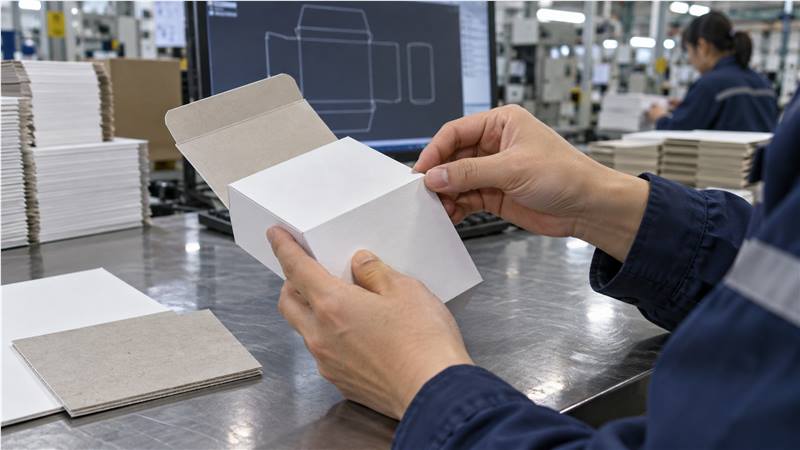
When SBS is worth specifying

SBS earns its place when the board is helping the pack sell the product, not simply hold it.

For a skincare, fragrance, or cosmetics range, buyers often need controlled colour, clean internal surfaces, and finishing that holds up under shelf handling. The board, print, structure, and presentation should be reviewed together on a beauty and skincare packaging project, rather than chosen as four separate decisions.

SBS is usually worth testing when:

  • both sides of the carton are visible;
  • the design uses pale colors, fine typography, or light metallic details;
  • the inner carton carries brand copy or a printed reveal;
  • the product is white, clear, metallic, or otherwise visually affected by a grey interior;
  • the carton is part of a premium retail or gift presentation;
  • the final pack requires a specific food-contact or product-contact document from the selected mill and converter.

The last point needs care. SBS is not a blanket food-contact approval. A food-contact decision depends on the full finished pack: the board, coatings, printing inks, adhesives, intended food type, temperature, storage period, and market. For U.S. products, the FDA explains that food-contact status is tied to the substances and intended conditions of use, not a broad material label alone. See its guidance on food-contact material components.

When CCNB is the smarter commercial choice

CCNB can be a good answer when the carton needs to be printed, folded, shipped, and sold efficiently—but does not need a white showpiece interior.

It is worth comparing when:

  • the product is already protected by a bag, sleeve, bottle, blister, or insert;
  • the reverse side is hidden once the carton is filled;
  • the inside does not need a high-quality printed reveal;
  • the design relies on stronger colors rather than large pale coverage;
  • recycled-fibre content is a meaningful item in the brief;
  • the project has enough volume for board-cost differences to matter.

For a standard retail folding carton, the material conversation should still include structure, board thickness, print coverage, packed weight, and the assembly sequence. The custom folding cartons page is useful here because it frames board choice alongside product fit, closure, printed panels, and sample approval—not as an isolated material decision.

CCNB is not automatically the lower-total-cost choice. If a grey reverse forces a separate inner wrap, limits the interior artwork, causes a redesign, or produces a less convincing product display, the apparent board saving may disappear.

Food contact, recycled content and recyclability: separate the claims

Packaging briefs often put “food-safe,” “recycled,” and “recyclable” in the same sentence. They are different questions.

Food contact asks whether the final package is suitable for its intended contact with food. That can involve paperboard, coatings, adhesives, inks, barrier layers, grease resistance, time, temperature, and the type of food.

Recycled content asks how much recovered fibre is present in the selected grade. Ask for the specific percentage, how it is defined, and which component of the carton it refers to.

Recyclability asks whether the final pack can be accepted and processed in the relevant collection system. Foil, plastic lamination, windows, labels, food residue, and local sorting rules may change that answer.

For EU-bound food packaging, the European Commission states that paper and cardboard used as food-contact materials must comply with applicable food-safety requirements. It is a reason to request documentation for the specific pack and market, rather than relying on the board category in a quotation. See the Commission’s food-contact materials guidance.

For end-of-life claims, keep the language specific. A carton may be paper-based and still need a local recycling check if it includes a heavy coating, laminate, plastic window, or food contamination. The U.S. EPA also advises checking what the relevant local programme accepts for paper and paperboard packaging. Its recycling guidance is a useful reminder that collection rules are not identical everywhere.

Compare total carton cost, not only board cost

Board price is visible on a quote. The cost of getting the wrong board is harder to see until after sampling or launch.

When comparing SBS and CCNB, ask for the same carton dieline, print coverage, finish stack, quantity, and packing method. Then look beyond the material line item.

Cost questionWhy it matters
Does the grey reverse require extra inner wrapping?A cheaper board can create another material or labour step.
Is the carton printed inside?Interior graphics may require a board that keeps the artwork clear and consistent.
Does the design have large pale areas?A new print proof may be cheaper than approving a weak colour result.
Does the carton use foil, debossing or heavy coating?Finishing can change score performance and the scrap rate.
Is the product displayed in an open carton?The reverse board colour may become part of the shelf presentation.
Will the pack be revised often?A stable carton structure and board specification make repeat orders easier to control.

The goal is not to avoid SBS or to default to CCNB. It is to pay for the board feature that the finished pack actually needs.

SBS vs CCNB decision checklist

Choose SBS for sample review when the answer to one or more of these questions is “yes”:

  • Will customers see the carton interior, back panel, or cut edges?
  • Does the design depend on pale shades, white space, fine typography, or strict colour control?
  • Is the carton part of a beauty, fragrance, food, gift, or presentation-led retail experience?
  • Does the product need a clean white interior to look right in the carton?
  • Does the project require specific food-contact documentation for a selected finished pack?

Put CCNB on the comparison list when these conditions apply:

  • The grey reverse is hidden during normal product use.
  • The product has its own bag, bottle, blister, sleeve, or insert.
  • The carton is functional retail packaging rather than an inner-display piece.
  • The artwork is suited to the selected white coated print face.
  • The project values recycled-fibre content and the final pack can still meet the required visual and compliance checks.

The best outcome is often simple: compare both on the same artwork, fold both into the same structure, put the real product inside, and approve the version that works after assembly—not just the version that looks best as a flat sheet.

The sample brief that prevents the wrong choice

A useful SBS-versus-CCNB comparison should not be two unprinted cartons sitting beside each other. Request both materials with the final design and relevant finishing.

Your brief should include:

  1. Product dimensions, weight, and whether the item is naked, bagged, sleeved, or inserted.
  2. Final carton dieline and the panels visible to the customer.
  3. Board grade, caliper or gsm target, and whether the reverse must be white.
  4. CMYK, Pantone, pale-background, foil, embossing, debossing, coating, or varnish requirements.
  5. Whether the inside will be printed.
  6. Food-contact, compliance, recycled-content, or fibre-certification requirements.
  7. Sales channel: retail shelf, e-commerce, gift set, subscription, or wholesale.
  8. Carton assembly method and expected handling route.
  9. A request to review the folded, filled carton—not only the flat print sample.

For brands that need a quote, the most useful first message includes the product dimensions, quantity, artwork status, intended market, board preference, and finish requirement. You can send that brief through the CustomPackMart inquiry page.

Frequently asked questions

Is SBS paperboard better than CCNB for cosmetics?

Often, SBS is worth testing for cosmetics because the white interior, colour control, and clean edges can support shelf presentation and unboxing. It is not mandatory for every beauty carton. If the product is enclosed and the interior is hidden, CCNB may still meet the brief.

Can CCNB be used for food packaging?

The answer depends on the finished packaging system and its intended use. Do not approve it based on the CCNB label alone. Confirm the selected board, coatings, inks, adhesives, contact condition, target market, and required documentation.

Can I print on the inside of a CCNB carton?

Yes, but the grey reverse can affect how the artwork appears. If the inside is part of the brand experience, request a printed, folded sample before deciding.

Is SBS chipboard the same as SBS paperboard?

Not always. “Chipboard” can mean different grades in different markets. Use a clear material specification instead of relying on the phrase alone.

Which board is better for recyclable folding cartons?

Neither board guarantees recyclability by itself. Review the complete structure, including coatings, foil, lamination, windows, labels, adhesive, contamination risk, and the destination market’s collection system.

Hot Foil vs Cold Foil for Packaging: Shine, Cost, Detail & Production Fit

Quick answer: Hot foil stamping is usually the better fit when a package needs a crisp metallic logo, a tactile impression, or a controlled premium finish on a rigid box, folding carton, or textured paper wrap. Cold foil can be a stronger option when the artwork needs broader metallic coverage, printed colour over foil, or an inline print workflow. The right process depends on the substrate, foil area, design detail, order quantity, and later finishing steps.

Foil is not a decoration to decide after the box structure is approved. It affects paper choice, print layers, fold lines, tooling, registration, and sampling. A screen mock-up can look right while a physical sample reveals broken fine lines, uneven foil coverage, or metallic graphics sitting too close to printed artwork.

What Is the Difference Between Hot Foil and Cold Foil?

Hot foil stamping transfers foil with a heated metal die and pressure. The die carries the artwork, presses foil against the board or paper, and leaves behind a metallic or pigment layer. It is normally a separate finishing pass.

Cold foil uses a printing plate to apply UV-curable adhesive where foil should transfer. The foil follows the adhesive, cures, and can then be overprinted as part of the printing workflow. It does not use a heated metal die pressing into the substrate.

The difference is more than temperature. Hot foil is a pressure-and-die process. Cold foil is an adhesive-and-printing process. The Foil & Specialty Effects Association’s process guide is useful for understanding the available methods, but the final decision should still come from a sample made with the actual packaging board.

Decision pointHot foil stampingCold foil transfer
Transfer methodHeated metal die and pressureUV adhesive and foil transfer
Visual characterCrisp metallic accent with tactile definitionMetallic layer that can work with printed colour
ToolingCustom metal diePrinting plate and adhesive setup
Suitable packagingRigid boxes, folding cartons, premium wraps, textured papersSmooth folding cartons, labels, printed sheets
Large foil areasNeed controlled heat and pressureCan be practical, but adhesive coverage must stay even
Fine lines and small textSharp when die and stock are matchedNeeds controlled adhesive transfer and registration
Main production riskUneven transfer, pressure marks, weak fine detailAdhesive coverage, curing, transfer, and overprint alignment

When Does Hot Foil Make More Sense for Packaging?

Hot foil makes sense when the metallic detail is part of the physical experience. A small logo on a perfume carton, a matte-gold crest on a wine gift box, or pigment foil on textured stock can benefit from the sharp edge and pressure-created definition of hot foil.

It is also a practical route when foil sits near embossing or debossing. The finishing sequence must be planned before tooling begins. A heated die, pressure-sensitive wrap paper, and blind deboss can affect one another in ways that a flat proof cannot show.

For fragrance cartons, gift sets, and limited editions, custom perfume boxes are a good example of why foil placement has to work around bottle support, fold lines, labels, and the opening sequence—not only the front-panel artwork.

Where Hot Foil Can Create Problems

Hot foil needs more than a good-looking vector file. Common sample-stage problems include:

  • Fine type or reverse-outs breaking at the edge.
  • Large foil areas showing uneven transfer.
  • Foil shifting too close to printed colour blocks.
  • Pressure marks on soft-touch or delicate paper wraps.
  • Cracking or distortion close to folds, scores, and corners.

These are not reasons to avoid hot foil. They are reasons to approve the foil artwork, paper, die, and pressure together before mass production.

When Is Cold Foil the Better Fit?

Cold foil is worth considering when metallic coverage behaves as part of the printed image rather than as a separate tactile accent. It can suit metallic graphics, colour-over-foil effects, gradients, or layouts with larger metallic sections.

The practical question is whether foil should feel like a distinct finishing detail or operate as a metallic image layer. A cosmetics carton with broad metallic graphics may point toward cold foil. A small signature logo on a magnetic gift box may still point toward hot foil.

Cold foil also needs a careful substrate review. Rough board can make the transferred foil look inconsistent. If the project includes full-coverage ink, spot UV, embossing, or matte coating, sample the actual production sequence instead of approving a foil swatch on unrelated stock.

What Cold Foil Does Not Automatically Solve

Cold foil avoids the heated metal die used in hot foil, but it introduces other controls: adhesive weight, curing, transfer quality, and registration. A metallic area that looks even on a flat press sheet can change after die-cutting, folding, rubbing, or carton erection.

Do not select cold foil only because the artwork may change often. Press setup, order volume, SKU count, foil area, and the finishing sequence still affect cost and production risk.

Which Packaging Structures Suit Each Foil Method?

The packaging format often narrows the choice faster than a generic cost comparison.

Packaging formatHot foil fitCold foil fitApproval check
Folding cartonStrong for logos, borders, and premium accentsStrong candidate for broad metallic graphics or colour-over-foil effectsFold cracking, registration, rub resistance
Rigid-box wrapStrong for tactile logos, matte gold, pigment foil, and deboss combinationsPossible, depending on wrap stock and production routeWrap mounting, corners, glue, pressure marks
Corrugated mailerLimited because of board texture and flute profileLimited; direct-print board often needs another visual strategyFlute show-through and scuffing
Labels and sleevesUseful for premium accents and smaller formatsOften practical for metallic print effects at scaleAdhesion, cure, and application
Gift-box insertsUseful for logos and presentation detailsDepends on material and flat-sheet processNesting, die-cutting, and abrasion

For a rigid box or folding carton, the foil decision should follow the structural decision. Confirm the paperboard, wrap paper, fold position, glue zone, and product pack-out before approving a finishing route.

Hot Foil, Cold Foil, or Scodix: Are They the Same Thing?

No. Scodix is a digital enhancement technology, not another name for hot foil or cold foil. Digital foil can suit short runs, versioned artwork, textured effects, and projects where conventional tooling is difficult to justify. Its substrate range, cost model, and finished appearance should be evaluated as a separate option.

A buyer may receive three quotations that all say “gold foil” while describing three different methods. Each quotation should name the process, substrate, foil effect, coverage area, print layers, and any coating or embossing step. The FSEA foil comparison sheet separates hot foil, cold foil, toner-based digital foil, and varnish-based digital foil for this reason.

Use digital foil when the project needs short-run flexibility or several artwork versions. Do not assume it replaces hot foil when the brand wants pressure-defined tactile detail, or cold foil when the job needs an inline metallic print treatment.

What Drives the Cost of Foil Packaging?

Foil cost is more than foil material plus box cost. The main variables are:

  • Foil area and foil-web waste.
  • Foil type: metallic, matte, pigment, holographic, pearlescent, or security foil.
  • Die size, line complexity, and foil colours.
  • Paperboard, wrap paper, coating, and surface preparation.
  • Whether foil requires a separate production pass.
  • Registration requirements beside CMYK, Pantone, or other print layers.
  • Order quantity and number of artwork versions.
  • Sampling rounds, approval standards, and rework risk.

A small foil logo can still need meaningful setup because it requires a die and press preparation. A wide metallic field can consume more foil and need more production control. Ask for a quote based on the complete package specification instead of comparing process names alone.

How Should You Approve Colour and Foil Before Mass Production?

Approve the package as a system. A foil swatch alone cannot show how the final box will look beside its brand colour, under retail lighting, after folding, or after handling.

A useful sample review should include:

  1. The actual board or rigid-box wrap material.
  2. The final foil colour and coverage area.
  3. Printed colour beside the foil.
  4. Fine type, line endings, and reverse-outs.
  5. Folds, scores, corners, and glue areas.
  6. Embossing or debossing, where applicable.
  7. Rub marks and handling wear.
  8. The finished carton or rigid box, not only a flat sheet.

Colour approval also needs a defined proofing condition. ICC print-production colour-management resources explain why profiles and output conditions matter when artwork moves between screens, proofs, and production printing.

BUYER DECISION · FRENCH SKINCARE

Why this skincare brand paid 18% more for foil

The team needed a metallic logo that could survive premium retail handling—not just look sharp on a flat sample. Cold foil was cheaper and easier to revise. It did not pass the reliability checks.

42kfirst-order gift boxes
€34korder value
4sample rounds
≤0.12 mmapproved registration error
✦

The brief

0.2 mm foil lines, CMYK overprint, 350g matte board, no laminate.

⚠

The risk

A gift box that looked sharp in approval but scratched or lost colour in retail handling.

Two routes. One retail-ready choice.

EASIER TO REVISE

Cold foil

  • Fine lines reproduced well.
  • Artwork changes were simpler.
  • Scratch and fold checks failed.
SELECTED

Hot foil

  • Sharper final champagne-gold edges.
  • 400+ dry-rub strokes passed.
  • Better fit for retail display.

What the samples proved

3.2% → 0.8%
reject rate
≤0.12 mm
registration error
+18%
foil operation cost
2 days
per sample round

Why it won

The brand paid more to avoid scuffed shelf packs, weak overprint adhesion, and rework after delivery.

✓

Buyer takeaway

For hairline metallic artwork, approve the finished carton—not a foil swatch or a digital proof.

Before approval, ask for

  • Both foil options on the final board.
  • A rub check and a fold check.
  • Fine lines at real printed size.
  • A stated registration tolerance.

Source note: Internal project record, France, March 2024. Customer identity withheld. Results apply to this artwork, substrate, finish stack, test approach, and handling conditions; they are not a universal performance guarantee.

A German Fragrance Box Where Foil Had to Stay Clear of the Deboss

One internal project record shows why hot foil and tactile finishing need to be developed together.

In November 2021, a German skincare and fragrance brand ordered a rigid gift box with a 2.0 mm greyboard core and a 157 g tactile matte paper wrap. The visual direction was restrained: a blind-debossed logo and decorative lines, paired with selected matte-gold foil text.

The first samples revealed two problems. The deboss did not feel deep enough, while foil edges near the deboss could blur or shift under pressure. Increasing machine pressure alone was not the answer because the tactile paper could rebound or crease.

The team made three focused adjustments:

  • Increased the die engraving depth and rebalanced press pressure.
  • Moved foiled elements to keep a 0.8 mm safety gap from blind-deboss artwork.
  • Adjusted the wrap paper’s humidity condition before pressing to reduce rebound.

After three sample rounds, the project proceeded with an order of about 8,000–12,000 rigid boxes, valued at roughly US$13,000–17,000.

This project is evidence for hot foil combined with blind debossing, not a universal hot-versus-cold comparison. Its practical lesson is narrower: if foil and deboss sit too close together, changing one process can damage the other. Set the safe distance during artwork development, not after the die is made. For the deeper finish comparison, see embossing vs debossing for packaging.

Does Foil Affect Packaging Recyclability?

Do not label a foiled carton recyclable or non-recyclable based only on whether it uses hot foil or cold foil. The answer depends on the board, ink, coating, adhesive, foil coverage, local collection rules, and the actual recycling stream.

For a brand reducing plastic layers, foil should be evaluated with laminates, varnishes, adhesives, and the amount of metallic coverage. If recyclability is a purchase requirement, ask for the complete material build and verify it against the destination market’s relevant guidance.

FAQ

Is hot foil more expensive than cold foil?

Hot foil often has metal-die and separate-pass setup costs. Cold foil can reduce some tooling exposure but has adhesive, curing, press, and registration requirements. Compare complete packaging specifications instead of process names alone.

Can cold foil achieve the same shine as hot foil?

Cold foil can create a strong metallic effect on the right smooth stock. Hot foil is often selected when the buyer needs dense, sharp, tactile metallic detail. Approve both methods on the final substrate if appearance matters.

Does hot foil work on recycled or textured paper?

It can, but results depend on fibre texture, coating, foil type, die detail, heat, and pressure. A physical sample is essential because rough texture can affect edge definition and coverage.

Can foil be combined with embossing or debossing?

Yes, but spacing, production sequence, die pressure, and board stability must be planned together. In the German fragrance-box project, moving the foil 0.8 mm away from the blind deboss helped keep the foil edge clean.

Is Scodix better than hot foil for short runs?

Scodix can suit short runs, versioned artwork, and digital enhancement. It is not a universal replacement for hot foil because tactile effect, substrate compatibility, and pricing logic differ.

What Should Be Included in a Hot Foil or Cold Foil RFQ?

A supplier can quote and sample more accurately when the brief includes:

  • Box type, assembled dimensions, and dieline.
  • Requested board, wrap paper, or material appearance.
  • Vector artwork.
  • Foil colour and estimated coverage area.
  • Whether foil sits beside CMYK, Pantone, embossing, debossing, spot UV, or lamination.
  • Quantity, SKU count, and expected artwork revisions.
  • Required delivery destination and deadline.
  • Product details and pack-out requirements for rigid boxes or gift sets.
  • Approval expectations for colour, registration, rub resistance, and folding.

Send the structure, artwork, material expectation, quantity, and destination through the packaging inquiry page rather than requesting a foil price without the board and finishing details.

For a finish that works on the actual box—not only on a mock-up—start with the board, artwork, quantity, and handling requirements. Forests Packaging Group can review those points before sampling.

Flexography vs Offset Printing for Packaging: When Flexo, Litho, or Digital Makes Sense

Quick answer: Flexography is often the practical choice for direct-print corrugated boxes, kraft packaging, labels, and repeat orders with stable artwork. Offset printing is usually the stronger option for folding cartons, rigid-box wraps, detailed illustrations, and brand-sensitive color work. Digital printing is useful when artwork changes often, quantities are limited, or several versions need to be tested before a larger run.

The wrong choice can create trouble long before the boxes leave the factory. A fine white line may fill in on an absorbent kraft surface. A premium carton may look flat if a photograph is printed through a process that does not suit the paperboard. A short-run launch can carry unnecessary plate costs if the artwork is likely to change in a few weeks.

The useful question is not “Which printing method is best?” It is: which method fits this packaging structure, this artwork, this paper, and this order pattern?

Flexography vs Offset Printing at a Glance

Flexography, offset lithography, and digital printing produce an image in different ways. The Flexographic Technical Association’s overview of flexo fundamentals{target=”_blank” rel=”noopener”} is useful background, but a buyer still needs to connect the process to the finished pack.

Decision pointFlexographyOffset / LithoDigital
Image transferFlexible relief plate prints directly onto the substratePlate transfers ink through a rubber blanketFile prints without traditional plates
Common packagingCorrugated boxes, kraft paper, labels, pouches, paper bagsFolding cartons, rigid-box wraps, sleeves, paperboard packsShort-run cartons, launch kits, test versions
Artwork strengthSimple graphics, bold type, stable repeat designsFine type, gradients, photos, detailed artworkFast artwork changes and multiple versions
SetupPlates and press setup requiredPlates and press setup requiredMinimal traditional setup
Revision effectNew or revised plate work may be neededNew or revised plate work may be neededArtwork can be revised in the file
Substrate behaviorStrong option for direct printing on many packaging surfacesOften printed on paperboard or wrap paper before conversionDepends heavily on the press and approved substrate
Brand-color controlCan use spot colors, subject to substrate and process controlStrong option for complex color-critical paperboard workMay simulate spot colors; physical approval still matters
Typical buyer fitRepeat transit packaging or functional packagingRetail-facing, premium, image-led packagingNew products, regional versions, limited campaigns

A table can make the choice look simple. Production rarely is. For example, two cartons may use the same logo and CMYK artwork, but one is printed on coated white paperboard while the other is direct-printed on recycled corrugated board. Their ink absorption, dot gain, color density, and small-text legibility can be very different.

How Do Flexo, Offset, and Digital Printing Work on Packaging?

Flexographic printing

Flexography uses a flexible raised plate. Ink is metered through an anilox roller, transferred to the plate, then printed directly onto the material. This direct approach is one reason flexo is widely used for corrugated cartons, kraft paper, labels, films, and other packaging substrates.

For a shipping carton, direct printing can be a sensible route. The artwork may include a logo, handling marks, product identification, simple brand graphics, or a one- or two-color pattern. Those marks need to survive a functional board surface; they do not always need the photographic detail expected from a cosmetics carton.

Offset lithographic printing

Offset printing uses plates, but the image does not transfer directly from the plate to the paper. It moves through a blanket cylinder before reaching the sheet. The process is commonly used for paperboard packaging where image detail matters: folding cartons, sleeves, rigid-box wrap paper, retail presentation packs, and litho-laminated corrugated formats.

Offset earns its place when the artwork includes fine typography, skin-tone photography, close gradients, complex illustrations, or demanding brand graphics. It is also often easier to coordinate with later converting steps such as lamination, foil stamping, embossing, debossing, and die cutting—provided those steps are included in the sample review.

Digital printing

Digital printing creates the image from the approved file instead of relying on conventional printing plates. That does not make it a shortcut for every job. It makes it useful when the job itself is uncertain: a new launch, several regional versions, a subscription-box test, an event kit, or a short campaign with multiple SKUs.

Digital can also reduce the friction of artwork changes. If a product claim, language version, barcode, or seasonal message changes, the file can be updated without remaking conventional plates. The buyer still needs to check the actual substrate, solid-color coverage, finish, and color expectation before treating a digital sample as equivalent to a later offset or flexo run.

When Is Flexography the Better Packaging Choice?

Flexo is often the better fit when the package has a practical job after printing. Think direct-print shipping cartons, kraft mailers, produce cartons, corrugated retail trays, paper bags, labels, and flexible packaging with a stable design.

It is especially worth evaluating when the artwork uses bold graphics, limited colors, repeated logos, handling symbols, or a pattern that needs to run consistently across repeat orders. A direct-print carton also removes the separate step of printing a wrap sheet and laminating it to corrugated board.

For brands developing custom corrugated shipping boxes, the print decision should sit beside the board, flute, packed weight, closure, and delivery route. The print surface is part of the shipment, not a design layer added after the box specification is fixed.

Flexo needs more care when the design contains hairline reverses, tiny light text, subtle tonal transitions, or fine photographic detail. Recycled and uncoated boards can absorb ink differently from coated papers. A brand that approves a screen mock-up without seeing the real board may find that its pale logo loses contrast or its small type fills in during production.

When Is Offset Printing Worth the Setup?

Offset is usually worth considering when the printed surface carries much of the package’s selling job. Folding cartons for beauty, fragrance, supplements, food, electronics, wine, and retail gift sets often need sharper graphics than a transit carton. The same applies to rigid-box wrap paper, presentation sleeves, and printed inserts.

Offset is a strong candidate when the design includes:

  • Fine serif or reversed type;
  • Dense illustration work;
  • Photography and tonal gradients;
  • Multiple brand colors;
  • Close visual consistency across a product range;
  • Premium finishes that need precise registration.

That does not mean offset automatically creates a premium package. A weak paper choice, a poor dieline, a badly placed fold, or a finish that cracks on the score can still make a good print job look cheap. The print method must follow the structure, not compete with it.

For example, a carton with a dark full-coverage background needs its fold positions reviewed before production. If the board cracks at a score line, the exposed paper fiber can become obvious. The answer may involve board choice, grain direction, scoring, coating, artwork placement, or a different finish—not merely “print it better.”

Where Does Digital Printing Fit—and Where Does It Not?

Digital printing is useful when flexibility has more value than long-run unit economics. It suits a business testing four box designs, launching a limited holiday pack, changing product information across several countries, or producing short runs before demand is proven.

It can also make sense where several SKU designs share one packaging structure. A brand may have one folding-carton dieline but six product variants. With digital, the artwork can change more easily while the structure remains fixed.

That flexibility does not remove the need for a production decision. Once the order becomes a stable repeat programme, conventional flexo or offset may give a better fit depending on the substrate, artwork, and expected order pattern. The right point to switch is not a universal quantity threshold. It depends on the number of colors, designs, repeat frequency, finishing requirements, material yield, and whether the artwork is actually settled.

For more procurement-focused comparisons beyond print, browse the Forests Packaging Insights blogfor material, insert, shipping, and packaging-structure guidance.

PRINT METHOD · ORDER WIN

A Danish fragrance brand needed a lighter way to keep pale colour consistent

Its E-flute mailer needed a full pale-grey base, a fine-line logo and frequent copy updates. The old offset route looked good—but it was too rigid for the way this brand launched products.

68kfirst-order mailer boxes
$29korder value
ΔE < 2.0same-batch colour variation
3 samplescolour, coverage, rub test

The brief was not “make it cheaper”

The customer sold candles and reed-diffuser sets in a Nordic, restrained visual style. It wanted recyclable packaging, less exposure to obsolete stock, and a pale background that would not look patchy on 80% recycled E-flute board.

GOOD, BUT TOO RIGID

Offset litho

Colour was stable, but the laminated construction and higher setup burden worked against frequent text changes.

  • Film and press setup for each revision
  • 3–5 day change cycle
  • Matte film complicated recyclability
FAST, BUT NOT THE FINISH

Digital print

The quickest route for new artwork, yet the full pale field showed grain and could scuff in parcel handling.

  • No plates and rapid artwork updates
  • Pale fill showed mottling
  • Unit cost climbed at volume
SELECTED

HD flexography

Direct water-based printing kept the box unlaminated and provided the practical middle ground between appearance and repeatability.

  • 4C CMYK + one Pantone pale grey
  • Water-based ink, no film laminate
  • Artwork update in 4–8 hours

What changed after the switch

Flexo reduced the former offset waste rate from 2.1% to 0.6%. Artwork revisions went from 3–5 days to 4–8 hours, while revision cost fell by 75%. The unlaminated mailer also lowered total box cost by 12%.

250g recycled kraft E-flute 80% recycled content 210 × 160 × 60 mm Water-based ink system

Why the customer approved it

The box still felt deliberate and premium, but the brand could run smaller launches without building old stock. Its recyclable material direction and faster update cycle finally matched the way it worked.

!

Production note: pale coverage needs its own colour

On recycled corrugated board, do not build a pale full-coverage background by stacking CMYK. This project used a dedicated Pantone pale-grey base with a 300 lpi anilox roller to lay down a thin, even ink film—avoiding the cloudy, uneven look that four-colour overprint can create on rough paper.

Source note: Internal project record, Denmark, January 2024. Customer identity withheld. Results reflect the stated box, artwork, board and handling conditions; they are not a universal performance guarantee.

Do Not Choose by Quantity Alone: Four Questions That Change the Answer

What surface will carry the print?

Coated white paperboard, uncoated kraft, recycled board, direct corrugated, metallized paper, and flexible film do not receive ink in the same way. The surface changes perceived color, sharpness, dot shape, and rub resistance.

A flexo design that works on a white coated label may not read the same on a brown corrugated carton. An offset design built for coated art paper may need adjustment before it goes onto an uncoated wrap sheet. Ask the supplier to print or simulate the artwork on the intended material rather than showing a generic proof.

How demanding is the artwork?

Separate the parts of the artwork that must be perfect from the parts that can be flexible. Is the critical element a small white logo? A skin-tone photograph? A large dark background? A Pantone brand color? A legal text block? A barcode?

This makes the conversation more useful than simply saying, “We need premium quality.” A supplier can test a 4-point reverse line or a dense black panel. “Premium” cannot be tested unless the buyer explains what visual failure would be unacceptable.

How many versions will the project need?

A single artwork repeated for months creates a different cost structure from ten language versions that may change every quarter. Plate-based methods can be a sound choice for stable programmes; frequent version changes require the buyer to account for revised plates, proofing, approvals, and obsolete inventory.

How will color be approved?

A Pantone number is useful, but it is not a substitute for an approved physical reference. Paper, ink, coating, lighting, and viewing conditions all influence the result. The International Color Consortium’s profile resources explain why print workflows use profiles and characterized printing conditions rather than relying on the appearance of a screen alone.

What Should You Approve Before Mass Production?

The sample stage is where printing method and package construction meet. Approving only a flat sheet can leave important questions unanswered. A packaging proof should reflect the real board, print process, structure, and, where practical, relevant finishing.

Use this checklist before approving a mass-production run:

  • Confirm the final artwork version and each SKU;
  • Confirm whether colors are CMYK, spot colors, or a combination;
  • Check the print on the actual paperboard, corrugated board, or kraft substrate;
  • Inspect small text, reverse text, barcodes, gradients, and large solid-color areas;
  • Check folds, scores, glue areas, windows, embossing, foil, and other locations that may affect the image;
  • Review the completed pack under normal viewing conditions, not only under a press-room light;
  • Retain an approved reference sample for the next repeat order.

Pantone itself notes that an on-screen simulation may not match a physical color standard. Use a physical Pantone reference or another agreed physical standard when color is commercially important.

What Should You Include in an RFQ for Flexo, Offset, or Digital Packaging?

A good RFQ lets a supplier identify the likely printing route before pricing an unsuitable process. It also exposes questions that can otherwise appear after the artwork has already been approved.

Include the following:

  1. Packaging type and final structure: carton, corrugated shipper, mailer, sleeve, rigid box, pouch, label, or bag.
  2. Finished dimensions and whether they are internal or external.
  3. Intended material and any recycled-content, coating, or texture requirement.
  4. Dieline or rough structural drawing, if available.
  5. Artwork files, number of designs, number of SKUs, and language versions.
  6. Print requirement: CMYK, Pantone references, number of printed sides, white ink, metallic effect, or special finish.
  7. Quantity per SKU and estimated reorder pattern.
  8. Product weight, packing method, and destination if the package also needs a shipping role.
  9. Sample requirement, deadline, and the visual or functional points that need approval.

If you have those details ready, send them through the Forests packaging inquiry page. It gives the production team a usable starting point instead of forcing the quotation to rely on a generic “custom box” description.

FAQ

Is flexographic printing cheaper than offset printing?

It can be, particularly for stable direct-print packaging and repeat work, but the answer depends on plate count, artwork complexity, material, quantity by SKU, and press setup. Compare total project cost, not only the quoted unit price.

Is flexo or offset better for corrugated boxes?

Flexo is commonly used for direct-print corrugated packaging. Offset can be a stronger option when the corrugated box needs a high-detail printed wrap sheet or litho-laminated presentation. The choice depends on whether transit function or shelf presentation drives the pack.

Can flexographic printing match Pantone colors?

Flexo can use spot colors, but the final result depends on ink, substrate, plate, press condition, and the approved color reference. Confirm the color on the actual production material.

Is digital printing suitable for retail packaging?

Yes, particularly for short runs, market tests, regional versions, and changing artwork. For stable, high-volume retail programmes with demanding graphics, offset may still be the more suitable route.

Do I need a physical proof before printing custom packaging?

A physical proof is strongly recommended when color, material surface, fine detail, folds, special finishes, or product fit matter. It is the clearest way to check how the design behaves as a finished package rather than as a screen file.

How Forests Matches the Print Method to the Package

A print choice should be checked against the whole pack: the product, structure, board, artwork, finish, assembly sequence, and delivery route. A direct-print corrugated carton may need flexo and a board-first review. A retail folding carton may need offset, a color proof, and a score-line check. A short campaign may need digital printing because the artwork is still changing.

Forests begins that conversation from the packaging brief rather than naming one process as the default. The project review can cover the product, structural drawing, material surface, artwork risk, sample requirements, conversion steps, and repeat-order expectation. Learn more about Forests Packaging Groupbefore sending the first artwork file.

The useful outcome is an approved package that can be repeated with fewer surprises—not a process selected only because it was familiar or appeared cheaper at the first quotation stage.

ECT vs Burst Strength: Which Corrugated Box Test Should You Specify?

Quick answer: ECT, burst strength, and BCT measure different packaging risks. ECT focuses on stacking and edge compression. Burst strength focuses on puncture and tearing. BCT tests the finished carton under compression.

For palletized cartons, ECT is usually the right starting point. For sharp or heavy products, burst strength matters more. For large export cartons, the finished box should also be compression-tested.

Buyer reviewing corrugated box dimensions and strength requirements for an RFQ

ECT vs Burst Strength: What Does Each Test Measure?

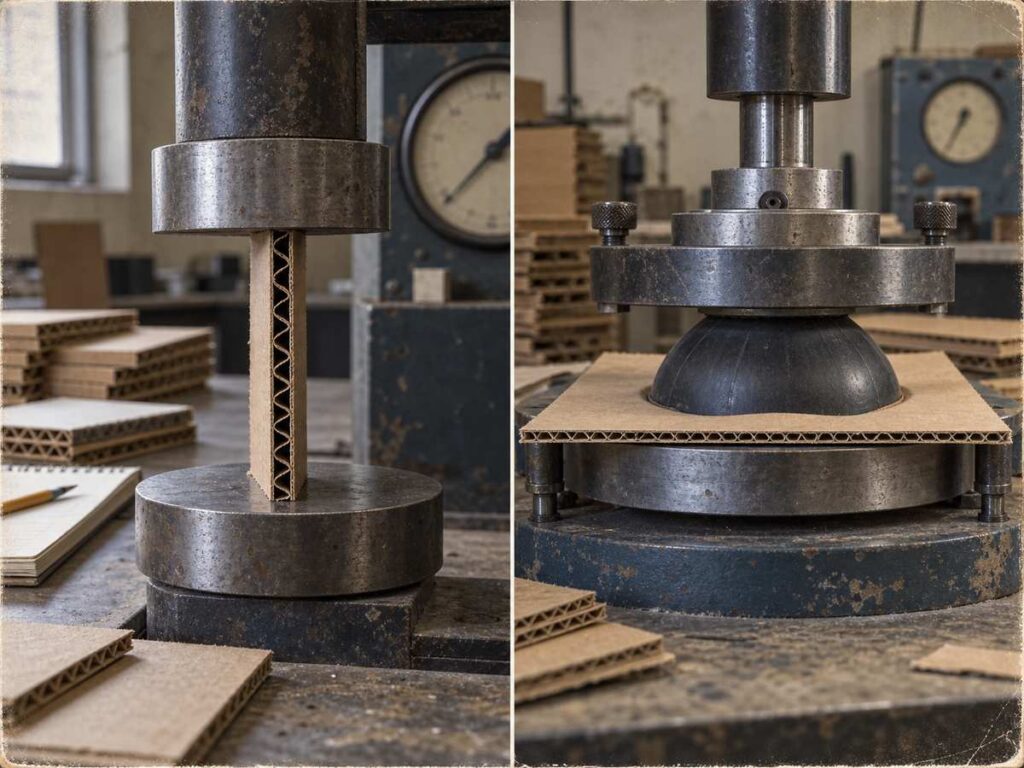
ECT stands for Edge Crush Test. It compresses the edge of a corrugated board sample until the fluting collapses. The result is normally reported in pounds per linear inch.

This matters because the vertical walls of stacked cartons carry load in a similar direction. When cartons are placed on a pallet, ECT gives a useful indication of how the board may perform under stacking pressure.

Burst strength, also called the Mullen test, measures resistance to puncture and rupture. A rubber diaphragm presses against the flat board surface until the liner or flute breaks.

The difference is straightforward:

  • ECT asks how much edge compression the board can resist.
  • Burst strength asks how much concentrated pressure the board can take.
  • BCT asks how much compression the completed carton can handle.

For technical background, buyers can also review the relationship between edge crush performance and box compression in the TAPPI technical reference.

A practical comparison

TestWhat it measuresBest used for
ECTEdge compressionPallet stacking and warehouse storage
Burst strengthPuncture and tearing resistanceSharp products and concentrated impact
BCTCompression of the completed cartonHeavy cartons and export shipping

When Should ECT Be Your Main Specification?

ECT is a practical starting point when boxes will be stacked during storage or transportation.

This includes:

  • Palletized shipments
  • Warehouse storage
  • Parcel cartons placed under other cartons
  • Long-distance road or sea freight
  • Heavy products packed in corrugated cartons
  • Shipments where vertical compression is the main concern

A common mistake is to select a carton only by paper weight or board thickness. A heavier-looking box is not automatically stronger. Flute type, liner quality, carton dimensions, humidity, joint position, and loading pattern all affect the result.

A large carton also places more stress on the board than a small carton. If the box is oversized or only partly filled, the panels may buckle before the paper reaches its theoretical rating.

For buyers comparing carton structures, custom corrugated shipping boxes can be specified with the product weight, internal dimensions, flute type, and expected stacking condition.

ECT and burst strength testing compared on corrugated board samples

When Does Burst Strength Matter More?

Burst strength becomes more important when a carton may experience puncture or concentrated impact.

Typical examples include:

  • Metal parts and hardware
  • Bottles and rigid components
  • Products with sharp corners
  • Heavy products that can shift inside the box
  • Cartons exposed to rough manual handling
  • Packaging with limited internal cushioning

A corrugated board can have good ECT performance and still fail when one sharp product presses against a small area. The force is concentrated, so the liner may tear or the flute may rupture.

Internal packaging matters here as well. A stronger outer board cannot fully solve a product movement problem. If the product repeatedly hits the same panel during transport, the board may eventually fail even when the basic material rating looks sufficient.

What Does a Box Compression Test Tell You?

BCT, or Box Compression Test, evaluates the complete carton rather than a flat board sample.

The finished box is placed between two compression plates. Pressure increases until the carton buckles or loses its structural shape.

This test includes details that a board test cannot fully represent:

  • Finished carton dimensions
  • Flap overlap
  • Joint method
  • Creasing quality
  • Glue or stitching
  • Printing and coating
  • Internal fit
  • Product weight
  • Moisture exposure

BCT is especially useful for large, heavy, or export cartons. It shows how the box performs after it has been folded, glued, loaded, and handled as a real shipping package.

For shipments exposed to rough parcel handling, a broader packaging test plan such as the one described by FedEx Packaging Testing can provide useful reference points.

Pallet stacking and box compression testing for corrugated cartons

Why the finished box matters

A carton can pass a board test but fail after conversion. A longer panel, deeper score line, weak joint, or poor flap overlap can reduce the compression strength of the completed box.

That is why the board specification and finished-box test should work together.

REAL PACKAGING DECISION · UK · MARCH 2024

Why ECT 28 Beat a Heavier Double-Wall Box

A UK outdoor cookware brand needed one carton to survive sea freight, six-layer warehouse stacking, and sharp metal product edges—without increasing the outer box size.

6.7% → 0.8%
transport damage
ECT 28
final board grade
3310 N
measured compression
128,000
sets in first order

⚠️ The original carton

  • Single-wall B-flute carton
  • ECT 23 / Burst 1400 kPa
  • 320 × 240 × 180 mm
  • 2.8 kg packed product
  • Middle-panel collapse and corner splitting
  • Metal cookware edges punctured the board

✅ The final specification

  • Single-wall C-flute carton
  • ECT 28 / Burst 1800 kPa
  • 200 g high-burst liner paper
  • 120 g fluting paper
  • 0201 regular slotted carton structure
  • R5 rounded corners to reduce split lines

📦 Four options were tested

Option Strength point Problem Decision
B-flute ECT 23 Lowest cost Insufficient stacking strength Rejected
Thicker B-flute ECT 29 Higher board rating BCT still weak for six-layer storage Rejected
BC double-wall ECT 32 Strong compression and puncture resistance Reduced container loading by 8% Too expensive to ship
C-flute ECT 28 Balanced compression and puncture resistance Required three sampling rounds Selected

🧪 What changed during testing?

Round 1

Basic C-flute board reached 2.2 m stacking height, but the box wall started to dent.

Round 2

High-burst liner improved puncture resistance, but sharp die-cut corners still split.

Round 3

R5 rounded corners completed the test: 2.8 m stacking for 24 hours with no permanent deformation.

💡 The practical lesson

The customer did not solve the problem by simply choosing the highest ECT grade. The better result came from combining C-flute ECT 28, high-burst liner paper, and rounded carton corners. For metal products, the face paper and die-cut design can be just as important as the compression rating.

Project figures supplied from an internal packaging sales record. Customer identity withheld.

Why a High Board Rating Does Not Guarantee a Strong Carton

A carton may fail even when the paper grade looks sufficient because:

  • The box is oversized for the product.
  • The product shifts during transportation.
  • The carton is stacked beyond its tested height.
  • Warehouse humidity weakens the paper.
  • The flaps do not overlap correctly.
  • The score lines are too deep.
  • The joint is placed in a high-stress area.
  • The box is compressed before the adhesive fully sets.

Moisture deserves special attention. Corrugated board absorbs moisture, and its compression performance may decline during humid storage or sea freight.

For recycled corrugated cartons, the balance between recycled content and physical performance also matters. Buyers comparing board options can review recycled shipping boxes together with ECT and compression requirements instead of choosing recycled content alone.

What Should You Include in a Corrugated Box RFQ?

A vague RFQ usually produces vague quotations. Suppliers need enough information to connect the material specification with the actual shipping risk.

1. Finished internal dimensions

State the usable internal length, width, and height. Do not provide only the product dimensions. Include clearance for inserts, cushioning, and loading.

2. Product weight

Give both the net product weight and the packed shipment weight. If the product contains several components, explain how the weight is distributed.

3. Board construction

Specify the flute type, number of walls, liner requirements, recycled-content target, and approximate board thickness.

4. ECT or burst requirement

State whether stacking resistance, puncture resistance, or both are important. If you already have a target value, include the testing method and unit.

5. Shipping environment

Describe pallet stacking, parcel handling, export freight, expected humidity, warehouse storage time, and possible exposure to rain or condensation.

6. Closure and joint method

Mention whether the box will use tape, hot melt, stitching, locking flaps, or water-activated tape.

7. Testing requirements

Ask whether the supplier can provide board certificates, compression testing, drop testing, or samples from the proposed production material.

8. Loading direction and pallet pattern

The same carton may perform differently when loaded upright, sideways, or in a mixed pallet pattern.

If you need help turning these details into a packaging specification, you can send the requirements through the packaging inquiry page.

Which Test Should You Specify?

Use ECT when vertical compression and pallet stacking are the main risks.

Use burst strength when the product can puncture, tear, or concentrate force on one small area.

Use BCT when you need to verify the complete carton, especially for heavy products, large cartons, export shipments, or new box structures.

In many projects, the best approach is to combine several tests:

  • Minimum ECT value for the board
  • Burst-strength requirement for puncture resistance
  • Finished-box compression testing
  • Drop testing with the real product
  • Humidity or conditioning tests when required

Independent research on corrugated-board compression also shows why board structure and loading conditions should be considered together. The published research on corrugated packaging performance is useful background for technical buyers.
Frequently Asked Questions

Is ECT better than burst strength for shipping boxes?

Neither test is universally better. ECT is more useful for cartons that will be stacked or palletized. Burst strength matters more when the product may puncture the carton or create concentrated pressure on one area.

Does a higher ECT rating always mean a stronger box?

No. Carton size, flute type, moisture, flap design, joint position, and internal product movement also affect performance. A high ECT board can still fail if the finished carton is oversized or poorly designed.

When should I request a BCT test?

Request BCT when the carton is large, heavy, palletized, or used for export shipping. BCT tests the completed box, so it reflects the effect of folding, gluing, scoring, flaps, and loading.

Can burst strength replace ECT?

Usually, no. Burst strength measures puncture and tearing resistance, while ECT focuses on edge compression. A carton may perform well in one test and poorly in the other, depending on the shipping risk.

What should be included in a corrugated box RFQ?

Include the finished internal dimensions, product weight, flute type, board construction, ECT or burst requirement, closure method, pallet pattern, shipping route, humidity exposure, and required drop or compression tests.

Should recycled corrugated boxes use ECT or burst strength?

They may need both, depending on the product and route. Recycled board can perform well, but moisture, fiber quality, box size, and stacking conditions should be tested before mass production.

Final Takeaway

ECT and burst strength are not two names for the same property.

ECT is mainly connected to edge compression and stacking. Burst strength focuses on puncture and rupture. BCT shows how the completed carton performs after converting and loading.

Start with the shipping risk, then choose the test.If the carton will be stacked, begin with ECT. If the product creates concentrated impact, check burst strength. If the carton is large, heavy, or used for export, validate the finished box with compression and drop testing as well.

EVA Foam vs EPE Foam for Packaging Inserts: Cost, Fit & Protection

Quick answer: EVA foam is usually the better choice for a precise cavity, premium presentation, and repeatable positioning. EPE foam is usually the better choice for lightweight cushioning, abrasion control, and cost-sensitive shipping protection. The result depends on density, thickness, cavity geometry, clearance, outer-box strength, and the handling route.

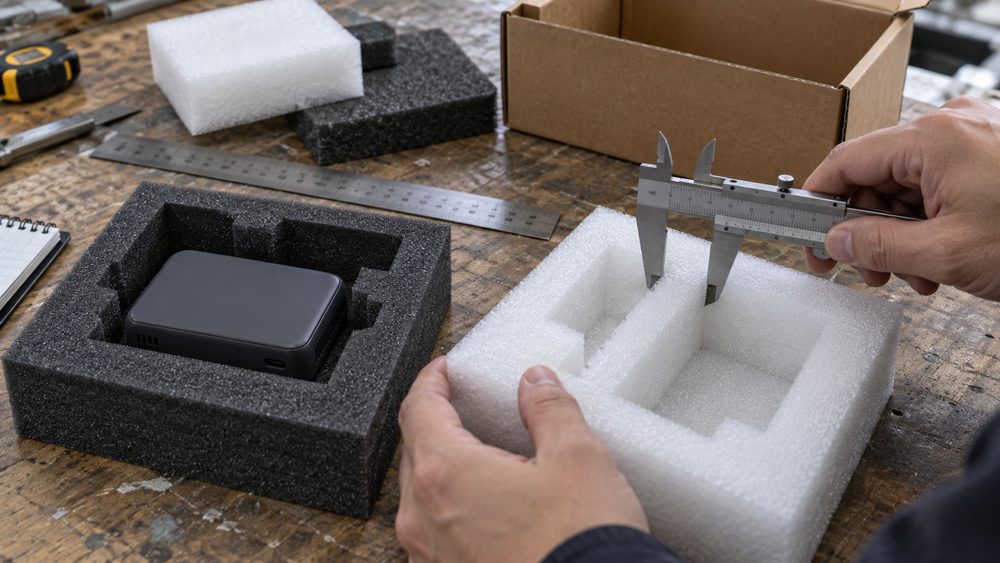
Calipers measuring foam insert thickness and cavity clearance for packaging

A color sample is not enough. The insert must hold the product, leave enough loading clearance, protect its surface, and stay effective after drops, stacking, and vibration.

EVA foam and EPE foam: what is the difference?

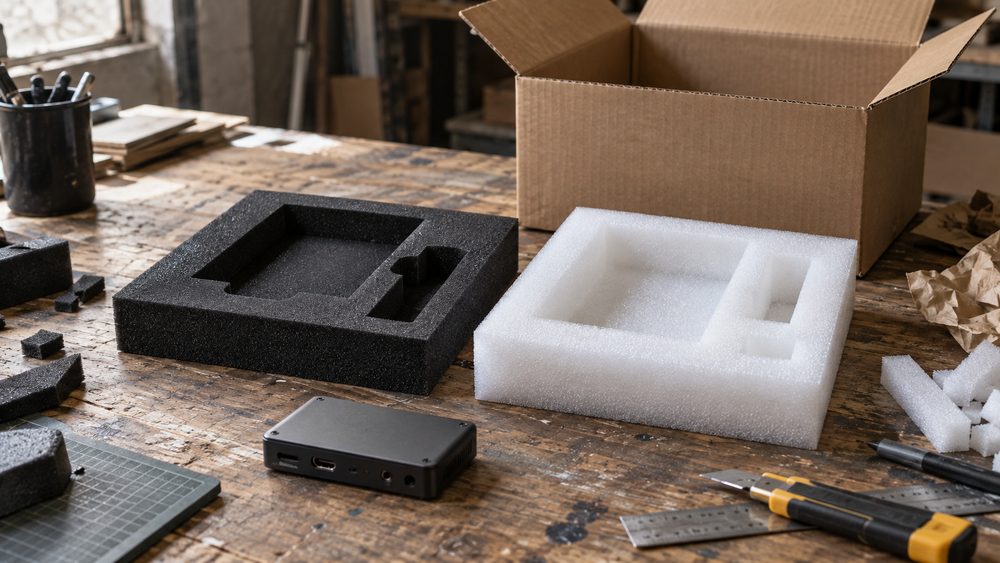
EVA is a denser closed-cell foam used for fitted trays, electronics, tools, medical devices, cosmetics, and gift packaging. It cuts cleanly and holds a shaped cavity well. It can also be laminated or flocked. The trade-off is higher material cost and, in some formats, a heavier structure.

EPE is expanded polyethylene foam. It is light, resilient, moisture-resistant, and common in pads, sleeves, end caps, separators, and concealed transport inserts. It absorbs handling shock well, but a loose cavity can allow the product to move.

Neither name defines density, hardness, thickness, surface finish, or cutting method. Those details belong in the RFQ. A 6 mm EVA insert and a 6 mm EPE insert will not support a product in the same way.

EVA vs EPE foam inserts: a buyer comparison

Decision pointEVA foamEPE foam
Best fitShaped cavity, premium opening, stable positioningLightweight pads, sleeves, general transit protection
SurfaceDense and controlled; can be flocked or laminatedLight and resilient; more utilitarian
WeightUsually heavier than a thin EPE padUsually lighter and efficient to ship
Cost directionHigher material and finishing cost in many projectsOften lower for simple pads and larger volumes
ProcessesCNC cutting, die-cutting, laminating, moldingDie-cutting, knife cutting, laminating, selected forming
Main riskOver-tight or over-hard cavities can mark surfacesLoose or over-soft cavities can shift

Use the table to narrow the options, then test the complete construction. Foam thickness alone is not a performance specification.

When should you choose EVA foam inserts?

Choose EVA when the product needs a shaped, stable cavity and the insert will be visible at unboxing. Watches, small electronic devices, cosmetic sets, and tool kits often benefit from clean edges and dedicated accessory pockets.

Measure the actual product, not only its nominal drawing. Record surface finish, protrusions, cable positions, loading direction, and removal method. A painted or glossy surface may need a softer contact layer even when the structural foam is dense EVA.

When the outer package is a premium gift box, review the full insert and box together through the rigid box packaging range. Approving the foam by itself can hide fit and presentation problems.

Real Packaging Decision · Germany · October 2023

The shaver looked premium—until EPE started marking the metal

A German DTC grooming brand replaced loose EPE blocks with a one-piece EVA insert after scratched housings began reaching European retail shelves.

4.3%
EPE scratch rate
<0.3%
After EVA insert
55 sec
New assembly time
24,000
First-order quantity
⚠️

The old EPE problem

  • 18 kg/m³ EPE had a rough bead surface.
  • Three hand-cut pieces created loose movement.
  • The shaver head could hit a hard insert edge.
  • Assembly took about 1 minute 40 seconds per unit.
✅

The EVA adjustment

  • 60 kg/m³ one-piece CNC-cut EVA.
  • 8 mm thickness with a 0.3 mm side clearance.
  • Upper and lower pieces held the product securely.
  • Four micro air-release grooves stopped suction during removal.
Four-round prototype lesson
① 45 kg/m³ EVA was too soft ② Large clearance caused movement ③ Tight contact caused suction ④ Grooves solved removal
TEST RESULT
76 cm · 12 drops

The complete pack passed six-face and three-edge ISTA 1A drops with no functional damage or visible scratches.

WHY THE CLIENT ORDERED
Lower total loss

EVA cost about RMB 1.80 more per set, but fewer scratched units, less rework, and fewer retail claims reduced the real packaging cost.

Practical takeaway: For anodized or matte metal products, density is only the starting point. Test the contact surface, clearance, removal force, and air-release groove design together.

When is EPE foam the more practical option?

EPE makes sense when low weight, resilience, and basic impact protection matter more than a luxury opening experience. Use it for corner blocks, sleeves, pads, separators, appliances, glassware, and shipping kits where the insert is concealed.

It can also suit changing product ranges because a layered pad is easier to revise than a complex molded cavity. The condition is movement control: if the product can rotate inside the carton, the foam is not doing enough.

Do not write only “white EPE” on a purchase order. Add density or hardness, thickness, pad or cavity dimensions, allowable compression, surface requirements, and any antistatic or low-odor requirement.

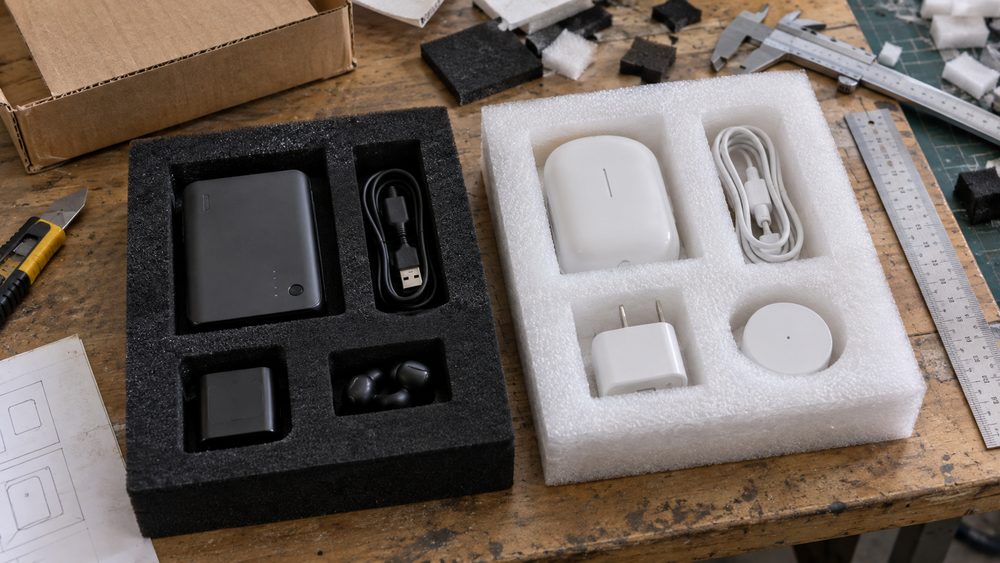
Black EVA and white EPE foam inserts compared for product protection and fit

Density, thickness, and clearance matter more than the label

Density affects firmness, cushioning response, compression, and cost. Soft foam can allow a heavy product to bottom out; hard foam can transfer impact or create pressure marks. Thickness must be matched to impact direction, product weight, and outer-carton crush resistance.

Define clearance as a range. Product variation, foam tolerance, surface layers, and the packer’s loading method all affect real fit. Include finger access, removal force, accessory pockets, and possible product revisions in the design review.

Cutting method: CNC, die-cut, or molded?

CNC cutting is useful for prototypes and complex cavities because the design can be revised without a production die. Die-cutting is practical for flat layers, pads, and repeat-volume parts. Molded foam suits stable product geometry and three-dimensional cradles, but it brings a higher tooling and revision commitment.

Ask whether the sample and bulk order use the same process. A CNC prototype may have different edges, tolerances, or surface marks from the final die-cut or molded part.

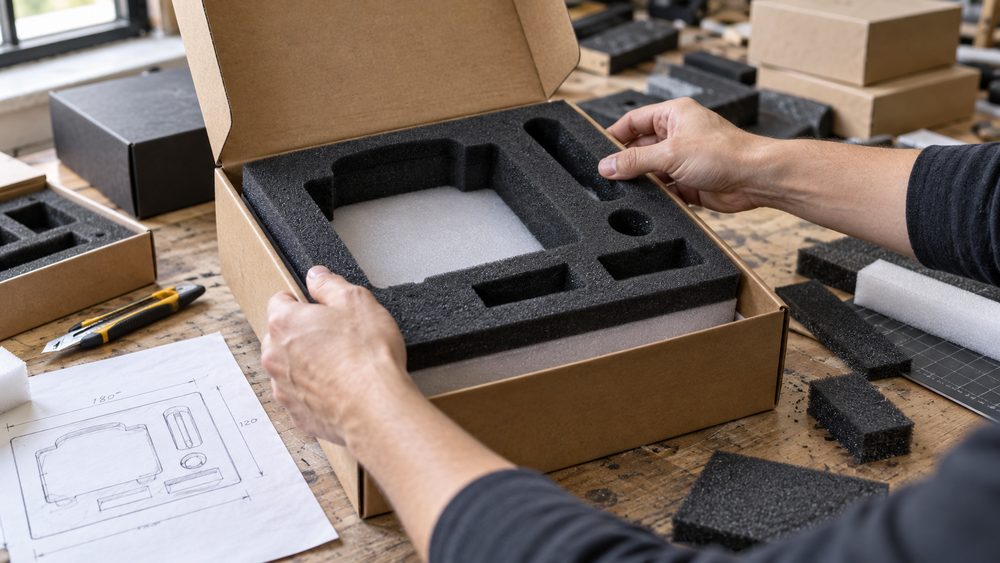
Hands fitting a custom foam insert into a cardboard packaging box

What should you include in a foam insert RFQ?

Include product dimensions, weight, photos or a physical sample, weak points, surface finish, accessories, outer-box internal dimensions, loading direction, quantity, destination, and distribution route. Request:

  • foam type, density or hardness, and thickness;
  • cavity dimensions and clearance range;
  • cutting, laminating, or molding process;
  • surface finish, color, flocking, and adhesive details;
  • antistatic, low-odor, or cleanliness requirements;
  • sample quantity and whether the sample matches bulk production;
  • export-carton dimensions and compression protection;
  • drop-test or pilot-shipment expectations.

Test the complete product, insert, closure, outer carton, and packing method. The ISTA test procedure resources can help frame the discussion around the actual distribution route.

Sustainability and disposal questions

EPE and EVA are polymer foams. Neither should be called universally recyclable without checking the local collection route and finished construction. Laminations, flocking, adhesives, and coatings can change what a recycler accepts. The EPA recycling guidance explains why local systems matter.

If paperboard or molded pulp is being considered, treat it as a new design. Recheck cavity fit, surface contact, drop performance, moisture, packing time, and damage rate. A replacement that causes more product damage is not a better solution.

FAQ

Is EVA foam better than EPE foam for electronics?

Not in every shipment. EVA is often useful for a precise, presentation-ready cavity. EPE can be sensible for lightweight transport cushioning. The device, surface finish, density, and route decide the result.

Is EPE foam cheaper than EVA foam?

It is often less expensive for simple pads, sleeves, and larger-volume transport parts. Compare tooling, freight, labor, replacement risk, and treatments before fixing the total cost.

Can foam inserts be replaced with paperboard?

Sometimes. The replacement must be tested for movement, surface protection, fit, moisture, assembly, and damage rate.

The practical choice

Choose EVA when precise fit, clean presentation, and durable cavity walls justify the higher cost. Choose EPE when lightweight cushioning and transport protection are the priority. If the project sits between the two, request both samples using the same product, outer box, and test checklist.

The useful question is not “which foam is stronger?” It is “which construction gives the lowest cost per successful delivery?” See the CustomPackMart packaging homepage for packaging formats, then send your product size, weight, quantity, route, and fragile areas through the packaging inquiry page.

Glassine Paper: Uses, Limits & Custom Packaging Options

Glassine paper is a smooth, dense and translucent paper made from highly refined wood pulp. It can protect a product from dust, light scuffing and some grease without looking or behaving like a clear plastic film. That makes it useful for apparel, stationery, artwork, jewellery and selected food applications.

The catch is just as important: glassine is still paper. It is not waterproof, not a shipping box and not a universal replacement for a poly bag. This guide explains what glassine is, how it is made, where it earns its place, and what to put in a request for custom packaging manufacturing.

What is glassine paper?

Glassine starts with wood pulp, but its familiar surface comes from how the sheet is processed. The fibres are highly refined, formed into a paper web and passed through heated, polished rollers called supercalenders. Pressure and heat compress the sheet, reduce its pores and create a smooth, glossy, partly see-through surface.

Is glassine plastic or paper?

Glassine is paper-based. Its shine can make it look coated, but traditional glassine gets its main characteristics from fibre refinement and calendering rather than a plastic film laminated to the surface. That distinction matters when you are checking recycling routes, food-contact documentation or a plastic-reduction brief.

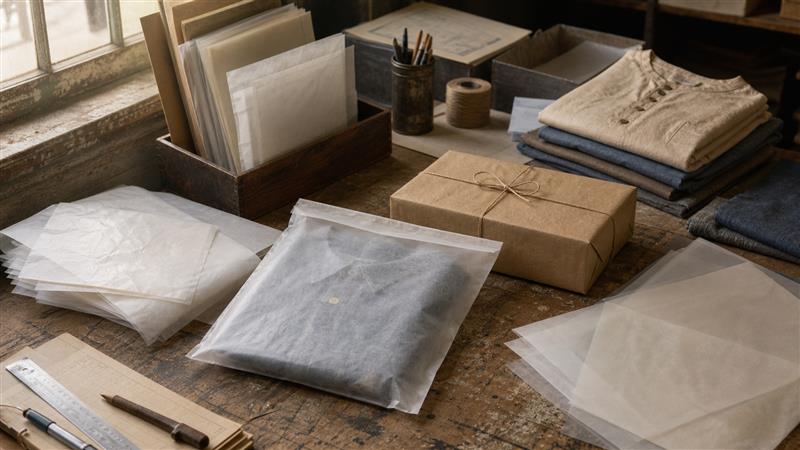
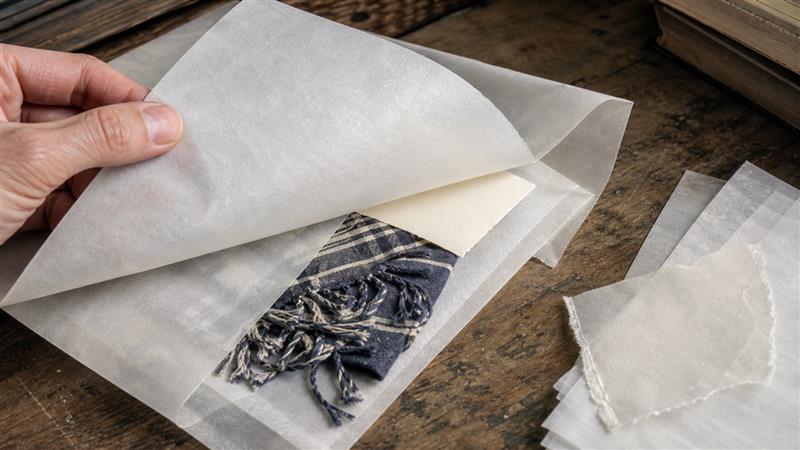
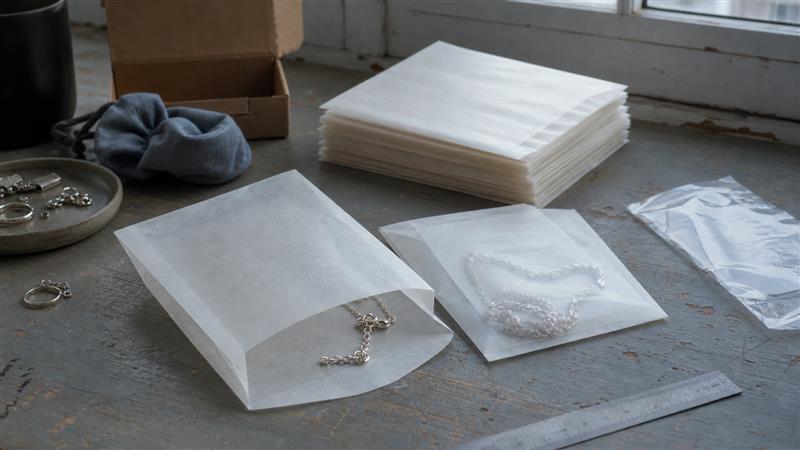
Close view of translucent glassine paper sheets and a glassine bag on a worn packaging workbench
Glassine’s smooth, dense sheet lets a product show through softly without the look of clear plastic.

Why is glassine translucent?

Ordinary paper contains more visible air spaces between fibres, so light is scattered and the sheet looks opaque. Glassine is denser and more compressed. Light passes through the sheet in a softer, hazier way. You can often see the outline or colour of the product, but glassine is not the same as a transparent poly bag.

How is glassine made?

  1. Refining the pulp: wood fibres are processed to create a fine, consistent furnish.
  2. Forming the sheet: the pulp is spread on a moving wire, drained, pressed and dried.
  3. Supercalendering: the dried paper passes through smooth, high-pressure rollers that compress and polish it.
  4. Converting: the finished roll is slit and converted into bags, envelopes, sheets or interleaving formats.

Glassine paper properties at a glance

  • Translucency: useful when the product should be partly visible.
  • Smooth surface: suitable for delicate surfaces that can be marked by rough paper.
  • Grease resistance: helpful for selected products, although the exact grade and end use must be checked.
  • Light moisture resistance: it can handle a few droplets or normal humidity better than porous paper.
  • Limited structural protection: it does not replace a rigid mailer, corrugated box or protective insert.

Is glassine waterproof?

No. A glassine bag may resist brief contact with moisture, but it will soften or fail when exposed to heavy rain, condensation, standing water or immersion. If the product is moisture-sensitive, use glassine as an inner wrap only and specify a stronger moisture barrier or outer shipping package.

What is glassine paper used for?

Glassine works best when the package has a light protective job. It keeps dust off a product, separates surfaces, reduces rubbing and gives the customer a quiet glimpse of what is inside. It is especially useful in apparel and retail packaging applications where presentation matters but a heavy box would be unnecessary.

Apparel and accessories

Scarves, socks, small garments, belts and fashion accessories can be wrapped or bagged in glassine before going into a mailer or carton. It gives the product a cleaner handoff than loose tissue and avoids the crinkly, disposable feel of a thin plastic bag.

Jewellery, stationery and artwork

Glassine envelopes and sheets are useful for jewellery cards, prints, paper goods, pins and delicate artwork that need separation from dust or abrasion. For archival use, confirm the exact grade, pH and storage conditions rather than treating “glassine” as a complete preservation specification.

Food and bakery packaging

Glassine is used for selected bakery and grease-prone products, but food contact is not automatic. Ask for documentation for the exact paper, ink, adhesive and converting construction. A food-safe claim for one grade should not be copied onto another bag simply because both are called glassine.

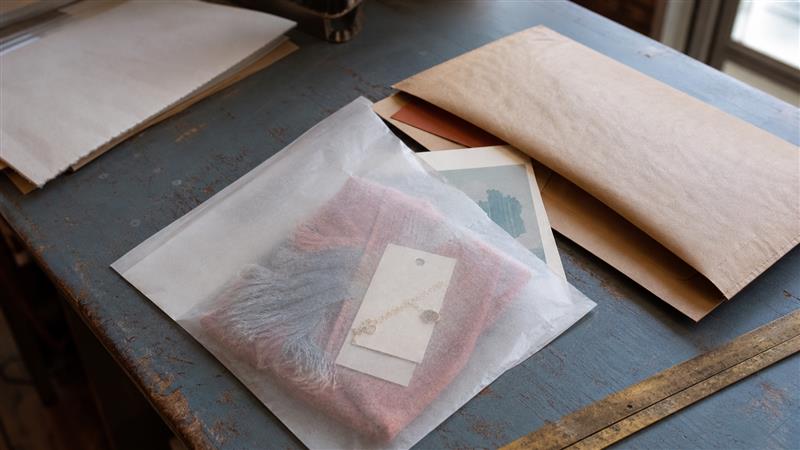
Glassine bag protecting a folded scarf, stationery and small retail products at an ecommerce packing bench
A practical use: glassine acts as a clean inner layer before the product enters its shipping mailer.

Glassine as inner packaging, not transit protection

This is where many packaging briefs go off track. Glassine can protect a surface, but it does not absorb a parcel drop or stop a box from being crushed. The usual system is product → glassine bag or sheet → padded mailer or corrugated carton. Each layer has a different job.

Use the glassine layer for presentation, dust control, separation and light scuff protection. Use the outer package for compression, puncture, impact and weather exposure. If the product can break, bend or leak, test the complete pack-out rather than approving the glassine bag in isolation.

Glassine paper vs. poly bags

Poly bags normally win on transparency, moisture resistance and puncture strength. Glassine can win on paper-based presentation, surface feel and a plastic-free packaging direction. Neither material is automatically “better”; the right choice depends on what the package has to survive.

RequirementGlassinePoly bag
Product visibilitySoft translucencyUsually clear
Light surface protectionGood for many flat or small productsGood, depending on film and fit
Moisture barrierLimitedGenerally stronger
Puncture resistanceLimited by paper grade and seamsUsually higher
Brand feelQuiet, paper-based, tactileClean and highly visible

Before replacing poly, run a real packing test. Check the product after handling, scan the barcode through the chosen format, measure packing time and see what happens when the bag is pulled across a carton edge. A material change that looks good in a sustainability presentation can create a slower or less reliable fulfilment line if these small tests are skipped.

Glassine vs. wax paper and parchment paper

Glassine, wax paper and parchment paper can look similar in a sample book, but they are not interchangeable. Wax paper relies on a wax treatment. Modern parchment paper is usually treated for non-stick and heat-resistant cooking use. Glassine is a calendered paper whose smoothness comes primarily from the paper-making process.

Choose by function, not appearance. If you need an oven-safe baking liner, glassine is the wrong starting point. If you need a translucent inner bag for a scarf, print or small accessory, parchment may bring properties you do not need and may complicate recycling or converting.

Is glassine paper sustainable?

Glassine can help reduce plastic use in applications where its performance is enough, but “paper-based” is not a complete environmental assessment. Ask whether the material uses virgin or recycled fibre, what inks and adhesives are added, and what happens in the market where the package will be discarded.

For fibre sourcing, a brand may ask for a recognised chain-of-custody system such as FSC certification information. That does not prove every part of the finished package is recyclable or compostable, but it gives the procurement team a way to check the fibre claim instead of relying on a green colour and a vague promise.

Recyclable, biodegradable or compostable?

These words describe different things. A paper package may be recyclable in one local system, biodegradable under certain conditions and not certified compostable. Printing, adhesive strips, windows and mixed-material laminates can change the answer. The safest product copy is specific: state the construction, the intended disposal route and any limitation.

Recycling acceptance is local, so check the destination market rather than assuming a universal rule. The US EPA recycling guidance is a useful reference point, but it is not a substitute for the collection rules used by the customer’s municipality or fulfilment centre.

For packaging-specific questions about fibre-based recovery, the CEPI paper-based packaging recyclability guidelines are a better starting point than a generic “paper is recyclable” claim.

Custom glassine paper packaging options

Packaging technician checking custom glassine paper samples with a ruler, caliper and print swatches
Sample checks should cover size, print registration, seal quality, translucency and barcode readability.

Custom glassine paper can be converted into bags, envelopes, sheets and interleaving pieces. The most useful customisation is often quite ordinary: the right width, the right opening and a closure that the packing team can use repeatedly without fighting the material.

  • Custom bag or envelope dimensions
  • Top opening, side opening or a wrap format
  • Self-adhesive flap, tuck flap or open-top design
  • Logo, one-colour print, repeat pattern or product information
  • Barcode and SKU area with enough contrast for scanning
  • Sheets for interleaving artwork, metal parts or delicate surfaces

Printing on a translucent substrate

Ink does not look exactly the same on glassine as it does on white, opaque paper. A light colour may become quieter; a dark colour can show through folds or overlap areas. Keep small legal or product text away from seams, request a printed sample and test the actual barcode with the scanner used in fulfilment.

Stock or custom glassine: which is sensible?

Stock bags are useful for small quantities, quick tests and products that fit a standard size without extra movement. Custom bags make more sense when the product is stable, the format will be reordered, branding matters or a standard bag leaves too much empty space.

Compare more than unit price. Put MOQ, sampling cost, lead time, size tolerance, closure performance, print registration and packing speed on the same sheet. A cheaper bag can become expensive if the team has to fold it twice, add a sticker or replace damaged product.

Sales win / glassine paper packaging

A Swedish jewellery brand replaced poly bags without hiding the product

SWEDEN · FEBRUARY 2023

The problem started with a small rub markThe customer sold silver jewellery and fabric accessories online. A piece could leave the packing bench looking perfect, then pick up fine scratches inside a clear poly bag. Plastic was easy to use, but it also looked out of step with the brand as Swedish rules and customer expectations moved away from single-use packaging.

Translucent glassine envelopes protecting silver jewellery and fabric accessories at a Swedish ecommerce packing station
Illustrative reconstruction of the packaging change, not a customer photograph.

Project numbers

14×18 cmEnvelope size
35 gPaper weight
25k–32kOrder quantity
$7.3k–$8.8kOrder value
01Semi-transparent, grease-resistant glassine paper.
02Side-opening envelope with simple folded closure.
03Light-grey one-colour brand print, no adhesive and no barcode.
04Two sample rounds before the volume order.

Before / clear poly bag

  • Plastic feel conflicted with the brand position
  • Metal pieces could rub against the film
  • Customers saw unnecessary plastic

After / glassine inner envelope

  • Smooth paper reduced direct rubbing
  • Soft translucency kept the product visible
  • Packing speed stayed broadly the same

The practical boundary

Glassine solved the inner-packaging problem, not the weather problem. It was smooth, presentable and suitable for product separation, but it was not waterproof. When rain reached the outer carton, the bag could wrinkle. The finished pack still needed a paper carton or water-resistant outer mailer.

Source note: Based on an internal sales-win record. Customer identity is withheld; order quantity and value are reported as ranges.

What to include in a supplier-ready glassine brief

  1. Product name, weight and packed dimensions.
  2. Required internal bag or sheet size, including clearance.
  3. Desired translucency, surface feel and paper weight.
  4. Grease, moisture, dust or scuffing requirement.
  5. Closure type and opening direction.
  6. Artwork, print colours, barcode position and readable area.
  7. Food-contact or archival documentation, if relevant.
  8. Quantity, destination market, target delivery date and repeat-order plan.

Send the supplier the actual product or a correctly weighted dummy. A bag can look perfect in a flat drawing and still be awkward once the product has corners, a label or a protective sleeve. Physical samples are not a formality here; they are the fastest way to catch a sizing or workflow problem.

Common glassine packaging mistakes

  • Assuming translucent means transparent.
  • Treating light moisture resistance as waterproof protection.
  • Using a thin inner bag as the only shipping package.
  • Assuming every glassine grade is food-contact approved.
  • Switching from poly without testing tears, seams and packing speed.
  • Making broad recycling or compostability claims without checking the complete construction.

How to choose a glassine paper supplier

A suitable glassine paper supplier should be able to discuss the paper grade and the converting process in the same conversation. Ask for samples, tolerances, closure details, printing limits, test reports where applicable and a clear explanation of what can change between the first order and a repeat order.

It also helps to review the supplier’s wider packaging material and sourcing guidance. The point is not to collect certificates for their own sake. It is to see whether the supplier can connect material choice with product fit, fulfilment handling, print quality and the disposal claims you plan to publish.

FAQs

1. What is glassine paper made from?

Glassine is made from highly refined wood pulp and finished through paper-making and supercalendering processes that make the sheet smooth, dense and translucent.

2. Is glassine paper waterproof?

No. It can resist light moisture, but it is still paper and should not be used as a waterproof barrier or exposed to standing water.

3. Can glassine replace a poly bag?

Sometimes. It can replace poly for products that mainly need dust, scuff and separation protection. Poly may still be the better choice when complete transparency, stronger moisture protection or higher puncture resistance is required.

4. Is glassine recyclable?

It may be accepted in paper recycling when the construction is free from incompatible coatings and components, but acceptance varies by location. Confirm the local route for the finished bag or envelope.

5. Can glassine bags be printed?

Yes. Custom printing is possible, but translucent paper changes colour appearance and can reduce contrast. Approve a physical print sample and test barcode readability before production.

Final answer: what is glassine paper?

Glassine is a smooth, dense, translucent paper with useful resistance to light grease, dust and surface rubbing. It is a strong candidate for inner packaging when the product is light, relatively flat and does not need waterproof or heavy structural protection.

For custom glassine paper packaging, start with the product and the real packing process. Confirm the internal dimensions, closure, print behaviour, documentation and end-of-life route before committing to volume. If the package has to survive a hard parcel journey, let the outer mailer or box do that job.

Request a custom glassine paper quote

Forests Packaging Group can help compare glassine bags, envelopes and sheet formats around the product, packing method, print requirement and destination market. Send the packed dimensions, quantity, artwork, closure preference and target date so the first sample answers a real production question.

For a practical next step, request a glassine paper quote with your product details and we can scope the suitable format before discussing bulk pricing.

Folding Carton Packaging Guide: Materials, Box Styles, Costs, and Custom Options

Folding carton packaging is the paperboard box you see on retail shelves: light enough to ship flat, polished enough to sell a product, and flexible enough to become far more than “just a box.” The right choice comes down to board, structure, print, protection, and how the carton will be packed in real life.

Blue printed carton shown beside an unprinted kraft flat-pack carton
Flat-packed cartons reduce inbound storage volume while keeping room for different paperboard and print directions.

What is folding carton packaging?

A folding carton is a paperboard package that is printed, cut, creased, folded, and usually glued before delivery. It arrives flat, then opens into a three-dimensional box for filling. That flat-shipping advantage is a big reason folding carton boxes work so well for retail programs.

The usual route is simple in theory: choose the board, approve the dieline and artwork, print the sheets, add finishes, die-cut, fold and glue, then inspect the finished cartons. In practice, the small decisions matter. Grain direction can affect a clean fold; a weak bottom can undo a handsome design; and a beautiful foil treatment is wasted if the barcode will not scan.

Folding cartons are common for beauty, food, supplements, electronics, candles, gifts, and shelf-ready consumer goods. For a structure-first overview, see our custom folding cartons page.

Choose materials by the job, not the board name

Material names are useful shorthand, but they do not replace a physical sample. Compare equal-size samples with the intended product inside. A carton should look right, fold cleanly, survive handling, and still make financial sense. That is the whole job.

PaperboardWhere it helpsWatch-out
SBSBright white surface, crisp fine graphics, premium beauty, health, food, and retail presentation.For food-contact or regulated use, confirm the required grade and project documentation against the relevant FDA food-contact guidance.
FBBA useful stiffness-to-weight balance for many printed retail cartons.Check actual caliper, score performance, and the final pack weight.
Coated recycled paperboardProjects prioritizing recycled fiber and cost-conscious shelf packaging.Surface consistency, edge appearance, and moisture behavior need sample review.
Kraft paperboardNatural visual direction, restrained graphics, and a tactile paper look.It will not reproduce every bright color or metallic effect like a white coated board.

The practical rule: choose the lightest board that safely meets the product, packing, print, and handling requirement. Going heavier “just in case” can add material and freight without fixing the real risk. If the product moves, add fit or an insert. If the bottom fails, change the structure. A thicker sheet is not magic.

Common folding carton styles

Straight tuck end cartons put both tuck closures on the same side, giving a neat front and back. Reverse tuck end cartons use opposite tuck directions and are often a practical choice for light-to-medium products. Auto-lock bottom cartons cost more in material and converting but assemble faster and give a more supportive base. Snap-lock bottoms add strength when manual assembly is acceptable. Sleeves are a lean way to add branding around a tray, bottle, or inner pack.

Windows can show the product, and inserts can control movement, but both add a question: what happens on the packing line, and what happens after the customer is done with the pack? That is why a working prototype beats a nice-looking render every time.

Unfolded white paperboard carton with two die-cut product holders
A structural sample can reveal product position, fold behavior, and assembly logic before artwork is finalized.

Folding carton vs rigid box: which one earns its place?

Decision pointFolding cartonRigid box
Storage and inbound freightShips flat; efficient before assembly.Ships set up; uses more cube.
Shelf graphicsExcellent print area and broad finish options.Premium wrapped presentation and tactile detail.
ProtectionBest for light to moderately heavy products with the right board, bottom, and insert.More structural presence for high-value or presentation-led products.
Best fitRetail scale, clear information panels, and efficient pack-out.Luxury gifting, high perceived value, and a lasting unboxing moment.

In short: choose a folding carton when efficient storage, strong shelf communication, and lower material use are leading the brief. Choose a custom rigid box when the object needs a heavier presentation, more durable structure, or a designed reveal. Neither is automatically “better”; one just fits the job with less compromise.

Custom printing and finishes: spend where shoppers look

Offset printing is a familiar choice for detailed, repeatable retail artwork. Digital printing can suit shorter or changing programs. CMYK, Pantone colors, matte or gloss coating, foil, embossing, debossing, and spot UV can all be useful. But use them with intent: a finish should clarify the hierarchy, encourage touch, or protect the surface—not simply prove that the budget existed.

For cosmetics and personal-care products, the carton has to carry claims, directions, INCI or ingredient information, and still look calm on shelf. Our beauty and skincare packaging guide shows why panel planning, small text, and product fit should be reviewed together.

Visual decision path for paperboard material, folding carton structure, and surface finish
Original visual: choose board, bottom structure, and finish as one connected decision—not three separate checkboxes.

What drives custom folding carton cost?

A carton price is not only board plus printing. Size, board grade and caliper, printing coverage, color count, die tooling, window material, inserts, finishing, quantity, hand assembly, packing method, storage, and destination all influence the quote. Quantity usually changes the unit cost because setup is spread across more cartons, but very high volumes can create inventory risk. Cheap per piece is not cheap if obsolete packaging fills a warehouse.

Use a fuller comparison: total packaging cost per shipped product = carton + labor + outer-pack impact + storage + damage risk. This keeps procurement focused on the pack that works at scale rather than the line item that looks smallest.

Prototype checks that catch the expensive mistakes

Before a full run, put the actual product into a full-size sample. Check fit and removal, then close the carton repeatedly. Test the bottom under realistic weight, look for scuffing, read small text at normal shelf distance, scan the barcode using GS1 barcode-quality guidance, and time the assembly. It sounds basic because it is basic—yet these checks prevent a surprising number of avoidable revisions.

  • Confirm internal product clearance, not only outer dimensions.
  • Test the closure and bottom after repeated handling.
  • Review folds, panel alignment, barcodes, and critical small type.
  • Photograph the carton in normal retail lighting and in its shipping pack.
  • Record the approved board, finish, packing method, and inspection points.

That workflow—brief, structure review, sample, production, inspection, and export-ready packing—is easier to manage when the same team can coordinate the handoffs. See how the Intelligent Factory workflow connects those production stages.

REAL PROJECT SNAPSHOT Customer details omitted

One lab-packaging brief, two very different box jobs

This laboratory-packaging project compared a lid-and-base box with a tuck-end carton. That is a useful folding-carton lesson: do not choose a structure only because it looks premium. First decide how the product should be packed, opened, displayed, and replenished.

📦
2 structures reviewed Lid-and-base + tuck-end carton
🗓️
Apr 26, 2024 Initial inquiry recorded
🧪
Jun 3, 2024 Samples received for review
🔄
Jun 26 onward Project follow-up continued
Structure Best question to ask What the sample should prove
Lid-and-base box Does the product need a more deliberate reveal? Fit, lid friction, presentation, and pack-out logic.
Tuck-end carton Does the program need efficient assembly and clear panel information? Closure security, fold accuracy, product removal, and packing speed.

Internal sales-case summary. Timeline and structures are taken from the case record; customer identity and commercial terms are not disclosed.

Laboratory packaging case showing a quoted 500-piece order and lid-and-base box with black product insert
Case reference: quotation communication and a lid-and-base sample with a fitted black insert.

From dieline to delivery: where delays usually start

The production route normally moves from structural brief to dieline, artwork preparation, prototype, printing, finishing, die-cutting, folding and gluing, quality control, packing, and delivery. The carton itself may be simple; the handoffs are where schedules get slippery. A late product-size change can restart the dieline. A new foil area can change the production sequence. A barcode added after approval can force a panel redesign.

Keep the brief specific from the start. State whether dimensions are internal or external, show the intended upright orientation, identify the fill or packing method, and call out any non-negotiable panel content. If a window, insert, perforation, or hanging feature is planned, it belongs in the first structural discussion—not as a footnote after the artwork is finished.

Three common mistakes—and the practical fix

Choosing by appearance alone: a white board that prints beautifully may still be the wrong answer if the product scuffs it, compresses the bottom, or needs more moisture resistance. Fix it with a packed sample and handling test.

Over-finishing the carton: piling on foil, spot UV, lamination, embossing, and a window can make a pack busy, expensive, and awkward to recycle. Pick one or two treatments that make the brand hierarchy clearer.

Testing only an empty carton: an empty sample almost always feels stronger than a filled one. Test closure, stacking, product removal, and pack-out with the real item and the intended insert. That is when the honest problems show up.

Sustainability: ask the awkward questions early

Paperboard alone does not make every carton sustainable. Right-sizing and flat shipping can reduce unnecessary material and warehouse volume; recycled or certified-fiber options may be relevant by project. But laminations, windows, metallic effects, product contamination, local collection rules, and the final pack design can change what is practical.

Ask for the relevant material and sourcing documentation, including how FSC chain of custody is verified when it applies, then evaluate the finished pack for its target market. It is less glamorous than a green badge, but it is a far more useful procurement habit.

Folding carton selection checklist

Before requesting a quote, prepare product dimensions and weight, required internal fit, carton style, board preference, artwork status, print and finish requirements, insert or window needs, quantity, packing method, target market, destination, and deadline. Include a reference sample or photo if opening direction or product orientation matters.

FAQs

What materials are folding cartons made from?

Common folding carton materials include SBS, FBB, coated recycled paperboard, and kraft paperboard. Choose using product weight, print needs, finish, shelf appearance, and any project-specific documentation requirements.

Are folding cartons cheaper than rigid boxes?

They are often more economical for retail programs because they use lighter paperboard and ship flat. Final cost still depends on size, board, printing, finishes, quantity, assembly, packing, and freight.

Can folding cartons hold heavy products?

They can support moderately heavy products with an appropriate board, bottom structure, and insert. Very heavy, fragile, or transit-sensitive products may need a rigid box, corrugated outer pack, or another protective system.

What is the difference between a straight tuck and reverse tuck carton?

A straight tuck has top and bottom tuck closures on the same side. A reverse tuck has closures on opposite sides. Both suit many light-to-medium retail products; the best choice depends on layout, assembly, and display needs.

What should I send for a custom folding carton quote?

Send product dimensions and weight, carton size or dieline, material preference, quantity, artwork status, required printing and finish, inserts or windows, destination market, shipping destination, and deadline.

Conclusion: make the structure do its share

Good folding carton packaging combines clear shelf communication with a structure that can actually be filled, closed, packed, and delivered. Match the board to the product, the bottom to the load, and the finish to the message. Then validate the whole system with a physical sample before committing to the full run.

Ready to specify a custom folding carton?

Share your product size and weight, target carton style, board preference, quantity, artwork status, finish, destination, and required date. Our team can review the structure, material options, dieline route, sampling needs, production checks, and export packing as one practical workflow.

Have a reference box but no dieline? Send photos and the product dimensions. We will help turn the brief into a quote-ready carton specification.