Recycled Shipping Boxes: Custom & Eco-Friendly

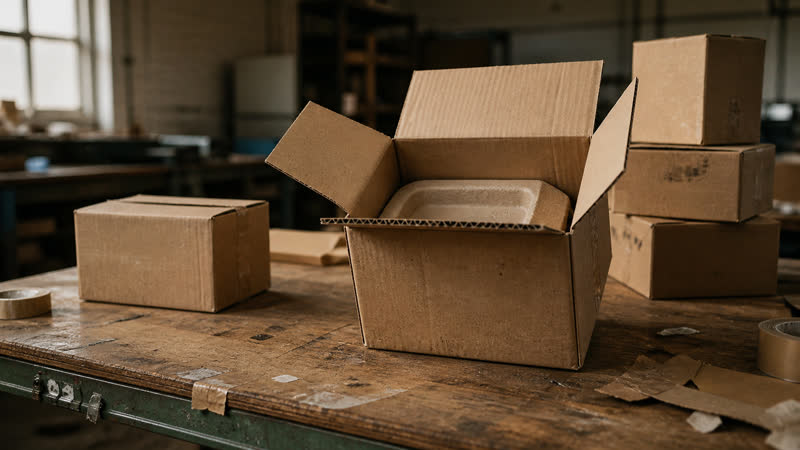
Recycled shipping boxes are not judged by the brown color alone. A buyer needs two answers before approving them: how much recovered fiber is actually in the board, and whether the finished box can survive the route from warehouse to customer.

This guide covers recycled content, PCR and PIR fiber, 32 ECT, right-sizing, printing, inserts, sampling and supplier questions. The aim is simple: turn an eco-friendly shipping box from a marketing phrase into a specification your purchasing team can check.
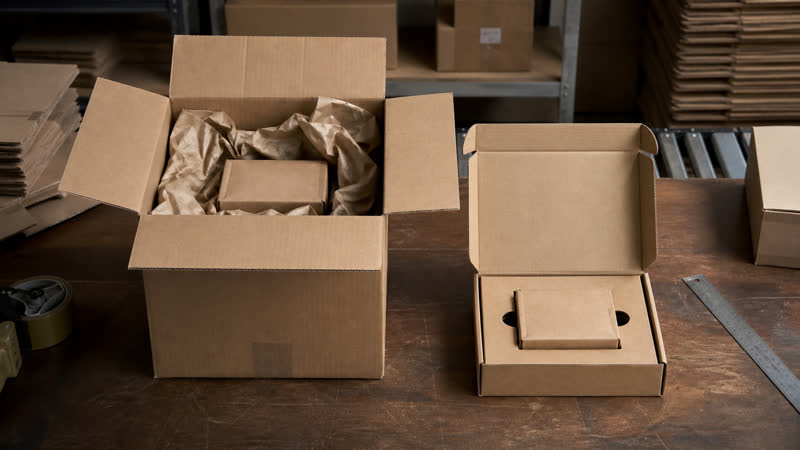
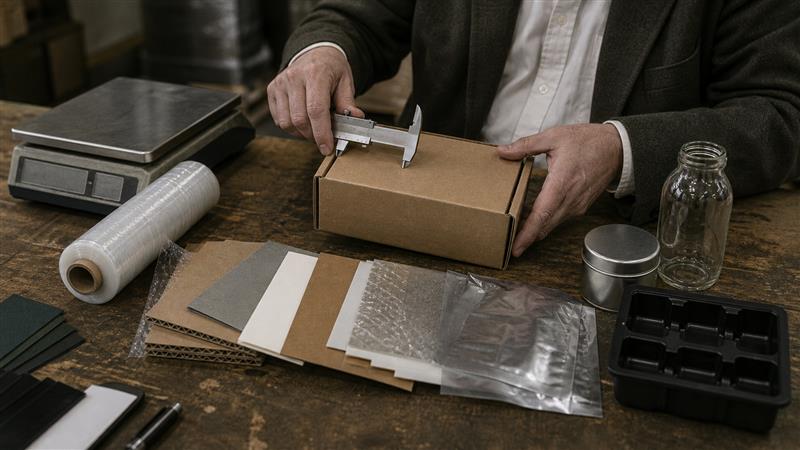
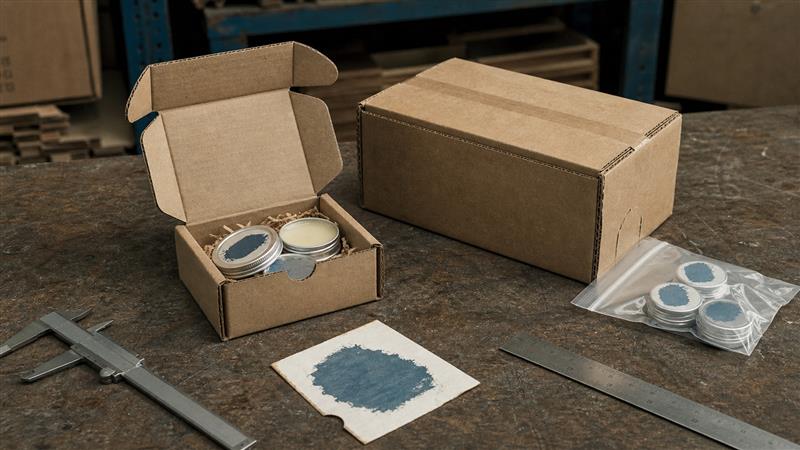
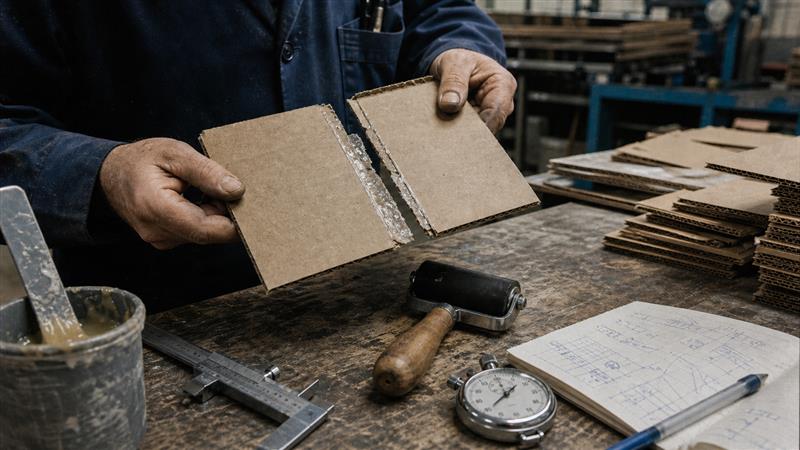
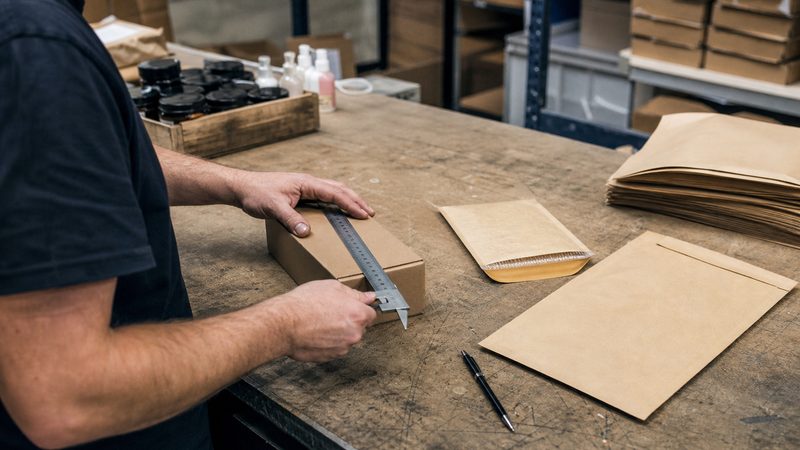
Technician checking the edge and flute structure of recycled corrugated shipping board
Strength belongs in the specification beside recycled content, not after it.

If you are comparing box formats for a live ecommerce program, our custom packaging manufacturing team can review the product and route before a board grade is chosen.

What are recycled shipping boxes?

Recycled fiber in corrugated packaging

A corrugated shipping box is built from liners and a fluted medium. Recovered paper fiber can be used in either layer, and the total recycled percentage depends on the paper grades selected for the complete board. Ask for the material declaration rather than estimating from the outside appearance.

Recycled is not the same as recyclable

“Recycled” describes what went into the box. “Recyclable” describes whether the used box can enter a suitable recovery stream. A box can have recycled content and still need a review of coatings, labels, tape and contamination before making a recycling claim.

Recycled, compostable and biodegradable are different claims

Recycled-content packaging keeps recovered fiber in the material supply. Compostable packaging is designed for a biological treatment route. Biodegradable is a much broader term and does not, by itself, state the time, conditions or facility required. Keep these claims separate in the artwork and product brief.

Why brown kraft is not proof

Virgin kraft can be brown, and recycled board can be made with a lighter or darker shade. Color is a visual choice, not a percentage. If recycled content matters to the buyer or retailer, specify total recycled fiber and ask whether a post-consumer percentage can be documented.
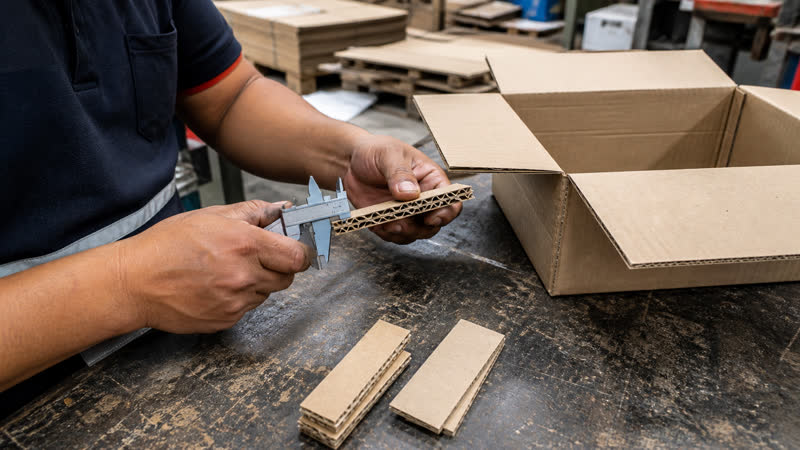
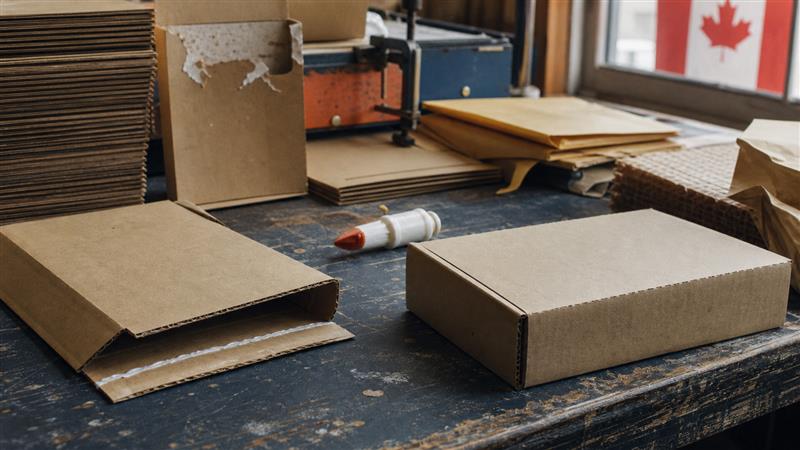
Stock shipping box beside a right-sized recycled corrugated box with paper void fill
Right-sizing reduces empty space before it becomes extra board, filler or dimensional freight.

How much recycled content should a shipping box have?

There is no useful percentage without a clear calculation basis. A supplier should state whether the figure refers to the whole corrugated board, a liner, a medium or a production batch. It should also distinguish between post-consumer and post-industrial sources.

Post-consumer and post-industrial fiber

Post-consumer fiber comes from paper that has already been used and recovered after consumer or commercial use. Post-industrial fiber is recovered earlier in manufacturing or converting. Both can be useful, but they tell different stories about the waste stream. A phrase such as “contains recycled material” does not answer how much of either source is present.

For a serious specification, request three figures: total recycled content, post-consumer content and the method used to calculate them. If the box will carry an environmental claim, keep the declaration with the purchase order and artwork approval.

Buyers can review recycled-content certification resources through the FSC certification information, then confirm that the specific supplier, board and claim are covered.

Are recycled shipping boxes strong enough?

They can be. Fiber source is only one part of box performance. Board grade, flute profile, wall construction, dimensions, product weight, stacking pattern, humidity and parcel handling all matter. A smaller recycled box with a well-matched structure may outperform a larger box chosen by habit.

What does 32 ECT mean?

ECT means Edge Crush Test. It measures how much edgewise compression a corrugated board sample can withstand. It is a useful reference for stacking and box selection, but it is not a complete shipping guarantee. The same ECT number can behave differently when box dimensions, humidity and loading patterns change.

Consider stronger board or a double-wall construction for heavy products, broad cartons, fragile goods, high pallet stacks or long distribution routes. For lighter parcels, the better answer may be a right-sized single-wall box with a suitable insert. Test the packed product before making a final call.

Choose box strength by shipping risk

A practical review starts with the route. A small, light item moving through a controlled local parcel network has a different risk profile from a dense product in a large carton traveling across several hubs.

  • Lower-risk parcels usually need a stable fit, modest stacking strength and simple paper protection.
  • Moderate-risk shipments may need stronger board, corner protection or a formed insert to stop movement.
  • Higher-risk shipments need a complete test of compression, drops, vibration, abrasion and moisture exposure.

The decision rule is to use the lowest-material corrugated structure that delivers the product intact through its actual distribution cycle. Removing board until the first failure is not sustainability; it is deferred waste.
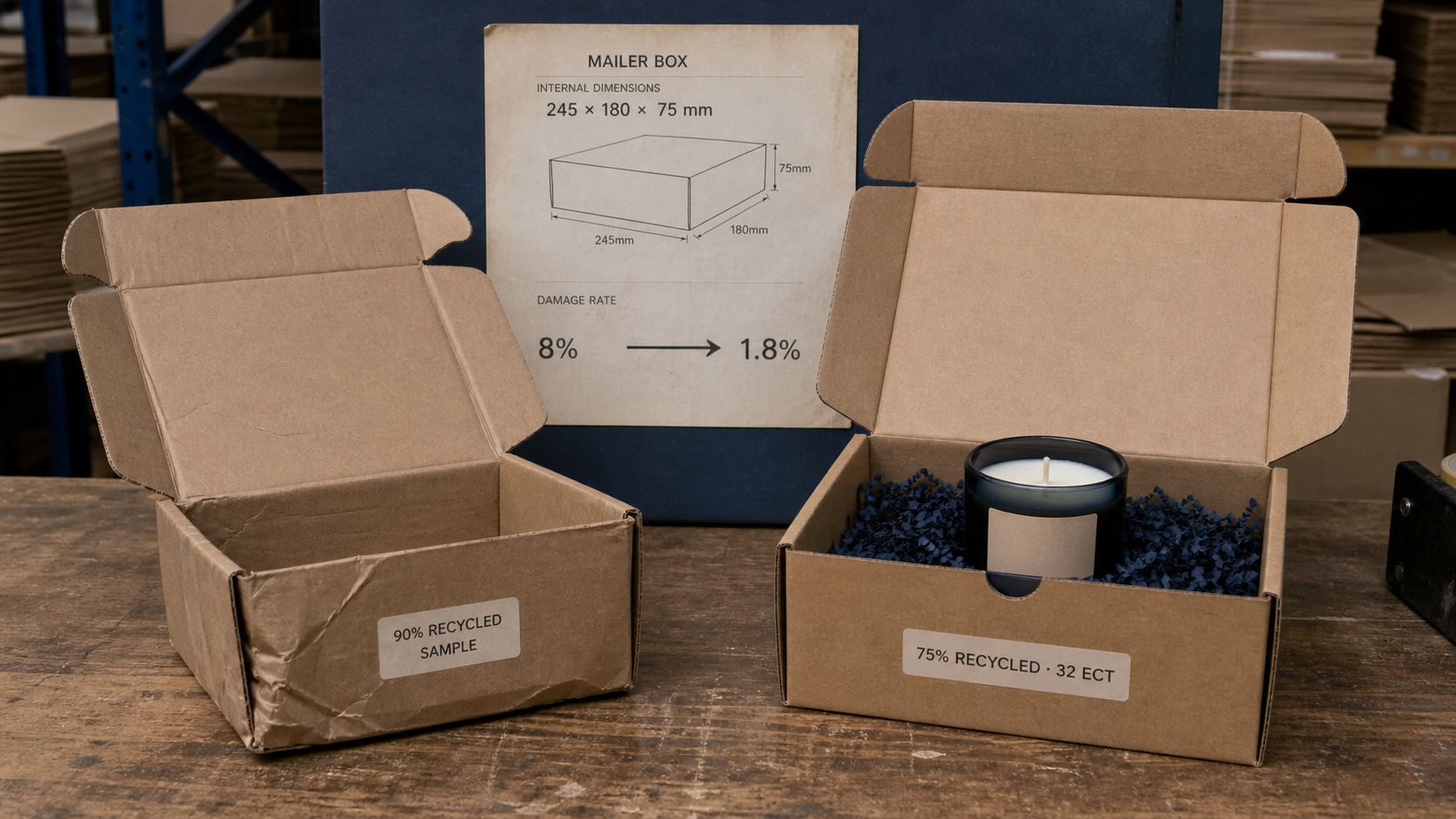
UK · June 2025 · Home fragrance DTC

The greener box was not the one with the highest number

A candle brand tested 90% recycled board, saw it struggle under stacking, and found a more reliable answer at 75%.

Comparison of a crushed 90 percent recycled mailer sample and an intact 75 percent recycled mailer for candle shipping
Illustrative reconstruction of the material decision; the customer identity is withheld.
75%recycled content
32 ECTboard strength
45–52kboxes ordered
8% → 1.8%damage rate
✕ 90% SAMPLE

Shorter fibres weakened puncture resistance. Simulated stacking damage approached 8%.

✓ 75% PRODUCTION BOARD

B-flute, 32 ECT and about 3.2 mm thick, with a self-locking base, tear strip and no lamination.

The practical lesson

Recycled content must be tested with ECT, box size, product weight and stacked transport. Here, 75% was the point where the environmental target and delivery performance stopped fighting each other.

Why right-sizing makes recycled boxes more sustainable

A 100% recycled box can still be wasteful if it is much larger than the product. Extra volume may require more board, more void fill and a larger shipping carton category. It also lets the product move farther before the package absorbs an impact.

Measure the packed product, then allow room for the protection it genuinely needs. The goal is not a box that squeezes the product. It is a box with controlled clearance, stable loading and enough compression room for the chosen board.

Right-sizing can improve pallet utilization and reduce the number of air-filled parcels in a truck. For custom corrugated structures, compare the material saving against tooling, changeover, storage and repeat-order requirements. Our custom mailer box options show how fit and opening structure can be reviewed together.

Stock or custom recycled shipping boxes?

Stock boxes are sensible when volumes are low, the product fits an existing size and speed matters more than branding. Custom recycled shipping boxes make more sense when the product has an awkward profile, void fill is excessive, repeat volume is stable or the brand needs a controlled unboxing experience.

Compare more than unit price. Put MOQ, sample cost, lead time, board grade, recycled percentage, print coverage, storage, freight cube and damage risk on the same sheet. A low-priced oversized carton can become expensive once void fill and dimensional freight are counted.

What can you customize?

  • Dimensions: specify internal length, width and depth after the product and insert are packed.
  • Board: choose the liner combination, flute, ECT or other agreed strength requirement.
  • Structure: select a regular slotted container, mailer, die-cut shipper, divider or insert system.
  • Printing: use one-color exterior printing for a restrained look, or add inside printing for the opening moment.
  • Closure: compare tape, water-activated tape, self-locking flaps and tamper-evident options.
  • Recycled content: state the total target and whether a post-consumer percentage is required.

Printing on recycled kraft shipping boxes

Recycled kraft board can have a warmer, less uniform surface than a coated sheet. Black and dark one-color graphics usually remain clear. Pale colors, fine lines and large solid areas need a physical proof because the board shade changes how the ink is perceived.

For many ecommerce programs, a small logo, URL, handling instruction or disposal note is enough. Full coverage printing can be done, but it should be weighed against ink coverage, registration, appearance variation and the recycling requirements of the complete box.

Do not approve a screen image as the final color reference. Ask for a print sample on the selected recycled board, then record the approved board shade and ink coverage with the artwork.

Optimize the whole protection system

The outer box is only one part of the shipment. Corrugated inserts, dividers, molded fiber, paper cushioning and void fill can change how much strength the outer box needs. A formed insert that stops a bottle from hitting the wall may be more efficient than simply moving to a much heavier carton. Our packaging logistics service is relevant when the pack-out has to be reviewed alongside handling and delivery conditions.
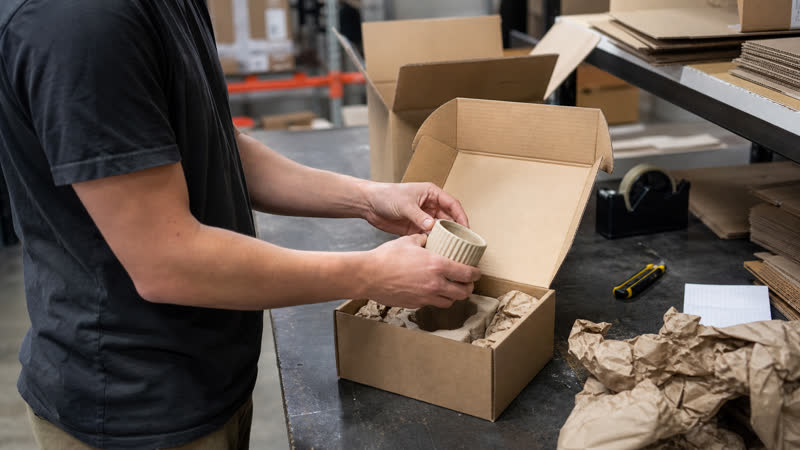
Recycled shipping box with paper insert and cushioning protecting a product during packing
Outer board and internal protection should be tested as one pack-out.

Keep the product centered, stop sharp edges from rubbing the board and prevent loose components from becoming impact points. Photograph the pack-out, record the packed weight and note where a sample deforms. Those details make the next supplier conversation much faster.

Is an eco-friendly shipping box really eco-friendly?

Use the phrase only with supporting specifications. Review recycled content, recyclability, material quantity, right-sizing, print and coating choices, supply distance and product damage. The most sustainable box is not always the one with the highest recycled percentage; it is the one that uses credible recovered material and completes the shipment without creating avoidable replacement waste.

Be careful with broad claims such as “100% eco-friendly.” The FTC Green Guides explain why environmental claims need qualification and evidence. Rules differ by market, so have the final wording reviewed for the country where the box will be sold.

Sampling before a bulk order

Pack the actual product in the proposed box. Check internal clearance, product movement, corner crush, seam strength, closure, print appearance and packed weight. Then run the handling tests that resemble the real route: pallet stacking, drops, vibration, abrasion and exposure to warehouse humidity. The ISTA testing resources are a useful reference when you need to define a repeatable distribution test.

Two or three prototypes can reveal a problem that a catalogue specification will not. If the box is too loose, reduce the dimensions or redesign the insert. If it is too weak, compare flute, board construction and load distribution before simply adding material everywhere.

Questions for a recycled shipping boxes supplier

  • What is the total recycled fiber percentage in the finished board?
  • What portion is post-consumer fiber, and what documentation supports it?
  • Which board grade, flute and ECT or compression value are proposed?
  • Are the quoted dimensions internal or external?
  • Can the supplier provide a sample using the real product?
  • How will inks, coatings, tape and labels affect the recovery route?
  • What are the MOQ, prototype charge, production lead time and repeat-order lead time?
  • Can the supplier produce the box, insert and protective components as one tested pack-out?

A capable recycled shipping boxes supplier should be able to discuss fiber content and shipping performance in the same meeting. If the conversation stops at a brown sample and the word “green,” the specification is not finished.

FAQs

Are recycled shipping boxes strong enough for shipping?

They can be. Strength depends on board construction, ECT, flute, dimensions, product weight, stacking and shipping conditions, not simply whether the fibers are recycled.

What is the difference between recycled and recyclable shipping boxes?

Recycled refers to recovered material used to make the box. Recyclable refers to whether the used box can enter an appropriate recovery stream. A box can have both attributes.

Can recycled shipping boxes be custom printed and sized?

Yes. Recycled corrugated boxes can be made in custom dimensions and printed outside or inside, with inserts and dividers added when the product needs more control.

What does 32 ECT mean?

32 ECT is an edge-crush measurement for corrugated board. It is a useful reference, but the right grade still depends on the complete box, load and distribution route.

What should a supplier document?

Request the finished board composition, total and post-consumer recycled content, strength specification, sample details, printing limits, MOQ, lead time and any recovery claim conditions.

Conclusion

Recycled shipping boxes work best when the environmental claim and the shipping job are specified together. Verify the fiber source, choose the board around the actual risk, right-size the carton, and test the complete pack-out before committing to volume.

Recycled, recyclable, compostable and biodegradable describe different things. A clear specification helps your team make a defensible choice and gives the supplier something measurable to produce.

Request a recycled shipping-box review

Send the product dimensions, packed weight, quantity, destinations, artwork and recycled-content target to our packaging consultation team. We can compare custom corrugated structures, board grades, print options, inserts and sample requirements around the way your product actually ships.

Ask for a physical sample before bulk production. A box that looks responsible on paper still has to arrive with the product inside it undamaged.
Packaging Materials: 80% Recycled Mailer, 22% Lighter

Quick answer: The best packaging material is the one that protects the product through its actual supply chain without adding unnecessary weight, cost or disposal problems. The main categories are paper and corrugated, plastic, glass, metal and multi-material structures. The material name is only the starting point; the package format, barrier, dimensions and shipping route decide whether it works.

Compare the product, handling risks and end market before asking for a quote. A cosmetic jar, machine part and ecommerce order may all need custom packaging, but not the same material.

What Are the 5 Main Types of Packaging Materials?

Most packaging decisions fall into five broad groups. Each group includes several grades, thicknesses and converting methods, so “paper” or “plastic” is not yet a usable specification.

1. Paper and Corrugated

Paper-based packaging includes kraft paper, paperboard, folding cartons, corrugated board, molded pulp and specialty papers. Corrugated packaging adds fluting between liner sheets, which creates a lightweight structure with useful compression and cushioning performance.

Paper is easy to print, die-cut and customize. It suits ecommerce mailers, shipping cartons, retail cartons and inserts. Its weak spot is moisture: board can soften or lose strength when wet. Coatings and liners can help, but they also change the recycling conversation.

2. Plastic

Plastic is a family of materials, not one single packaging substrate. LDPE and other flexible films are common in bags and pouches, while PET, HDPE and PP appear in bottles, tubs, jars and rigid components. The choice changes stiffness, clarity, sealability, chemical resistance and barrier performance.

Plastic is light and often performs well against water and puncture. The tradeoff is recovery: a mono-material structure may be easier to process than a mixed laminate, but local infrastructure still matters.

3. Glass

Glass provides a strong, nonporous barrier and lets the customer see the product. It is common in beverages, sauces, candles, cosmetics and premium presentation. It can also be reused when the format and return system support that model.

Weight and breakage are the practical concerns. A glass package may need molded pulp, dividers, corner protection or a stronger outer carton during parcel shipping. Evaluate the product and protective packaging as one system.

4. Metal

Aluminum and steel bring durability, heat tolerance and strong protection from light and gases. Cans, tins, pails and drums serve food, beverage, industrial and personal-care applications. Thin metal can dent, but it usually will not shatter like glass.

Metal can involve tooling and forming decisions that are less flexible at very low volumes. It is also heavier than many flexible alternatives, so freight density matters.

5. Multi-Material Packaging

Multi-material packaging combines substrates to get a property that one layer cannot provide alone. A pouch may use different layers for seal strength, oxygen protection, light blocking and puncture resistance. A paper-based structure may add a barrier layer when the product or climate demands it.

This is not automatically a bad choice. Ask whether the extra layer solves a real performance problem. If it does not, complexity may add cost and end-of-life friction without improving the package.

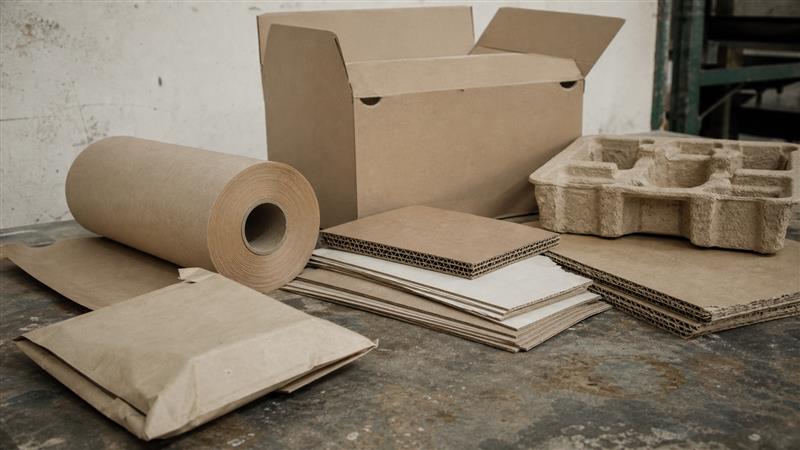
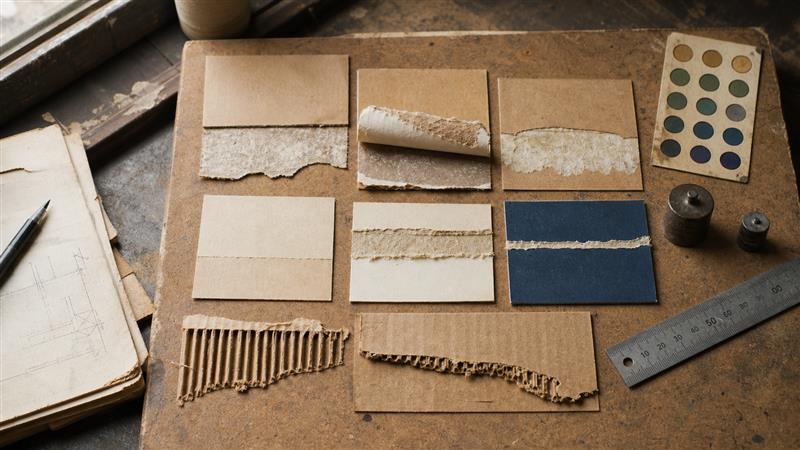
Kraft paper corrugated board molded pulp and paperboard samples on a worn packaging workbench
Paper and corrugated grades can look similar on a sample table but behave differently once moisture, compression and printing are added.

Material vs. Packaging Format: Do Not Mix Them Up

A box is a format. Corrugated board or paperboard is a material choice within that format. A bottle may be made from glass, PET, HDPE or metal. A pouch may use PE, PP, paper-based layers or a laminate.

This distinction matters when preparing a request for quotation. “We need a sustainable box” leaves too many unanswered questions. A better brief states the format, internal dimensions, product weight, loading method, board grade, printing, closure and shipping environment.

Which Packaging Material Fits Your Product?

ApplicationUsually importantMaterials to investigate
FoodBarrier, food-contact suitability, seal integrity and shelf lifePaperboard, films, glass, metal or approved laminates
EcommerceImpact protection, low weight, right-sizing and easy openingCorrugated, paper mailers, flexible mailers and protective inserts
CosmeticsProduct compatibility, appearance, barrier and presentationGlass, plastic, folding cartons, rigid boxes and molded pulp
ElectronicsShock, moisture, static control and dimensional stabilityCorrugated, molded pulp, EPE or engineered plastic components
Luxury goodsRigidity, surface feel, print and unboxing sequenceRigid board, paperboard, glass, metal and specialty papers

For a broader application review, buyers can start with the site’s packaging applications and then narrow the material based on product risk.

Five Questions to Ask Before Choosing a Material

1. What must the product be protected from?

Impact, compression, moisture, oxygen, light, contamination and temperature each point toward different structures. A moisture problem cannot be solved by choosing a thicker carton alone, and a fragile product may need a fitted insert rather than loose fill.

2. How heavy and fragile is it?

Record the actual packed product, not only the product on its own. Weight affects box strength, pallet loading, parcel charges and the amount of protective material required.

3. How will it move?

Warehouse handling, parcel networks, cross-border trucking, ocean freight and retail palletization create different risks. Note the route, likely stacking, climate exposure and whether the package will be handled by people or automated equipment.

4. What shelf life or barrier is required?

Food, fragrance, chemicals and moisture-sensitive goods may need a specific barrier. Ask for technical data and test the finished package, because a material’s headline property may change after printing, sealing, forming or perforation.

5. What happens after use?

Separate three questions: does the package contain recycled content, can it be recycled, and is there a realistic collection route where it will be sold? They are related, but they are not the same claim.

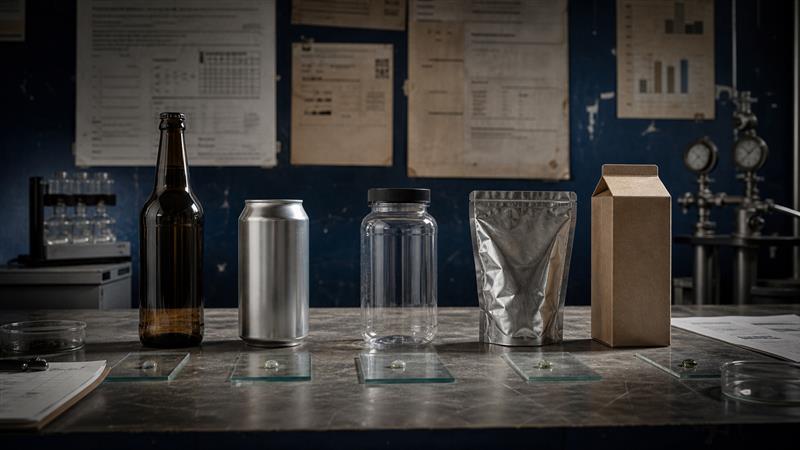
Glass bottle aluminum tin plastic jar flexible pouch and paper carton compared for packaging barrier needs
Barrier selection should follow the product’s actual exposure to moisture, oxygen, light and handling.

Which Packaging Material Is Most Sustainable?

There is no universal winner. A lighter package can reduce transport weight, while a heavier reusable format may make sense in a return loop. A paper package may have a familiar recovery route in one market and a moisture limitation in another. A plastic structure may protect a product with less material, but its collection pathway needs to be checked.

Compare material quantity, recycled content, shipping weight, reuse potential, local recovery and product damage together. Product loss matters too: a package that fails repeatedly can create more waste and cost than a slightly heavier design that keeps the product intact.

For general sustainability terminology and waste-prevention context, the EPA’s sustainable materials guidance is a useful reference point.

How Material Choice Changes Shipping Cost

Material price is only one line in the total. Compare the finished package’s weight, packed dimensions, pallet density, dimensional-weight exposure, protective components and expected damage or returns. A cheap carton that needs extra void fill may cost more once it reaches the parcel network.

Right-sizing can be more valuable than switching materials blindly. Measure the product, leave only the clearance needed for loading and protection, and check the packed unit on the carrier’s scale. If breakage or movement is the problem, fix the structure before adding more loose filler.

How Material Choice Affects Printing and Branding

Paperboard and corrugated support direct printing, labels, coatings, foil, embossing and debossing. Plastic may use flexographic, gravure or digital printing, while glass and metal often rely on labels, sleeves, direct decoration or formed details. The chosen surface changes color, ink adhesion, scuff resistance and the acceptable level of variation.

Ask for a physical proof on the final substrate. A logo that looks correct on a white coated sheet may look warmer on recycled kraft board or softer on an uncoated surface.

Custom Packaging Materials: What Can Be Specified?

A custom packaging order can define more than a color and a logo. Specify the material or grade, thickness, internal dimensions, structure, closure, barrier, coating, print process, recycled-content target, insert, tolerance and intended shipping route.

When food or cosmetic contact is involved, confirm the relevant compliance requirements before production. The FDA food-contact reference explains why the intended use and substance matter; a supplier should still provide documentation for the specific material and application.

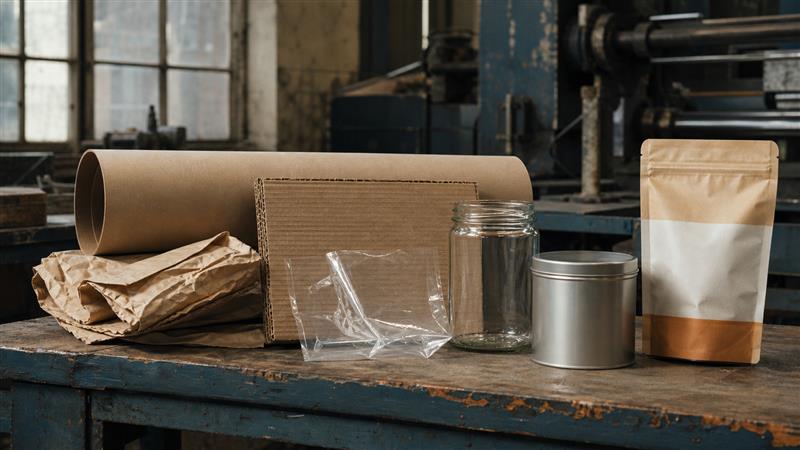
Packaging buyer measuring a corrugated box while comparing paper plastic glass and metal samples
A useful material review ends with a tested specification, not just a preferred sample on a table.

Stock or Custom Packaging?

Stock packaging makes sense when the volume is low, a standard size fits and speed is more important than branding or material optimization. Custom packaging earns its place when product fit, print, protection, barrier or repeat volume justify the setup and sampling work.

Compare MOQ, lead time, fit, print, material options, freight density and sample approval. A custom size that removes empty space may reduce shipping cost, but it should be validated with the actual product before the order is released.

Packaging Material Testing Checklist

  • Pack the actual product and check movement in every direction.
  • Record packed dimensions and weight.
  • Check compression, impact, seal or closure performance where relevant.
  • Expose the package to realistic moisture, temperature or handling conditions.
  • Review print, color, coating, scuffing and opening experience.
  • Run a realistic distribution trial rather than relying only on a bench sample.
  • Document failures and revise the structure before mass production.

For distribution-testing terminology, buyers can review the relevant ASTM distribution testing standard and then agree with the supplier which tests match the route.

Common Packaging Material Selection Mistakes

The most common mistake is choosing by appearance alone. Other costly shortcuts include assuming paper is always more sustainable, ignoring barrier needs, specifying material before format, comparing only unit price, using a complex laminate without a performance reason and skipping real-world testing.

The cleanest correction is simple: write down the product risk first. Then choose the format, material, structure and finish in that order. This keeps a premium look from hiding a weak seam, a wet carton or an avoidable freight charge.

Materials selection · sales win

A French perfume brand cut damage with a lighter mailer

The winning change was not “use more material.” It was choosing the right recycled board and designing the mailer around the product.

FRANCEJune 2023
Solid perfume ecommerce brand
French solid perfume ecommerce brand using a recycled E-flute paper mailer beside heavier packaging materials
Illustrative reconstruction; customer identity withheld.
The old package was heavy before it was protective.

A PET composite pouch sat inside a three-layer B-flute carton. It protected the tins, but increased logistics cost, triggered an environmental packaging surcharge and gave the brand a dull print surface.

80%recycled content
16×22×4 cmmailer size
21k–27korder quantity
6–7% → ≤2%damage rate

BEFOREMore layers, more cost

  • PET composite pouch plus three-layer B-flute carton.
  • Heavy outer box and weak print appearance.
  • Damage rate around 6–7%.

AFTEROne recycled mailer

  • 80% recycled E-flute, 250 gsm liner, about 1.2 mm board.
  • 16×22×4 cm one-piece folding structure.
  • Moisture-resistant treatment; no extra inner box.

What the team learned

When changing material, do not copy the old carton size. Measure the product, check compression reserve and test the finished surface. After three sample rounds, the new mailer reduced package weight by 22%, brought damage to 2% or less and led to a repeat order.

Source: Internal sales-win record, France, June 2023. Order value: approximately US$9,600–11,200. Customer identity withheld.

How to Choose a Packaging Materials Supplier

A capable packaging materials supplier should help connect the product, material, structure and production method. Ask whether the supplier can provide samples, explain grade differences, recommend a realistic material option, support testing, document sustainability claims and maintain the same specification across repeat orders.

Share the product type, dimensions, weight, quantity, artwork, target market, shipping destination, barrier needs, preferred material and deadline. The more concrete the brief, the less likely the quote will compare different packages as if they were the same thing.

For more practical packaging comparisons before sending a brief, browse the packaging blog and use the examples to refine the questions for your own product.

Our custom packaging team can help compare paper, corrugated, rigid, flexible and protective formats against the product and delivery route.

FAQs

What are the five main types of packaging materials?

The five broad groups are paper and corrugated, plastic, glass, metal and multi-material packaging. Each group contains many grades and formats.

Which packaging material is best for shipping?

It depends on product weight, fragility, dimensions, route and protection requirements. Corrugated is widely used, but paper mailers, flexible formats, inserts or specialized structures may fit better.

Are paper packaging materials always more sustainable?

No. Compare material quantity, recycled content, transport weight, product protection and local recovery. A paper package still needs the right moisture and strength performance.

What should I include in a custom packaging material request?

Include product dimensions and weight, units per pack, fragility, barrier needs, shipping route, material preference, artwork, finish, quantity, target budget and delivery date.

Should I choose stock or custom packaging?

Choose stock when standard sizes and speed are enough. Choose custom when fit, protection, branding, barrier performance or repeat volume justify sampling and setup.

Conclusion: Choose the System, Not Just the Substrate

Paper and corrugated, plastic, glass, metal and multi-material packaging each have a sensible place. The right answer depends on what the product must survive, how it will move, how it will be presented and what happens after use.

Define the material, structure and format together. Then sample, test and compare the total delivered cost. If you need to turn that brief into a production-ready request, use the packaging inquiry page and include the product details, quantity and deadline.

Eco-Friendly Packaging Adhesives: Types, Uses and Selection

Quick answer: An eco friendly adhesive is not chosen by the word “natural” alone. The practical choice depends on the substrate, bond strength, set speed, equipment, emissions, adhesive quantity and what happens to the finished package after use.

Packaging glue is easy to ignore until a carton opens, a label lifts or a mailer stalls on the packing line. This guide compares the main packaging glue types and shows how to choose a sustainable packaging adhesive without turning a real production decision into a green-label guessing game.

Water-based adhesive tray and hot-melt glue nozzle applying adhesive to paper cartons on a worn packaging production line
Adhesive selection changes with the board, application method and set-speed requirement.

What makes a packaging adhesive sustainable?

Start with the bond. If a carton fails during transport, the result may be a damaged product, a replacement shipment and another package being made. A formulation that uses renewable feedstock but needs three times as much adhesive, runs slowly or fails in humidity may have a worse practical result than a synthetic adhesive applied in a thin, reliable layer.

For procurement, assess six things together: bond performance, raw material source, VOC profile, application energy, waste and end-of-life compatibility. A water-based adhesive can reduce reliance on solvent carriers, but it is not automatically bio-based or biodegradable. A hot-melt adhesive can be synthetic, yet its fast set may reduce waiting time and excess application.

VOC is also a specific term, not a synonym for “bad glue.” The US EPA includes glues and adhesives among products that can emit volatile organic compounds, so ask for the technical or safety data rather than relying on a front-label claim. The EPA’s VOC overview is a useful starting point when your brief includes indoor air or emissions concerns.

Packaging glue types: how the main systems work

Water-based adhesives

Water-based systems use water as a carrier or dispersion medium. As the water leaves by evaporation or absorption, the adhesive film forms. They are common on porous paper, board, cartons, paper mailers and some labels. Their strengths are formulation flexibility and good compatibility with many fibre-based substrates.

The trade-off is time. Drying depends on coat weight, board absorbency, temperature and humidity. A recycled sheet with a dusty or uneven surface may absorb differently from a clean virgin board. Water-based does not mean weak, but the process needs enough open time and drying capacity.

Hot-melt adhesives

Hot melt is solid at room temperature, heated until it flows, then bonded as it cools. It is useful when cartons, boxes or mailers need a quick set. The fast cycle suits automated packaging lines, but the equipment needs controlled temperature, safe handling and regular cleaning.

Hot melt also needs a more careful sustainability discussion than “plastic versus natural.” Some formulations are polymer-based, but a small, well-controlled application can prevent rejects and keep a high-speed line moving. Ask about the adhesive chemistry, application weight, energy use and how the complete package behaves in its intended recycling route.

Pressure-sensitive adhesives

Pressure-sensitive adhesive, or PSA, bonds when the user presses it onto a surface. It appears on labels, stickers, tapes and self-seal mailers. Initial tack, peel strength, shear strength and the pressure applied during closing all matter.

PSA is often where recycled corrugated creates a surprise. Rough fibres, dust and lower surface strength can make a standard label lift at the edges. The answer may be a different adhesive, a different label face stock or simply a short, deliberate pressure step during application.

Starch-based adhesives

Starch systems are widely associated with corrugated board and water-activated paper tape. They can use plant-derived feedstocks such as corn or potato starch and are a familiar option for paper-to-paper bonding. That makes them relevant to paper packaging, but not automatically compostable in every finished construction.

Reactive and solvent-based systems

Reactive adhesives cure through a chemical reaction and are used when a demanding bond or specialised structure requires them. Solvent-based adhesives also have specific applications, especially where wetting or substrate compatibility is difficult. They should be assessed through technical data, ventilation needs, VOC content and the actual production process, not dismissed or approved by category name alone.

Water-based adhesive vs. hot melt: which is better?

Decision factor Water-based Hot melt
Bond formation Drying or absorption Cooling from a molten state
Typical substrates Paper, board and porous surfaces Board, mailers and selected mixed substrates
Set speed Depends on drying conditions Usually fast once cooled
Equipment Roller, nozzle or coating system plus drying control Heated tank, hose and applicator
Main watch-out Humidity, absorbency and open time Heat, energy and formulation-specific recycling behaviour

There is no universal winner. Choose water-based when the substrate and line can accommodate drying. Choose hot melt when a quick, repeatable set matters more and the equipment is already suited to it. Compare the complete process, including rejected packs and downtime, rather than comparing one drum of adhesive with another.

Packaging technician testing adhesive bond strength on rough recycled corrugated board with a hand roller and notes
A practical adhesive trial should use the same recycled board and pressure expected in production.

Where adhesives appear in a packaging system

One package can contain several adhesive decisions. Corrugated board may use starch adhesive at the board-making stage. A folding carton may use water-based or hot-melt glue at the side seam. A mailer may use a construction adhesive plus a pressure-sensitive strip for the customer to close. A shipping label may use a PSA and a release liner.

This is why a supplier brief should describe the whole structure. If you need a paper mailer, for example, specify the paper grade, flap design, seal type, opening direction, expected handling and whether the mailer must pass through a particular recycling stream. For broader packaging formats, see our packaging applications page and map the adhesive to the product’s real use.

How to choose an eco friendly adhesive

1. Name the substrates first

Write down exactly what is being bonded: virgin kraft, recycled corrugated, coated board, glassine paper, film, label stock or a mixed structure. Two materials that look similar can have very different surface energy, absorbency and fibre pull.

2. Define the bond and the line

Is the bond permanent or intended to open cleanly? Does the pack need to survive cold storage, humidity, parcel impact or shelf handling? Then record the line speed, application method, available temperature range and the time the package can remain under pressure.

3. Test the actual board

Do not approve an adhesive on a bright white laboratory sheet when production will use dusty recycled corrugated. Run a sample on the final board, with the final print, coating and fold direction. Check the bond after a short dwell and again after conditioning.

4. Measure application, not just chemistry

Ask for recommended coat weight or bead size, open time, set time, operating temperature and storage conditions. A glue that works at one speed may string, squeeze out or fail when the machine is adjusted for a different board thickness.

5. Decide the end-of-life route

For paper packaging, ask how the adhesive behaves during repulping and whether the full construction has been evaluated. The Cepi paper-based packaging recyclability guidelines make the important point that coatings, laminates and functional treatments must be considered with the paper, not separately from it.

Three adhesive failure modes shown on paper packaging test swatches with torn board and split glue lines
Failure diagnosis is more useful than simply calling a seal weak.

Why recycled corrugated can be harder to bond

Recycled corrugated is not one uniform material. Fibre length, surface dust, absorbency, coatings and humidity can vary between batches. A PSA label that worked on a smooth virgin liner may lift on a rough recycled liner because the adhesive cannot make the same contact.

Start with the simplest correction: clean the surface, apply the specified pressure and allow the bond to develop. If the problem remains, test a higher-tack or corrugated-specific formulation, adjust the label construction or review the board surface. Increasing the adhesive amount is not always the fix. It can increase mess, cost and recycling complications.

How to diagnose adhesive failure

When a package opens, do not immediately order a stronger glue. Pull the failed joint apart and look at the surfaces.

  • Adhesive failure: the glue releases cleanly from one substrate.
  • Cohesive failure: the adhesive layer splits and remains on both surfaces.
  • Substrate failure: the paper or board tears before the bond gives way.

Each failure points to a different response. Adhesive failure may need better wetting, pressure or a different formulation. Cohesive failure may need more cure or a thicker, better-matched adhesive film. Substrate failure may mean the bond is already stronger than the board, so changing glue will not solve the weak paper. For further technical reading, TAPPI’s corrugated adhesive resources show why troubleshooting should be tied to the actual process.

Sales win · starch-based adhesive

The Canadian paper mailer that stopped opening in transit

A 75% recycled-content mailer did not need a louder glue claim. It needed the adhesive, pressure and drying window tuned to the board.

CANADAOctober 2022
Local ecommerce brand · high-volume mailers
Canadian ecommerce paper mailer made with 75% recycled E-flute board and starch-based adhesive
Illustrative reconstruction of the mailer project; customer identity withheld.
The seam failed before the packaging brief did.

On the higher-recycled-content E-flute board, the old water-based adhesive dried slowly. Winter temperature and humidity changes made the side seam unpredictable, leaving the customer with rework, opening failures and a packaging line that could not hold a steady rhythm.

75%recycled content
18k–24kmailer order
$11k–$13.5korder value
8% → ≤1.5%opening failure
3sample rounds

BEFORE Ordinary water-based adhesive

  • Recycled fibers and paper expansion weakened the seam.
  • Drying time stretched as the season changed.
  • Side tearing and transit opening pushed rework to about 8%.

AFTER Starch adhesive, matched to the line

  • Coat weight was raised only as far as the board required.
  • Compression pressure and contact time were reset together.
  • Drying temperature and liner surface finish were fine-tuned.

What changed on the production line

01 / BOARDRead the recycled surface

The team treated the 75% recycled E-flute board as a different bonding surface, not a standard sheet.

02 / GLUEMove to starch-based adhesive

The new adhesive supported the odor-free, recyclable packaging brief.

03 / PRESSHold the seam longer

Coat weight, compression pressure and contact time were adjusted as one set.

04 / DRYStabilize the finish

Drying temperature and a small liner-surface adjustment helped the line keep pace.

What this project taught us

High-recycled-content board is not fixed by simply choosing a “stronger” glue. The repeatable result came from matching coat weight, compression and drying conditions to the paper. That is why the opening-failure rate fell to 1.5% or lower, while the mailer stayed odor-free and recyclable.

Source note: Based on an internal sales-win record for a Canadian paper mailer project. Customer identity is withheld; order quantity, value and failure-rate figures are reported as ranges or approximate production data.

Questions to ask an adhesive supplier

A useful technical conversation should produce more than a product name. Ask which substrates were tested, what application weight is recommended, how much pressure or heat is needed, and what happens when board moisture changes.

Also ask for VOC information, storage life, working temperature, open time, set time, recycling-compatibility evidence and food-contact documentation where relevant. If the adhesive is part of a custom carton, mailer or corrugated structure, request a production sample before placing a large order. Our custom packaging manufacturing team can review those details with the structure rather than treating the glue as an isolated purchase.

Common mistakes with sustainable packaging adhesives

  • Assuming water-based means biodegradable.
  • Assuming starch-based means the whole package is compostable.
  • Choosing chemistry before checking the actual substrate.
  • Ignoring production speed, pressure and equipment.
  • Testing on virgin board but shipping with recycled corrugated.
  • Using a broad “recyclable glue” claim without checking the finished construction.

A good packaging adhesive is the smallest, cleanest and most reliable amount that keeps the package working through production, distribution and use. That may be a water based adhesive, a starch system, a hot melt or a pressure-sensitive formulation. The label comes after the test. You can also browse our packaging materials and process articles when building a broader packaging brief.

FAQs

What is an eco friendly adhesive?

It is an adhesive selected for a lower-impact packaging system after considering bond performance, raw material source, VOCs, application quantity, process energy, waste and end-of-life compatibility. No single chemistry is automatically sustainable.

Is water-based adhesive more sustainable than hot melt?

Not in every application. Water-based adhesive may reduce reliance on solvent carriers, while hot melt can set quickly and reduce production waiting time. Compare the substrate, equipment, energy, application weight, failures and recycling route.

Which adhesive is used for corrugated packaging?

Starch-based adhesives are common for forming corrugated board. Box converting may also use hot melt or other systems for seams and closures. The right choice depends on the board, line speed, joint design and required set time.

Can packaging adhesive affect paper recycling?

Yes. Some adhesive fragments can become contaminants during repulping, especially when the formulation or application is poorly matched to the package. Check the complete construction and the target market’s recycling guidance instead of judging the adhesive alone.

How should adhesive performance be tested?

Test the final adhesive on the actual paper or board, with the final print and coating where possible. Check bond strength, set time, pressure, humidity, temperature, line speed and failure mode before approving volume production.

Conclusion: choose the bond, then judge the footprint

Eco friendly glue is not a single product category. Water-based, hot-melt, PSA, starch and reactive systems each solve different packaging problems. The better sustainable packaging adhesive is the one that fits the substrate, survives the route, uses an efficient application and has a credible end-of-life path.

For a custom project, prepare the product dimensions, board or paper specification, quantity, artwork, line speed, shipping conditions and target market. That gives the supplier enough information to compare packaging glue types honestly and test the bond before the final run.

Request a packaging adhesive review

Forests Packaging Group can help review adhesive choices alongside cartons, corrugated boxes, paper mailers, labels and tape. Send the substrate, structure, quantity, application method, destination market and deadline so the recommendation is tied to a real package.

For a practical next step, use our packaging inquiry form to request a material and adhesive review before sampling.

Padded Envelopes: Types, Sizes, Materials & Custom Packaging

Quick answer: a padded envelope is useful when a product needs more protection than a flat mailer but does not need a full corrugated box. The right choice depends on the item’s weight, thickness, shape, fragility, moisture exposure and shipping route. A bubble mailer, paper padded mailer and rigid mailer may look similar from a warehouse shelf, but they do different jobs.

For ecommerce teams, the practical question is not “Which padded envelope looks nicest?” It is “What is the lightest format that will protect this product without creating movement, waste or a packing slowdown?” A custom packaging manufacturer can help answer that when the SKU, pack-out and shipment volume are known.

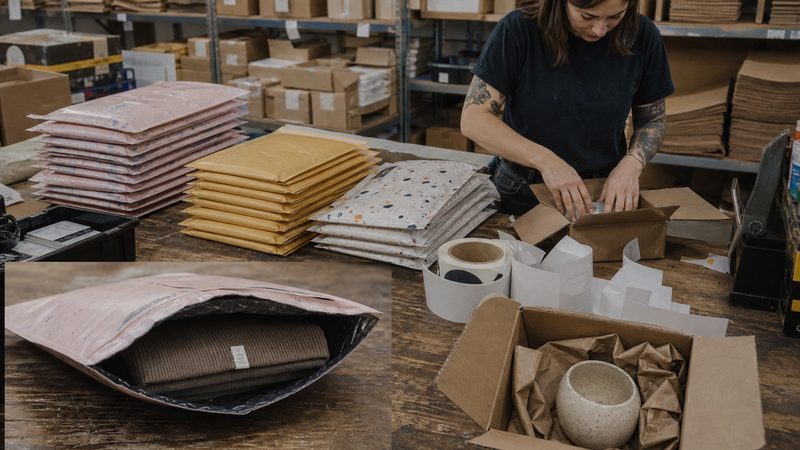
Ecommerce fulfillment station with custom padded envelopes, paper mailers, bubble mailers and rigid mailers
A fulfillment station comparing padded, paper, bubble and rigid mailers.

What is a padded envelope?

A padded envelope, also called a cushioned mailer or padded mailer, is a flexible shipping envelope with a built-in protective layer. That layer may be plastic bubble film, paper padding, foam, a honeycomb-style structure or another cushioning material.

Padded envelope vs. bubble mailer

“Padded envelope” is the broader category. A bubble mailer is one type of padded envelope that uses air bubbles for cushioning. A paper padded mailer may use crimped paper, shredded paper or a folded paper structure instead. The visible kraft exterior does not tell you the complete construction inside.

Where does it fit in ecommerce packaging?

It sits between an unpadded mailer and a corrugated shipping box. That makes it useful for light products with moderate impact or scuffing risk, but a poor fit for heavy, crush-sensitive or highly fragile items that need structural support.

Is a padded envelope right for your product?

Start with four filters: weight, thickness, dimensions and fragility. If one of those sits outside the normal range, test the package before placing a volume order.

The U.S. Postal Service packaging guidance describes padded envelopes as one option for small odd-shaped items, but it still emphasizes padding, separation and prevention of movement. That is a useful reminder: the mailer format does not replace a proper fit.

Types of padded envelopes

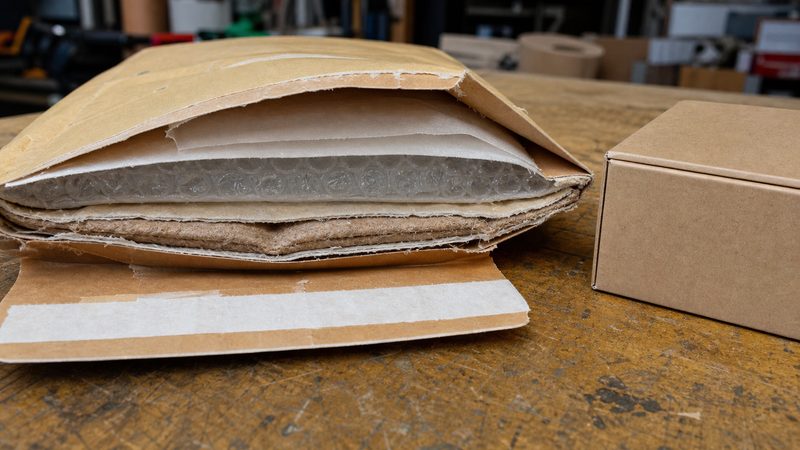
Open padded envelope showing paper and bubble cushioning layers beside a small product box
An open padded envelope showing different cushioning structures.

All-plastic bubble mailers

These combine a plastic outer film with bubble cushioning. They are light, flexible and more resistant to brief moisture exposure than an untreated paper mailer. They work well for compact goods where moderate cushioning matters, but the plastic structure may complicate end-of-life handling depending on the local collection route.

Paper and plastic bubble mailers

A kraft or paper-looking exterior may be bonded to a plastic bubble interior. This can improve print appearance and give the mailer a familiar retail feel, but it creates a mixed-material structure. Check whether the paper and plastic can be separated and what the customer is realistically expected to do after use.

Fully paper padded mailers

Paper padded mailers use a paper exterior and paper-based cushioning. They are attractive to brands trying to simplify the material story, especially when curbside paper recycling is available. Performance still depends on the paper weight, cushioning geometry, seam strength and the product being shipped.

Specialty and degradable mailers

Some products use recycled content, compostable components or degradable additives. Treat each claim as a specification to verify, not a shortcut. Ask whether the claim covers the whole mailer, whether it needs an industrial facility and whether that disposal route exists for the target market.

Compare packaging by protection level

A simple protection ladder helps buyers avoid using a box for everything or a padded envelope for products that need more structure.

  • Level 1 — Flat mailer: surface protection with little cushioning.
  • Level 2 — Lightweight paper padding: light buffering for compact, low-risk items.
  • Level 3 — Bubble or padded mailer: moderate impact cushioning for small goods.
  • Level 4 — Rigid mailer: better bend resistance for flat, sensitive products.
  • Level 5 — Corrugated box with cushioning: structural protection for heavy or fragile products.

The decision rule is simple: choose the lowest level that reliably survives the expected handling route. Then test it with the actual product, not an empty envelope.

Padded envelope vs. shipping box

Choose a padded envelope when the product is lightweight, moderately compact, and unlikely to be crushed by the items around it. It also makes sense when packing speed, storage density and low outbound weight matter.

Choose a box when the product is heavy, crush-sensitive, irregular, highly fragile or dependent on a fitted insert. A box gives you more control over compression and separation, although it uses more warehouse space and usually takes longer to pack.

Padded envelope vs. flat mailer vs. rigid mailer

A flat mailer suits soft goods and low-risk items. A padded envelope adds cushioning for compact products. A rigid mailer is the better answer when bending is the main threat, such as with prints, cards, documents or thin books. If the item is both fragile and heavy, move up to a corrugated box.

The most useful packaging application guidance should connect these formats to real products instead of presenting mailers as interchangeable stock sizes.

Paper vs. plastic padded envelopes

Paper and plastic should be compared as complete structures, not as two labels. Protection efficiency, moisture resistance, recycled content, printability, storage, unit price and local recovery all matter.

When paper has an advantage

A paper padded envelope can support a simpler material message and may fit existing paper recycling systems. Paper surfaces also provide a natural print area and can work well for brands that want a tactile, uncoated appearance.

When plastic has an advantage

Plastic bubble construction is often lighter and more tolerant of brief moisture exposure. It can also offer consistent cushioning with a thin profile. The tradeoff is that film collection and mixed-material recycling are not equally available in every market.

CEPI’s paper-based packaging recyclability guidance makes the same broader point: combining paperboard with other materials should not be judged by appearance alone, and national collection systems can differ.

Are padded envelopes recyclable?

Sometimes. A single-material paper padded mailer may have a simpler recycling path where paper packaging is collected. A bonded paper-and-plastic mailer may not. Recycled content and recyclability are also different claims: one describes what went into the package, while the other describes what can happen after use.

Ask the supplier for the material breakdown by weight, adhesive details, recycled-content documentation and disposal instructions for the market where the mailer will be used. The American Forest & Paper Association’s guidance on recycling paper padded mailers is a useful starting point, but local collection rules still control the real outcome.

How to choose the right padded envelope size

Ecommerce worker measuring a packed product before choosing the correct padded envelope size
Measuring a packed product before selecting a padded envelope size.

Measure the product after its inner packaging is complete. Record length, width and thickness, then check the mailer’s usable internal dimensions rather than relying on the outside measurement printed on a catalogue.

  1. Place the packed product on a flat surface.
  2. Measure the longest side, shortest side and maximum thickness.
  3. Allow enough room for easy insertion without forcing the seams.
  4. Leave closure clearance so the adhesive flap can seal cleanly.
  5. Test whether the product can move too freely after sealing.

An undersized envelope causes seam stress, bent corners and difficult fulfillment. An oversized one adds material, storage volume and movement. Samples should be tested with the actual SKU before production is approved.

Why mailer size affects total packaging cost

Size changes more than the purchase price. It affects material consumption, inbound freight, pallet density, shelf space, packing time and outbound dimensions. A mailer that is slightly more expensive but fits the product cleanly may still reduce total cost by cutting extra cushioning and packing labor.

For ecommerce operations, record the packed weight and outer dimensions of each common SKU. Those numbers make it easier to compare stock and custom sizes without guessing from the empty mailer.

What can you customize?

A custom padded envelope can be specified by more than logo and color. Important choices include internal dimensions, exterior paper or film, cushioning structure, recycled content, adhesive closure, tear-open strip, return strip, barcode area and print coverage.

For repeat programs, the best improvement may be a small change: a wider flap, a better label zone, a stronger seam or an extra adhesive strip for returns. These details can make a bigger warehouse difference than a decorative print upgrade.

Stock vs. custom padded envelopes

Stock mailers make sense for lower volume, standard products and urgent launches. Custom production becomes more attractive when the same SKUs ship repeatedly, standard sizes leave too much space, or the brand needs a specific construction.

Compare MOQ, lead time, unit cost, storage, print setup, fit and repeat-order consistency. A low unit price is not a saving if the packer needs extra filler or the wrong fit causes preventable returns.

Packaging project snapshot

When a padded envelope stopped cosmetic tools from arriving scratched

UK · September 2022

A British beauty ecommerce seller was shipping colourful cosmetics and metal makeup tools in ordinary plastic mailers. The parcels were light, but the products were not forgiving: metal edges rubbed against the outer surface, and short courier drops quickly became customer complaints.

22×30 cmFinished mailer size
2–3 mmPaper cushioning layer
12k–16kOrder quantity
≤2%Damage rate after change

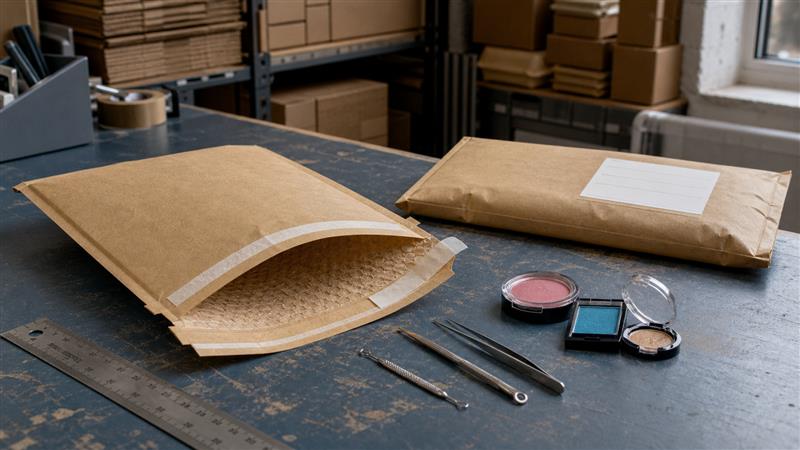
Paper padded envelope protecting cosmetics and metal makeup tools at a UK ecommerce packing station
Case illustration: the envelope was selected around the product and its cushioning thickness, not around the product alone.

What changed?

1Paper padded envelope.
Recycled kraft outer paper with a 2–3 mm paper cushioning layer.
2Product-fit sizing.
22×30 cm gave the tools room to enter without leaving a loose pocket around them.
3Practical closure.
Self-seal flap, tear strip and an added tamper-resistant strip for repeat ecommerce handling.

Before: ordinary plastic mailer

  • No cushioning around metal parts
  • Scratches and corner knocks
  • Damage rate around 7–9%

After: custom paper padded mailer

  • Built-in 2–3 mm paper cushioning
  • Branded print without an extra sleeve
  • Damage rate reduced to 2% or less

What the project taught us

For padded envelope packaging, measure the product plus the full cushioning layer. A mailer that looks compact on a quotation sheet can become too tight after padding is added; one that is too large lets small tools move and rub. The useful specification is the usable internal size, tested with the packed product—not the outside dimension printed on a catalogue.

Source note: Based on an internal sales-win record. Customer identity is withheld; quantities and performance figures are reported as project ranges.

Test before placing a volume order

Request samples with the real product. Check insertion, closure clearance, seam stress, cushioning contact, label placement and the opening experience. Weigh the sealed package and record its dimensions.

Then run a practical movement check. Turn the mailer over, listen for sliding, inspect the corners and open it again. If the product has a higher damage cost, use a realistic shipping test rather than approving the sample from a clean desk.

Common padded envelope mistakes

  • Choosing by exterior appearance instead of product risk.
  • Assuming every bubble mailer provides the same cushioning.
  • Using a padded envelope for heavy or highly fragile products.
  • Ignoring usable internal dimensions and closure clearance.
  • Assuming a kraft exterior means the whole mailer is paper-based.
  • Comparing only the empty-mailer price.
  • Ordering custom production without testing a packed sample.

How to choose a padded envelope supplier

Ask for the available stock sizes, custom sizing range, paper and plastic constructions, cushioning options, print capability, recycled-content documentation, samples, MOQ, lead time and high-volume capacity.

A good supplier should ask about the product, packed dimensions, monthly usage, target market and damage history before recommending a mailer. Its packaging blog and technical content should also show how it thinks through fit, materials and fulfillment instead of only displaying finished artwork.

Supplier-ready padded envelope brief

Include the product dimensions and weight, inner packaging, fragility, required protection level, preferred material, mailer size, closure, return function, artwork, sustainability requirements, quantity, monthly usage and target delivery date.

The more complete the brief, the easier it is to compare two quotations fairly. Ask suppliers to state whether dimensions are internal or external, whether the price includes printing and tooling, and what sample will be approved before production.

FAQs

What can I ship in a padded envelope?

Lightweight, relatively compact products that need moderate cushioning are usually suitable. Heavy, crush-sensitive or highly fragile products generally need a corrugated box and a fitted pack-out.

Is a padded envelope the same as a bubble mailer?

No. A bubble mailer is one type of padded envelope. Other padded mailers use paper-based or alternative cushioning structures.

How do I choose the right padded envelope size?

Measure the fully packed product, including inner packaging. Choose a mailer with enough usable internal space for easy insertion and closure, but not so much space that the product slides.

Are paper padded mailers recyclable?

Some are, depending on their construction and local collection system. Check whether the mailer is single-material paper or a bonded paper-plastic combination, then follow local recycling instructions.

When should I choose a custom padded envelope?

Custom production is worth considering when you ship repeat volumes, need a better fit, require specific materials or closures, or want to standardize packing across several ecommerce SKUs.

Conclusion

The right padded envelope is a product-fit decision. Weight, thickness, dimensions and fragility should come before paper-versus-plastic preference. Then compare protection level, material structure, size, storage, fulfillment speed and end-of-life route.

Custom padded envelopes make the most sense when repeat volume, unusual dimensions, branding or warehouse efficiency justify the development work. The goal is not the softest mailer on the shelf. It is a package that arrives intact, packs consistently and costs less across the full shipping cycle.

Request a custom padded envelope quote

Share the product dimensions, packed weight, monthly quantity, preferred material, destination markets, artwork and delivery target. A packaging team can then compare a paper padded mailer, bubble mailer, rigid mailer or box based on the real product risk.

For custom sizing, print, return features or a new cushioning structure, request a padded envelope quote with the packed product dimensions and a sample requirement.

Shipping Artwork: How to Pack and Ship Art Safely

Quick answer: safe shipping artwork starts with the artwork itself. A small print, an unstretched canvas, a framed painting and a glazed original do not share the same damage risks, so they should not leave the studio in the same package. Protect the surface first, add rigidity or cushioning second, then choose an outer box that controls movement.

A useful custom packaging supplier should help you make that decision from the medium, size, value and shipping route, not from a generic “extra bubble wrap” recipe.

Choose the package by artwork type

The simplest way to avoid overpacking one item and underpacking another is to match the format to the main failure mode.

  • Small prints and photographs: ship flat in a rigid mailer when bending or corner damage is the main concern.
  • Rollable posters: use a mailing tube only when the paper, ink and finish can tolerate rolling.
  • Unframed canvas: use surface protection, corner guards and a reinforced flat carton. Do not let cushioning press hard against a wet or delicate painted face.
  • Framed artwork: protect the face, all four corners and the frame finish before placing it in a picture box or telescoping carton.
  • Framed artwork with glass: treat the glazing as a separate risk. It may justify a glass mask, rigid separation and a double-box system.
  • Large or high-value work: consider engineered packaging, a crate or a specialist carrier instead of a parcel carton chosen by size alone.

What materials do you need for shipping artwork?

Use the fewest materials that solve the actual risk. More layers can make a parcel heavier, larger and harder to inspect, while still leaving the artwork free to slide inside.

Surface-safe barrier

Paper, pastel, photographs and some painted surfaces need a smooth barrier before they meet foam, bubble wrap or corrugated board. Glassine or another suitable acid-free interleaving material can prevent texture transfer and reduce direct contact. The Smithsonian’s storage guidance for works on paper lists glassine, acid-free paper and board among materials used for safe storage; the exact choice still depends on the medium and finish.

Rigidity and corner protection

Foam board, corrugated pads or a fitted insert keep a flat print from folding and stop a frame from taking a direct hit. Corners deserve their own protection because a box can look intact while one frame corner has taken the whole impact.

Cushioning and void control

Cushioning should absorb shock and reduce movement, not act as loose decoration. A close-fitting insert, pads at the right contact points and a small amount of controlled void fill usually perform better than filling every empty area with soft material.

Hands placing a flat art print between protective paper and rigid corrugated boards
Flat artwork protected between a surface-safe barrier and rigid boards.

The protection-layer method

Pack from the artwork outward. That order matters because an outer carton cannot repair a surface that was already scratched or a frame that was allowed to move.

  1. Inspect and photograph. Record the front, back, corners, frame joints and glazing before packing. For repeat shipments, keep the photos with the order record.
  2. Protect the face. Add the appropriate glassine, interleaving paper or a clean protective sheet. Do not tape anything directly to the artwork.
  3. Protect edges and corners. Use corner guards or a shaped insert, especially on framed pieces and stretched canvas.
  4. Add a rigid backer. The backer should be large enough to support the work without creating new pressure points.
  5. Select the outer package. A rigid mailer suits a small flat item; a tube suits a rollable poster; a picture box or telescoping carton suits larger flat work.
  6. Immobilize the artwork. Close the space around the piece so it cannot gain speed inside the carton.
  7. Seal the outside. Tape the package seams and outer carton, never the protected surface.
  8. Perform a gentle movement check. A small controlled movement may be acceptable; a noticeable sliding sound means the pack-out needs revision.

How to ship prints and works on paper

Most small prints fail through bending, corner crush or surface scuffing. For a flat shipment, place the print between suitable protective sheets, add a rigid board on both sides and use a close-fitting flat mailer. Mark the packed dimensions before buying postage; a mailer that is only slightly larger can be cheaper and safer than a large box with a lot of empty room.

Rolling is not automatically the economical answer. A flexible poster may travel well in a rigid tube, but an original, thickly printed, brittle, mounted or highly valued work may remember the roll long after delivery. If the recipient expects a flat presentation, the packaging decision should start there.

How to ship canvas artwork

Canvas needs a balance between surface clearance and edge support. A clean barrier protects the painted face, while a rigid panel behind the canvas reduces flexing. Corner guards protect the stretcher bars, and pads around the perimeter stop the frame from rubbing against the outer carton.

Do not seal a piece before its surface is ready for contact. If the finish is tacky, soft or easily marked, increase the clearance and confirm the protective material with the artist or conservator. A box that looks sturdy can still cause damage if the inner layers touch the paint.

How to ship framed artwork with or without glass

Framed artwork being fitted into a telescoping corrugated shipping box with corner protection
A framed artwork pack-out with corner protection and a close-fitting outer box.

A frame adds weight, corners and a finish that can be scratched. Start with a clean face barrier, then protect all four corners and the frame edges. The inner pack should hold the frame away from the carton walls so a side impact does not transfer straight to the artwork.

Glass raises the stakes. A cracked pane can cut the artwork, damage the frame and spread shards through the box. Use a suitable glass mask or separation layer, rigid corner protection and enough cushioning to prevent the frame from shifting. For valuable glazed work, double boxing or specialist handling may be sensible. FedEx’s artwork shipping guidance also separates flat artwork, posters and higher-value pieces into different packaging approaches.

Rigid mailer, tube, box or crate?

There is no universal best package. The right format is the one that gives the piece enough support without creating unnecessary size, weight or movement.

FormatBest forWatch out for
Rigid mailerSmall flat prints and photosToo little edge protection on large pieces
Mailing tubePosters and prints that can be rolledCreasing, curl memory and unsuitable media
Picture or telescoping boxFramed or larger flat artworkLoose fit and weak corners
Double boxFragile, heavy or higher-risk parcelsExtra size and cost if not properly fitted
Custom crateOversized, valuable or highly fragile workWeight, freight handling and storage

Why movement inside the box causes damage

Damage is often caused by the second or third impact, not the first. If the artwork slides from one wall to another, the cushioning is being asked to stop a moving object rather than soften a small shock. A correctly sized carton, fitted pads and a firm insert reduce that travel distance.

Oversizing also affects freight cost. The packed length, width and height can matter as much as the scale reading, particularly for large flat pieces. FedEx’s freight packing guidance specifically treats artwork as a shipment that needs a sturdy container and suitable testing before transit.

Real Artwork Shipping Project

How a Dutch Art E-commerce Brand Cut Breakage Below 1.5%

Netherlands · April 2022 · Framed limited-edition art prints

🖼️

The customer shipped 60 × 80 cm framed art prints with tempered glass across Europe. Their old pack-out used a standard corrugated box and bubble bags. On 300–1,200 km cross-border routes, the artwork moved inside the carton, corners were crushed and glass breakage pushed the damage rate to 8–12%.

8–12% old damage rate
<1.5% after redesign
2 sampling rounds
700–1,000 sets ordered

The packaging change

📦
Reinforced mailer

B flute + E flute combined corrugated board for a stronger outer shell.

🛡️
Four-corner protection

Paper corner guards reduced direct impact on the framed edges.

🧩
Fitted EPE insert

The insert followed the frame outline and stopped the artwork from sliding.

The practical takeaway

The solution was not simply adding more bubble wrap. The decisive improvement was controlling the empty space around the frame. Once the artwork was held firmly in place, the outer carton, corner guards and cushioning could work together instead of shifting independently during long-distance transport.

The customer accepted the design after two sampling rounds, placed an order worth approximately $9,500–$12,000, and later returned for repeat orders.

How much does it cost to ship artwork?

Start with the complete shipment cost, not the postage label alone. The main variables are packed dimensions, weight, distance, delivery speed, declared value, insurance terms and the packaging format. A cheap carton that allows damage or triggers an oversized surcharge is not cheap by the time the job is finished.

For occasional shipments, a standard picture box may be enough. For a gallery, artist, ecommerce seller or fulfillment team sending the same formats every week, the bigger opportunity is consistency: fewer box sizes, repeatable inserts, recorded packed dimensions and a short packing checklist.

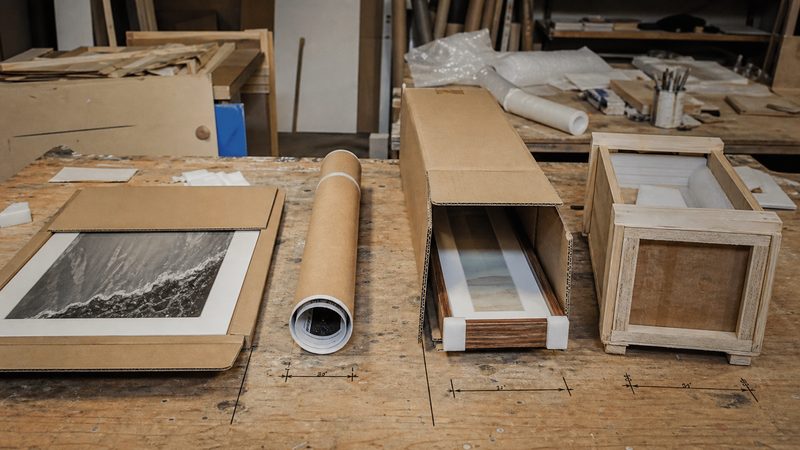
Rigid mailer, mailing tube, telescoping box and small crate arranged on an artwork packing table
Four artwork shipping formats: rigid mailer, tube, box and crate.

When custom artwork shipping packaging makes sense

Custom packaging becomes useful when the same artwork sizes move repeatedly, when the product is too large for a convenient stock carton, or when packing time and damage claims are becoming visible operating costs. A right-sized rigid mailer, corrugated art box, telescoping carton or protective insert can make the pack-out easier to repeat.

The best custom design is not necessarily the most decorated one. It is the one that gives the artwork a stable home, limits void fill, protects the vulnerable points and records the packed size accurately. The packaging applications on a supplier’s site can help you compare formats, but the final design should be tested with the actual artwork and route.

A practical artwork shipping checklist

  • Artwork condition photographed before packing
  • Surface-safe barrier selected for the medium
  • Edges and corners protected
  • Rigid backer or insert added where needed
  • Cushioning matched to fragility and weight
  • Correct mailer, tube, box or crate selected
  • Artwork immobilized inside the package
  • No tape touching the artwork
  • Packed dimensions and weight recorded
  • Tracking, signature and declared-value requirements checked

Common mistakes in shipping artwork

Putting bubble wrap directly against a delicate surface can leave texture marks or create pressure points. Rolling work that should stay flat trades a small carton for a crease risk. Protecting only the front leaves the edges and corners exposed. Using a large box with loose fill gives the artwork room to build momentum.

Another common mistake is changing the packaging for every shipment. Group the artwork by format, record the damage risks and test a small number of repeatable pack-outs. Keep an eye on packing time, damage claims and actual shipping dimensions. Those records are more useful than a one-off opinion about which material “feels safest.”

How to choose an artwork packaging supplier

Ask whether the supplier can provide custom sizes, corrugated strength options, rigid or telescoping formats, protective inserts, samples and repeatable quality. You should also ask how they handle artwork measurements, corner clearance, packing instructions, MOQ, lead time and dimensional efficiency.

A supplier should be able to discuss the full protection system, not only sell a box. Review its packaging blog or technical resources to see whether it explains materials, sampling and shipping risks in plain language.

FAQs

What is the safest way to ship artwork?

Match the package to the artwork type, protect the surface first, add rigidity and cushioning, protect corners and immobilize the piece inside a strong outer package.

Can I use bubble wrap directly on artwork?

Not for every surface. Delicate painted or paper artwork may need a suitable glassine or acid-free barrier before cushioning is added.

Should artwork be shipped flat or rolled?

Ship it flat when the medium is rigid, brittle, mounted or sensitive to creasing. Use a tube only when the artwork can safely tolerate rolling.

When is a double box useful?

A double box can add separation and impact protection for fragile, heavy, glazed or higher-value work, provided the inner package is immobilized.

What should I send a packaging supplier for a quote?

Provide the artwork format, finished size, weight, photos, quantity, surface risks, shipping destination, packing speed target and deadline.

Conclusion

Shipping artwork safely is a matching problem. Prints, posters, canvas, frames, glass and high-value originals need different combinations of surface protection, rigidity, cushioning and movement control. The strongest pack-out is usually the one that solves the actual weak point without adding a pile of unnecessary material.

Request a custom artwork packaging quote

Send the artwork type, finished dimensions, weight, quantity, surface sensitivity, destination and target delivery date. With those details, a packaging team can compare a rigid mailer, flat carton, telescoping box, insert or crate against the real shipping route.

For repeat shipments, include photos of the current pack-out and any damage points. You can request an artwork packaging quote for a right-sized protective packaging system.

What Is the Opposite of Embossed? Embossing vs Debossing

Quick answer: The opposite of embossed is debossed. Embossing pushes a logo or pattern up from the paperboard; debossing presses it into the surface. Both can add a quiet, premium feel to packaging, but the better choice depends on the board, artwork, viewing distance, foil, and how the box will be handled.

What Is the Opposite of Embossed?

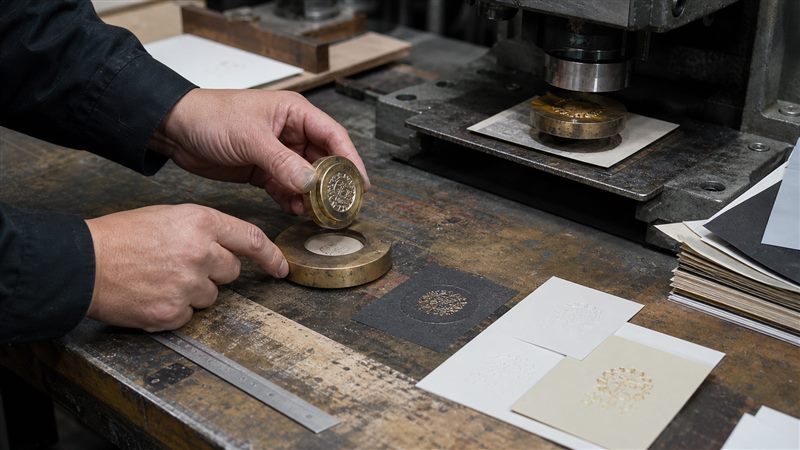
If a mark stands above the surrounding surface, it is embossed. For brands comparing finishes with a custom packaging manufacturer, the physical board sample matters more than a screen preview. If the same mark is pressed below the surface, it is debossed. That is the simple answer behind the search term opposite of embossed, but packaging decisions are rarely that simple. The depth, board construction, artwork, and lighting all affect what a customer actually sees.

FinishWhat happens to the boardTypical visual effectWorks well for
EmbossingThe design is raisedLight catches the high point and edgeLogos, seals, short headlines, tactile brand marks
DebossingThe design is pressed inwardShadow sits inside the markQuiet luxury, natural papers, recessed icons, blind finishes

On a screen, the two finishes can look almost identical. In the hand, they are not. Embossing feels like a small ridge or relief. Debossing feels like a pocket or channel. A sample viewed under flat office lighting may hide both effects, so final approval should include a physical sample and a quick check under angled light.

Close-up comparison of a raised embossed mark and a recessed debossed mark on paperboard samples
Raking light makes the difference between a raised and recessed finish easier to inspect.

Embossing vs Debossing for Packaging

The choice is usually made at the brand-mark stage. The right direction can also depend on the product category and presentation goal, so it helps to review relevant packaging applications before locking the artwork. A raised symbol attracts the fingers and gives a rigid box a more pronounced presentation. A recessed mark is often calmer. It lets the paper, coating, or foil carry more of the visual work without making the surface feel busy.

There is no universal winner. A thin folding carton with a very small line drawing may not hold a deep relief cleanly. A thick rigid box may accept either finish, but its corner, wrap, and inner board still need to be checked. Packaging that looks impressive on a flat proof can lose definition after folding, wrapping, or transportation.

Which Finish Is Better for a Logo?

Use the brand’s personality as the starting point, then test the mark at its real size. Embossing is a strong fit when the logo needs to be noticed as soon as the box is picked up. Debossing suits brands that want a more restrained mark, especially on uncoated, recycled, or textured stocks.

  • Choose embossing when the logo has a clean silhouette, enough open space, and a clear tactile role.
  • Choose debossing when the brand wants depth without a bright raised edge or when a recessed mark fits the natural character of the paper.
  • Test both when the finish is part of a new launch. Two small samples often settle the question faster than a long email thread.

Blind Finish, Foil, or Both?

A blind emboss or blind deboss has no ink or foil in the finished mark. The shape is created only by pressure and the change in surface. It is subtle, which can be exactly right for a premium sleeve, invitation-style box, or uncoated paper label.

Foil can be added to the high or low area, but registration matters. For a concise explanation of the transfer process and finish options, see this foil stamping packaging guide. Gold foil over an embossed logo can make the relief more obvious. A recessed foil mark can look quieter and more controlled. Metallic film also reflects differently on coated and uncoated board, so the foil swatch should be checked on the actual material rather than selected from a screen.

🇩🇪 Germany · 🗓 November 2021 · ✦ Surface finishing project

The Box Looked Right — Until the Finger Test

A skincare and fragrance brand wanted a rigid box that felt expensive without shouting for attention. The first sample looked elegant, but the deboss was barely there and the nearby matte-gold line was spreading.

📦
2.0 mm
greyboard
🧪
3
sample rounds
🔢
8k–12k
pieces
💰
$13k–17k
order value
🎯

The brief: quiet luxury

The logo and decorative lines needed to sit below the surface, while selected small text received a matte-gold finish. The brand wanted tactile restraint, not a bright luxury effect, and the tooling budget had to stay within a mid-range target.

⚠️

The first sample: two red flags

The deboss was too shallow to feel clearly by hand. Worse, the nearby matte-gold area showed edge spread and slight misregistration. Simply increasing press pressure was not a safe fix because the 157g specialty tactile paper could wrinkle or spring back.

🔧

The fix: separate the pressure zones

The team deepened the engraving on the debossing die, recalibrated press pressure, and separated the two finishes. The artwork was moved to create a 0.8 mm safety gap between the recessed lines and the matte-gold elements. The specialty wrap paper was also preconditioned to reduce rebound during pressing.

🧪 What changed after three samples?

❌ Before
Weak tactile depth
Gold edge spread near the deboss
✅ After
Clear recessed hand feel
Clean matte-gold edges
Only a small tooling-cost increase

💡 The practical takeaway

When blind debossing and foil are placed on the same rigid box, leave room between them before asking the press for more force. On elastic specialty wrap paper, a deeper die and controlled pressure are usually safer than simply increasing machine pressure.

For the RFQ, specify the board thickness, wrap paper, finish locations, safety gap, sample rounds, and whether the quoted tooling cost covers the final approved design.

Materials and Artwork Limits

Paperboard, coated stock, specialty papers, and rigid-box wraps can all be suitable, but they do not behave in the same way. A useful paperboard finishing reference explains why substrate construction changes the result. Board thickness, fiber direction, coating, lamination, and the distance between the finish and a fold or cut edge affect the result. More pressure is not a substitute for the right construction.

Artwork should be supplied as vector paths where possible. Very fine lines, tight counters, tiny type, and large solid areas need a production review. A small letter may close up when pressed. A large solid panel may show more stress or a visible halo around the edge. Keeping the relief away from score lines and sharp corners usually gives the factory more room to control the sample.

Packaging technician preparing an embossing and debossing die beside a foil stamping press
The die, counter-die, board, and press setup all affect the final tactile result.

How the Finish Is Made

  1. The artwork is checked for line weight, open areas, and its position on the dieline.
  2. A metal die is produced for the raised or recessed form, with a matching counter-die where the construction requires it.
  3. The press is set up and pressure is adjusted against the actual board or wrap material.
  4. Foil, ink, or coating is added if the design calls for it.
  5. The sample is inspected for depth, edge definition, registration, cracking, and the effect of folding.

That last step is where many avoidable problems are found. Designers who need a practical file-preparation checklist can also review this emboss and deboss setup guide. The sample should be opened, folded, stacked, and viewed from the distance at which a customer will see it. A finish that looks sharp on a flat sheet may sit too close to a crease once the box is assembled.

What Changes the Cost?

Embossing is not automatically more expensive, and debossing is not automatically cheaper. The cost usually comes from the die, the number of finished surfaces, press setup, foil or ink, material choice, artwork complexity, and order quantity. A simple mark on one panel may be straightforward. Multiple dies, tight registration, a foil pass, and several box sizes add work regardless of which direction the mark moves.

For an accurate quote, send the supplier the assembled box size, board or wrap material, flat dieline, finish location, artwork, foil requirement, quantity, and delivery date. Ask whether the quoted price includes a physical proof and whether a new die is required for each size or design.

Packaging designer checking embossed and debossed samples with a loupe and ruler
Proofing should include small artwork, fold clearance, edge definition, and realistic lighting.

A Practical Sample Check Before Approval

In production, the most useful comparison is not “which one looks more luxurious?” It is “which one still reads correctly on the finished package?” Check the sample in five ways:

  • Run a finger across the mark and confirm that the raised or recessed effect is clear.
  • Hold the sample under angled light, then under normal store or office light.
  • Inspect small type and counters with a loupe or phone camera.
  • Fold and assemble the carton to check the finish near scores, seams, and corners.
  • Compare foil color, registration, and edge cleanliness against the approved reference.

Common Mistakes to Avoid

The first mistake is choosing from a digital mockup alone. The second is placing the finish too close to a fold or cutting line. Another is sending artwork with very small details and assuming pressure will make them clearer. It will not. Finally, do not approve a beautiful flat sample before checking the assembled box, the packing process, and the lighting in which it will be displayed.

Match the Finish to the Buying Moment

A package does not live in one viewing situation. It may be seen on a shelf, in a parcel, under a shop light, or in a customer’s hands at home. Embossing can help a plain box catch a passing highlight, while debossing may be easier to appreciate when someone turns the pack over and feels the mark. If the package will be photographed often, test the finish with the same type of light used for product images. Strong side light can exaggerate relief; flat light can make a subtle deboss nearly disappear.

Think about the rest of the design, too. A busy printed carton may need a restrained blind deboss so the surface does not compete with the artwork. A mostly unprinted rigid box may benefit from an embossed seal or a small foil detail. The finish should give the customer one clear point to notice, not turn every panel into a special effect.

Questions to Put in the RFQ

A good request for quotation makes the comparison easier for everyone. State whether you want a raised or recessed mark, but also describe what must remain consistent: logo size, position, depth impression, foil color, and the acceptable appearance after assembly. If the same artwork will appear on several box sizes, list them separately. One die may not suit every panel or scale.

  • What board or wrap material will be used, and is it coated, laminated, or textured?
  • Will the mark sit near a score, fold, seam, handle, or cut edge?
  • Is the finish blind, foil-stamped, printed, or a combination?
  • What physical sample will be supplied before the production run?
  • How will the factory check depth, registration, cracking, and color?
  • Are tooling, setup, sampling, and repeat-order costs shown separately?

These questions also reveal how a supplier works. A response that only gives a unit price leaves important risk unpriced. A useful response explains the material assumption, proof route, tooling, likely production constraint, and what the customer needs to approve. That is especially important when a debossed or embossed detail is central to the unboxing experience.

How to Choose an Opposite of Embossed Packaging Supplier

Look for a supplier that can discuss the whole package, not just the finishing machine. It is also worth reviewing a supplier’s packaging blog to see whether its recommendations cover materials, production, and inspection—not only finished photos. They should review board construction, dieline placement, artwork, foil, assembly, and the intended handling route. Ask to see comparable physical samples, confirm the proof process, and make sure the quote identifies tooling and setup instead of hiding them inside a single unit price.

For a custom opposite of embossed project, the best supplier conversation is specific: “Here is the mark, here is the board, here is the fold, and here is the way the box will be handled.” That gives the factory enough information to recommend embossing, debossing, or a simpler printed finish with a clear reason.

FAQs

What is the opposite of embossed?

The opposite of embossed is debossed. Embossing raises a design above the surface; debossing presses it into the material.

Is debossing better than embossing for packaging?

Neither is always better. The right option depends on the artwork, board, fold position, desired tactile effect, foil, quantity, and handling conditions.

Can embossing and debossing be combined with foil?

Yes. Foil can be registered to a raised or recessed mark, but the sample should be checked for edge definition, color, and registration on the actual packaging material.

Does embossing work on recycled paperboard?

It can, but recycled fibers, surface texture, thickness, and coating influence the result. A physical proof is the safest way to confirm depth and edge quality.

What should I send a supplier for an embossing quote?

Send the dieline, assembled dimensions, material, artwork, finish location, foil or ink requirements, quantity, box style, and delivery date. Also ask whether tooling and a physical proof are included.

Need help choosing between embossed and debossed packaging? You can request a packaging quote with the dieline, material, artwork, and target quantity. Share your dieline, material, artwork, and target quantity. A packaging supplier can then recommend a finish based on the finished box rather than a screen mockup.

Conclusion

The opposite of embossed is debossed, but the real decision is about how the finished package should feel and read. Embossing brings a mark forward. Debossing draws it inward. Test both on the final material, at the final size, after folding, and under realistic light. That short proofing step protects the brand experience and keeps a decorative finish from becoming a production problem.

Pet Food Packaging: Bags, Pouches and Material Choices

Quick answer: The right pet food packaging starts with the food, not the artwork. Dry kibble, wet food, and treats need different barriers, seals, formats, and handling strength. After that, the package has to make the range easy to shop. A useful design is both a food-protection system and a shelf-side signpost.

That balance is why pet food packaging is harder than it looks. A bag can look excellent in a presentation and still lose aroma, pick up moisture, split at the seal, or become confusing when six similar SKUs sit next to it. This guide covers the practical choices behind custom bags and pouches, then turns them into a brief a supplier can actually quote.

What good pet food packaging has to do

Pet food packaging has two jobs that happen at the same time. It protects the product through filling, storage, transport, and opening; it also helps a shopper answer a simple question in a few seconds: is this the right food for my dog or cat?

Technician checking the zipper and heat seal on a pet food pouch
Checking the zipper and heat seal on a filled pet food pouch.

Protect freshness and product quality

Dry food is sensitive to moisture, oxygen, aroma loss, and the oils in the recipe. Treats may need stronger aroma retention because smell is part of the buying experience. Wet food usually demands a high-barrier structure and seals that suit the product and its processing route. The exact construction should follow the formulation and target shelf life, not a generic “premium bag” label.

Survive the route to the bowl

A 10 kg bag is handled differently from a small treat pouch. Larger packs need a stable base, strong seals, useful lift points, and enough puncture resistance for warehouse and parcel handling. E-commerce adds another layer: the pack may be dropped, squeezed into a carton, or shipped beside products with hard edges. A neat front panel cannot compensate for a weak side gusset.

Make the range easy to read

The front of pack should establish a fixed reading order: brand, dog or cat, life stage, food type, flavour or protein, then the main benefit. A shopper should not have to decode the colour, tiny icons, and product name separately. When a brand sells puppy, adult, senior, grain-free, and sensitive recipes, the system matters more than one attractive bag.

Choose the format by product and pack size

ProductCommon formatsPoints to check
Dry dog or cat foodStand-up, flat-bottom, quad-seal, side-gussetOil and oxygen barrier, seal strength, pack weight, resealing
TreatsSmall pouches, zipper bags, sachetsAroma retention, easy opening, portion size, display area
Wet pet foodRetort pouches or other high-barrier formatsHermetic sealing, processing compatibility, puncture resistance

Stand-up pouches suit treats and smaller food packs where display presence and resealing matter. Flat-bottom and quad-seal bags give larger dry-food packs a more stable footprint and several printable panels. Side-gusset bags are useful when capacity and efficient filling matter more than a small shelf footprint. Rollstock and sachets can make sense for automated filling or portion formats, but the filling line should be checked before artwork is finalised.

Barrier and material choices

Packaging suppliers often talk about layers, but buyers should ask what each layer is doing. One layer may provide stiffness, another printability, another oxygen or moisture resistance, and another reliable sealing. A paper-looking pack may still contain a functional barrier layer. A mono-material option may simplify end-of-life handling but still need validation for oil, aroma, seal, and drop performance.

For a dry food project, ask for the target moisture and oxygen performance, grease resistance, seal range, and the test method behind those figures. If the recipe contains a high level of fats or oils, a beautiful paper-forward construction that allows aroma or grease migration is not a sustainable result. It is a return problem waiting for a calendar date.

Flexible pet food packaging material and barrier samples on a workbench
Material and barrier samples should be compared against the food and shelf-life brief.

Use a simple protection-first decision route

When several materials look acceptable on paper, use a fixed order of questions. First, define what can damage the food: moisture pickup, oxidation, aroma loss, grease migration, light, or rough handling. Second, identify where the pack will be filled and sealed. A structure that performs well in a laboratory may still be a poor fit if the filling line runs outside its seal window or if the zipper does not close cleanly at production speed.

Third, decide how much of the material is actually necessary. This is where sustainability becomes useful rather than decorative. A thinner or mono-material structure may reduce material complexity, but only if it still holds the target shelf life and survives the route. If the package fails early, the wasted food and replacement shipment can outweigh the material saving. Finally, test the complete filled pack, including the closure and coding area. The bag should be checked after filling, stacking, transport simulation, and opening by a real user.

This sequence also makes supplier conversations faster. Instead of asking for a catalogue of films, you can ask for two or three structures against a known performance brief. The supplier can then explain the trade-off between barrier, stiffness, print surface, seal behaviour, cost, and end-of-life options. That is a much better starting point than choosing the shiniest sample in a showroom.

Coordinated dog food and cat food packaging range on a retail shelf
A coordinated range uses colour and placement to help shoppers find the right SKU.

What the Asda redesign gets right

In 2023, Asda worked with STORMBRANDS on new packaging for its own-label Hero dog food and Tiger cat food ranges. Packaging Europe reported that the redesign used expressive cat and dog photography, softer colours, a friendlier type style, consistent colour coding, and clearer life-stage signposting.

The useful lesson is not to copy the visual style. It is to understand the job of the system. The pets look up from the pack, the range uses repeatable cues, and the shopper gets a stronger sense of what changes from one SKU to the next. That is especially valuable for private-label products competing beside familiar national brands. The design connects emotionally, but the hierarchy does the quiet selling work.

For a custom pet food packaging programme, keep the parts that identify the brand fixed. Give one variable, such as colour or a clearly placed life-stage band, responsibility for range navigation. Keep the product name, protein, and benefit in the same positions across dog, cat, and treat lines. When the next SKU arrives, the team should be extending a system, not starting another design argument.

Read the Packaging Europe report on the Asda redesign.

Retail and e-commerce do not ask for the same bag

Retail packs need shelf stability, a readable front face, and quick range recognition. E-commerce packs need puncture resistance, dependable seals, and a shape that can travel inside a shipping carton without wasting too much space. If the same SKU serves both channels, test against the harder route instead of designing for the showroom alone.

Convenience features should also follow the real use case. A zipper helps households that open a bag over several days. A tear notch improves first opening. A handle can matter on a large pack, but it adds a stress point that needs testing. A window may help product visibility, yet it can reduce the available barrier or print area. Each feature should earn its place.

Build a supplier-ready packaging brief

A vague request for “custom pet food bags” creates a vague quote. Send the supplier a short brief with the information below:

  • Food type, formulation risks, pack weight, and target shelf life.
  • Bag or pouch format, finished dimensions, fill direction, and opening method.
  • Required moisture, oxygen, aroma, grease, light, and puncture performance.
  • Zipper, handle, tear notch, valve, window, or other convenience features.
  • Filling equipment, seal temperature range, and coding or label area.
  • Number of SKUs, artwork status, colour expectations, quantity, and launch date.
  • Retail, parcel, export, or warehouse conditions that the pack must survive.
  • Sustainability target and the evidence needed to support any claim.

Ask for a production-representative sample, not only a flat artwork proof. Check the filled pack, seal, gusset, zipper, coding area, and how the bag sits on a shelf. If possible, run it through the actual filling and handling process. A sample that looks good on a table has only passed the easiest test.

REAL SALES RECORD · 58154

One Pet Packaging Order.
Two Inserts. Three Products.

The customer wanted a paper insert, but the real decision was simple: how much protection was worth paying for?

04/28
Inquiry received
3
Product weights
2
Insert options
1
Paper-only rule
OPTION A

More protection

Glued paperboard insert

Higher cost
OPTION B

Lower cost

Simpler paper insert

Protection concern
1
Check the products
Three weights were supplied before the insert was quoted.
2
Respect the material brief
The customer required a paper-based insert.
3
Show the trade-off
Two quotations made cost versus protection visible.
EXPERIENCE OUTPUT

Do not quote the outer box first.
Start with product weight, insert material and protection level.

Internal sales record 58154, “Pet Packaging Series Order Sharing.” The case confirms the inquiry, three product weights, paper insert requirement and two insert quotations.

How to compare a pet food packaging supplier

Price matters, but it should be compared after the structure and performance are comparable. Ask whether the supplier has experience with food-contact packaging, multilayer or mono-material structures, flexographic or rotogravure printing, zipper and seal control, and repeat-order colour consistency. Also check what documents and test records can be supplied for the intended market.

Samples, MOQ, lead time, quality checks, and artwork control deserve their own questions. A supplier who cannot explain how a seal is checked or how a second SKU is matched to the first will create more work after the purchase order. For a growing range, repeatability is a production requirement, not a nice extra.

Five common mistakes

  1. Choosing the bag shape before defining shelf-life and barrier needs.
  2. Using colour as the only way to distinguish life stages or recipes.
  3. Adding a zipper or handle without testing the filled pack.
  4. Calling a paper-forward or mono-material structure recyclable without checking the complete construction and local recovery route.
  5. Approving artwork without a production sample and filling-line check.

Conclusion

Good pet food packaging keeps food stable, survives the route, and helps shoppers choose without hesitation. Start with the recipe and shelf-life target. Then choose the format, barrier, closure, print system, and sustainability path that the product can actually support.

The Asda example shows how much clearer a range becomes when emotion and information work together. A strong custom pet food packaging programme does the same thing at production level: it gives every SKU a recognisable place while keeping the material and sealing decisions grounded in real use.

Plan your custom pet food packaging

Forests Packaging Group can review your product type, pack size, barrier target, filling method, artwork, SKU range, and delivery route before recommending a bag or pouch format. Send the recipe category, dimensions, quantity, artwork status, destination market, and launch timing so the quotation starts with a usable brief.

Request samples when the seal, zipper, standing performance, or print match needs to be checked before production.

FAQs

What is the best packaging for dry pet food?

It depends on pack weight, shelf life, oil content, barrier needs, filling method, and whether the customer needs a zipper or handle. Flat-bottom, quad-seal, and side-gusset bags are common choices for larger dry-food packs.

Can pet food packaging be recyclable?

Some mono-material and recyclable structures are available, but the complete bag still has to meet barrier, seal, strength, food-contact, and local recovery requirements. The claim should be checked against the actual construction.

Should pet food bags have a zipper?

A zipper is useful when the pack will be opened and stored over time. It should be selected alongside the film, seal width, fill weight, and opening method, then checked on filled samples.

How do I prepare a pet food packaging RFQ?

Include the food type, pack size, dimensions, target shelf life, barrier requirements, bag format, closure features, filling process, number of SKUs, artwork, quantity, destination, and launch date.

What should I ask a pet food packaging supplier?

Ask about material structure, barrier testing, seal control, printing, sample methods, MOQ, lead time, food-contact documentation, quality checks, and repeat-order consistency.

Poly Bags With Suffocation Warning: Requirements, Sizes & Custom Options

Quick answer: Poly bags with a suffocation warning are usually specified by more than the warning itself. The buyer also needs to confirm the bag’s opening, flat dimensions, film thickness, sales channel, destination market, wording, type size, barcode area, and closure. A legal rule, an Amazon FBA rule, and a retailer manual are not automatically the same thing.

Why Poly Bags With Suffocation Warnings Need Careful Specification

A warning printed on a bag looks like a small artwork task. It is not. The usable space changes with the bag size, the film stretches around the product, and the warning may share the front panel with a logo, barcode, SKU, recycling information, or retailer label. Buyers comparing custom poly bags and mailing bags should define that layout before requesting a final price.

The first question is not “Which sentence should we print?” It is “Where will this bag be used?” A thin inner bag for apparel stored and fulfilled by a marketplace may face different instructions from a thicker outer poly mailer used only for parcel transport.

Poly bag opening, flat size, and film thickness being checked with a ruler and gauge
Record the measurement method, not only the final number.

Does Every Poly Bag Need a Suffocation Warning?

No single rule covers every plastic bag. Applicability can depend on the destination, intended use, bag construction, opening size, film thickness, and sales channel. California, Massachusetts, New York, Rhode Island, Virginia, several cities, Canada, Amazon, and major retailers may use different triggers or wording rules. California’s polyethylene bag statute illustrates why thickness, bag size, use, and type size should be checked together.

That is why a supplier should not label every request as “legally compliant” without knowing the market and use. The supplier can help convert the requirement into artwork and production details, but the brand or importer remains responsible for checking the rule that applies to its product.

Three requirements to keep separate

  • Law: a state, city, or national requirement that may apply to certain bags.
  • Marketplace policy: a fulfillment platform’s operational rule, which may be stricter or broader than local law.
  • Retailer standard: a vendor manual that can add its own print, labeling, or packaging conditions.

What Amazon FBA Usually Expects

Amazon’s poly-bag preparation guidance is a common reason buyers request custom poly bags with suffocation warning print. The current guidance should be checked in Seller Central before production, but the usual specification points include a transparent bag, minimum film thickness, complete sealing, a scannable barcode, and a prominent warning when the opening reaches the stated threshold.

Amazon’s guidance has commonly specified a minimum thickness of 1.5 mil and a warning for bags with an opening of 5 inches or more when measured flat. It also limits loose excess material around the product. The official Amazon poly-bag preparation guidance should be treated as the controlling source for an FBA shipment, not an old supplier template.

For apparel and textile products, the bag may need to protect the unit from dust and moisture while keeping the barcode readable. A warning that is technically present but hidden by the product, folded into the seal, or printed too lightly can still create an operational problem at receiving.

Printed poly bag artwork proof showing warning copy, barcode clearance, and brand placement
Artwork approval should include the warning, barcode clearance, and the filled-bag view.

Bag Size, Opening, and Film Thickness

These measurements are often mixed together in a quotation, which is where avoidable mistakes begin. Ask the supplier to state how each measurement is taken.

  • Width: the bag width measured flat, excluding or including gussets as agreed.
  • Length: the body length from the bottom seal to the opening or flap.
  • Opening: the usable mouth width, measured flat if the rule or marketplace says so.
  • Film thickness: the target mil or micron value, with the permitted production tolerance.

Do not assume that a 1.5 mil bag is automatically exempt from every warning requirement. Thickness can affect the scope of a local law, while Amazon or a retailer can still require a warning as part of its own packaging program. Put both the compliance trigger and the purchasing specification on the same approval sheet.

What Should the Warning Say?

Most accepted warning copy contains four ideas: a clear signal word such as “WARNING,” the risk of suffocation, a direction to keep the bag away from babies and children, and a safe-disposal or no-toy instruction where required. The exact wording is not universal.

A commonly used US-style example is: “WARNING: To avoid danger of suffocation, keep this plastic bag away from babies and children. Do not use this bag in cribs, beds, carriages or playpens. This bag is not a toy.” Do not shorten or rewrite mandatory copy just to make room for a logo. The Massachusetts plastic bag regulation is a useful example of how wording, prominence, contrast, and type size can be specified together.

For a global program, ask whether English, French, Spanish, or another language is needed. A translation added at the end can make the warning too small, so multilingual space should be planned before the artwork is approved.

SALES WIN · CASE 40935

When a “Simple Bag” Became a Repeat-Order Test

A sales record titled “Drawer Gift Box & Ghost Garbage Bag Order Review” shows why poly bag projects should be treated as specification work—not just a quick printing job.

♻️
Returning customer The customer had already worked with the supplier for more than one year.
🖨️
Print approval first The customer wanted to confirm the printed result before committing to production.
💵
USD 613 sample quote Instead of printing the complete set, the discussion focused on the part that needed approval.

The useful part of the conversation

The customer was not simply asking, “How much is the bag?” The real concern was whether the final printed appearance would be accepted by the end customer. That changed the next step from a blind production order into a controlled proofing decision.

Confirm film and size Confirm warning artwork Approve print density Then release production

What packaging buyers can take from it

  1. Do not approve a poly bag from a screen image alone. Film surface, opacity and ink coverage can change the result.
  2. Separate structural approval from print approval. The bag may be physically correct while the warning text or artwork still needs revision.
  3. Put the warning into the artwork proof. Do not add the suffocation warning after the main design has already been approved.
  4. Use a targeted sample when the customer’s concern is visual. This can reduce wasted sampling while keeping the final decision clear.

Source note: Based on internal sales-win record 40935, “Drawer Gift Box & Ghost Garbage Bag Order Review.” The archive confirms the project title and proofing discussion; specific warning wording, film thickness and order quantity should be confirmed separately before being used in a technical specification.

Printed Warning or Applied Label?

Direct printing works well when the bag size, wording, and market are stable. It removes a manual labeling step and gives repeat orders a consistent appearance. It also means that a rule change may leave printed stock that cannot be used in every channel.

An applied warning label is more flexible for a trial run, a small order, or a product sold into several markets with different language needs. It adds label cost and packing labor, and the label must stay attached and readable through handling.

Choose printed warningChoose applied label
Repeat orders and stable artworkChanging markets or wording
High packing volumeSmall or pilot quantities
Branding and warning share a planned layoutWarning is added after product approval

How to Design the Bag Without Hiding the Warning

Start with a simple artwork hierarchy: warning area, product identification area, barcode area, then brand area. This does not mean the warning has to dominate the front of the bag. It means the warning must remain visible when the bag is filled, folded, sealed, and viewed under warehouse lighting.

Leave quiet space around the text. Use enough contrast against the film and avoid placing small type over a busy print. If a transparent bag contains a dark garment, a thin black warning can disappear. A white ink panel or a stronger contrast treatment may be more practical than reducing the logo.

Before mass production, inspect a filled sample, not just a flat artwork proof. Check the warning after the bag is sealed, confirm the barcode scans through the film, and measure the printed type on the physical bag.

Build a Supplier-Ready Specification

A useful RFQ does not say only “custom poly bags with suffocation warning.” Send a short specification with these fields:

  1. Product type, packed dimensions, weight, and whether the item is apparel, retail goods, or an FBA unit.
  2. Bag width, length, opening, flap length, gusset if any, closure, and flat-measurement method.
  3. Film material, thickness in mil or micron, transparency, recycled-content requirement, and tolerance.
  4. Destination markets, fulfillment channels, retailer requirements, warning language, and legal copy source.
  5. Logo artwork, barcode type and location, print colors, warning type size, and clear-space requirement.
  6. Quantity, target delivery date, repeat-order forecast, sample requirement, and packaging method for shipment.

Ask for a physical sample or digital proof that shows the bag filled with the intended product. If the final bag is made for a marketplace, include a screenshot or current policy reference in the approval file and date it. That small habit prevents an old requirement from quietly becoming the production standard.

Stock or Custom Poly Bags With Suffocation Warning?

Stock bags are sensible when the size is standard, the order is small, and speed matters more than branding. Custom production earns its place when the product needs a precise fit, a printed logo, a barcode layout, multilingual warnings, a special closure, or repeat-order consistency. The relevant packaging compliance support should be discussed by product, market, and material rather than assumed from a general certificate list.

Custom does not mean “print everything.” It means fixing the details that create labor or compliance risk. A well-sized bag can reduce excess film, keep the warning in one visible area, and stop the packer from covering the barcode with a second label.

Pre-Production Checklist

  • Target market and fulfillment channel confirmed.
  • Current legal and marketplace guidance saved with the artwork.
  • Opening, width, length, and thickness measured using an agreed method.
  • Warning wording and language approved by the buyer.
  • Type size, contrast, placement, and repeat interval checked.
  • Barcode scans through the finished bag or is placed on the outside.
  • Filled sample sealed and reviewed before bulk production.
Packaging buyer and supplier reviewing custom poly bag samples and warning artwork
Warning copy has to remain readable after the bag specification and artwork are finalized.

Common Mistakes Buyers Make

The most common mistake is treating a marketplace rule as universal law. The next is copying a warning from an old bag without checking the destination. Buyers also confuse film thickness with opening size, approve artwork at screen scale, forget the barcode area, or add a second language after the print layout is already full.

A supplier can catch many of these problems during sampling, but the approval needs the buyer’s actual sales channels and destination markets. Without that information, even a neat-looking warning bag may be the wrong bag for the shipment.

Choosing a Poly Bag Supplier

Compare suppliers on more than unit price. Ask about film thickness control, custom dimensions, printing registration, small-text legibility, barcode handling, sample approval, repeat-order consistency, MOQ, and production inspection. A supplier that asks for the opening measurement and destination market is usually protecting the project from a bad assumption.

Forests Packaging Group can review the packaging specification around product dimensions, film, closure, warning layout, artwork, quantity, and destination. The team can also coordinate sampling, production checks, carton packing, and export arrangements through its packaging and logistics workflow. For a separate starting point, see the company’s ecommerce shipping packaging guidance.

For a project-specific review, send the product details, target market, warning artwork, quantity, and delivery date through the custom packaging inquiry page. The first review can then focus on the actual bag specification instead of a generic warning template.

FAQs

Do all poly bags need a suffocation warning?

No. The answer depends on the bag, destination, intended use, and sales channel. Check applicable law and marketplace or retailer rules separately.

What size opening triggers an Amazon FBA warning?

Amazon guidance has commonly used a 5-inch opening measured flat as the warning threshold. Confirm the current Seller Central requirement before production because platform rules can change.

Can the warning be printed with my logo?

Yes, when the artwork keeps the warning prominent, legible, and separated from the barcode and other graphics. Approve the finished filled bag, not only the screen proof.

Is 1.5 mil thick enough for every market?

Not automatically. Thickness may affect a local legal threshold, while a marketplace can impose its own minimum. Confirm the rule and the physical bag specification independently.

What should I send a supplier for a quote?

Send the product details, bag dimensions, opening, film thickness, material, closure, warning copy, languages, artwork, barcode, destination markets, quantity, and delivery date.

Final Takeaway

Poly bags with a suffocation warning are a compliance and production decision, not just a printed sentence. Check the market, channel, bag opening, dimensions, thickness, wording, type size, language, barcode, and closure together. Then turn those verified details into a supplier-ready specification before requesting a quote.

When the bag is part of Amazon FBA, retail, or international fulfillment, a physical filled sample is worth the extra step. It shows whether the warning remains readable when the product, seal, barcode, and branding are all competing for the same piece of film.